
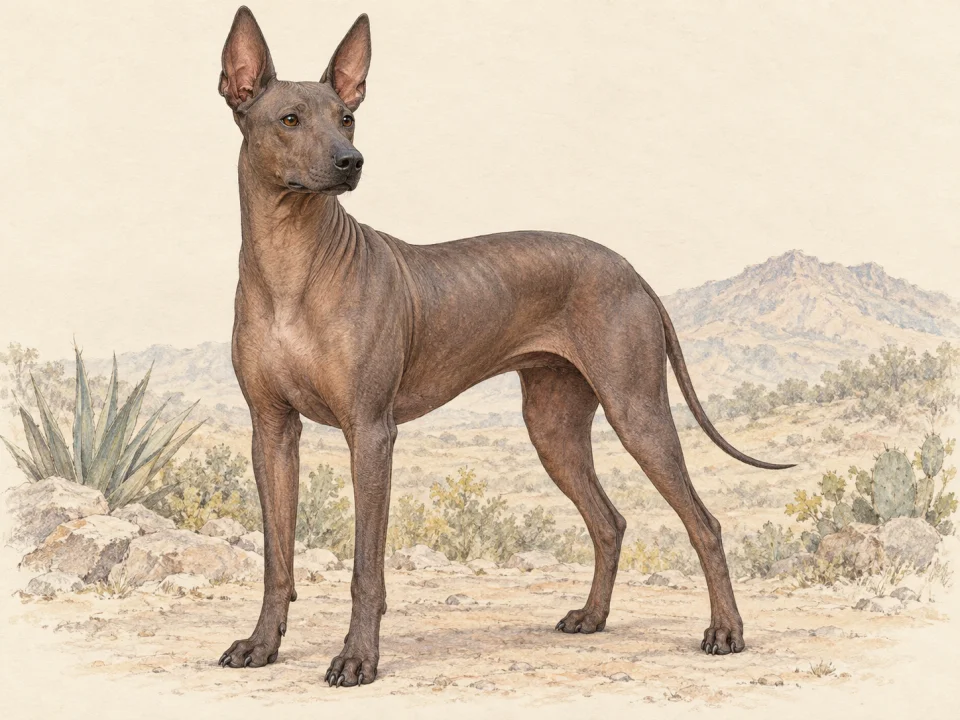
Choose a size and variety before choosing the equipment
AKC recognizes three sizes and both hairless and coated Xolos. Confirm the expected adult size before buying a carrier, harness or resting space; “a Xolo” is not one fixed-size dog. The coated variety needs occasional brushing, while a hairless youngster may need help with adolescent skin problems. Neither type is exempt from nail and dental care. A settled adult can be quiet indoors, but young dogs still need play, walks and consistent teaching. Meet the individual and discuss its experience with visitors. Being watchful does not establish that it will be comfortable with every unfamiliar person or situation.[1]
Plan shade before choosing sunscreen
For a hairless Xolo, a long outdoor visit requires a sun-protection plan. Choose shaded rest areas and avoid making a sunny patio the dog’s only place to settle. AKC recommends sunscreen formulated for dogs and warns against products containing zinc oxide or PABA. Ask your veterinarian which product and application routine suit your dog, particularly if the skin is already irritated. Do not assume a product intended for people is safe for a dog that may lick it. Protective clothing may help, but check fit and comfort and do not use it as a reason to prolong heat exposure. If a new skin problem appears, obtain advice instead of adding several creams and losing track of what changed.[2]
Hairless is not an allergy guarantee
The American Academy of Allergy, Asthma & Immunology states that even hairless dogs produce allergens. A Xolo therefore cannot be promised safe for a person with dog allergy. If allergy is central to your decision, discuss the plan with your allergy clinician before committing to a dog. Keep the human allergy question separate from the dog’s skin-care question: removing visible hair from the household is not the same as removing allergens. Avoid interpreting the breed’s appearance or a “hypoallergenic” sales description as a medical assurance.[3]
Read the size-specific health recommendation
The US breed club’s January 2015 statement recommends hip evaluation for standard Xolos and patella evaluation for toy and miniature Xolos, alongside eye and cardiac screening. It uses the older CERF terminology for eyes, so confirm the current accepted examination and registry requirements with the breeder and veterinarian. Ask for identifiable results rather than a checklist with no dates. The same statement mentions von Willebrand disease as a possible additional concern, not as an adopted CHIC requirement at that time. Keep that distinction when discussing testing; an older document is useful evidence of the club’s recommendations, not proof that today’s requirements are unchanged.[4]
Frequently asked questions
Can a Xoloitzcuintli have a full coat?
Yes. AKC recognizes a short-coated variety as well as the hairless variety. Care should follow the dog’s actual coat and skin.
Source [1]Can I use my own sunscreen on a hairless Xolo?
Do not assume it is suitable. AKC recommends a dog-formulated product and warns against zinc oxide and PABA. Ask your veterinarian for a suitable choice and directions.
Source [2]Is a hairless Xolo guaranteed not to trigger dog allergy?
No. AAAAI explains that hairless dogs still produce allergens. Discuss a suspected or known allergy with an allergy clinician before deciding to bring a dog home.
Source [3]Why do the health recommendations mention hips for some Xolos and patellas for others?
The club’s 2015 statement separates standard-size hip screening from toy and miniature patella screening. Confirm current recommendations for the size you are considering and request the actual reports.
Source [4]FAQ sources
- American Kennel Club — Xoloitzcuintli care ↗FAQ reference 1
- American Kennel Club — Dog sunscreen and sunburn protection ↗FAQ reference 2
- American Academy of Allergy, Asthma & Immunology — The truth about pet allergies ↗FAQ reference 3
- Xoloitzcuintli Club of America — Health statement, January 2015 ↗FAQ reference 4
Sources & methodology
Breed-level measurements and comparison scores provide context. They do not predict an individual dog's health, behaviour or suitability. Open the original publisher pages below to verify the facts and compare any later updates.
- American Kennel Club — Xoloitzcuintli care ↗Reference 1 · reviewed 2026-09-27
- American Kennel Club — Dog sunscreen and sunburn protection ↗Reference 2 · reviewed 2026-09-27
- American Academy of Allergy, Asthma & Immunology — The truth about pet allergies ↗Reference 3 · reviewed 2026-09-27
- Xoloitzcuintli Club of America — Health statement, January 2015 ↗Reference 4 · reviewed 2026-09-27
Make it about your dog
Build a profile around your dog's age, experiences and everyday needs.
Meet your dog →Explore local care