
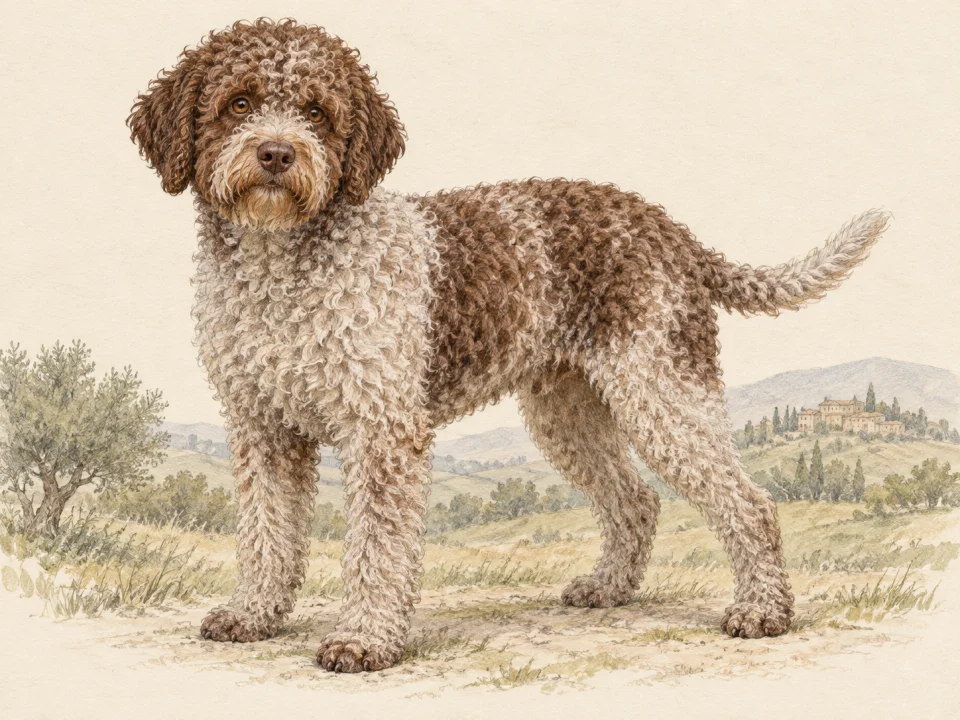
Give the nose a task, and the curls a care plan
AKC describes an active working companion suited to scent activities and needing both physical activity and mental engagement. You do not need access to a truffle orchard to consider the breed, but a plan consisting only of admiring its teddy-bear appearance misses its working background. Ask a qualified instructor about introductory scent games appropriate to the dog and use controlled materials and locations; finding something outdoors does not establish that it is safe to eat. The coat also needs more than an occasional tidy-up. AKC recommends regular trimming and grooming to prevent mats, noting that coats differ in their tendency to tangle. Arrange a demonstration for the individual coat, including how to maintain it between appointments. Low visible shedding should not be confused with little grooming work. Family interaction belongs in the plan too: time outside is not a substitute for living as part of the household.[1]
BFJE and LSD are separate lines in the health record
The LRCA health statement hosted by AKC in October 2023 lists separate DNA tests for Benign Familial Juvenile Epilepsy and Lagotto Storage Disease. It also names hip, patellar, annual eye and basic cardiac examinations, alongside other requirements. When someone says a dog is “genetically tested,” ask to see which conditions the report actually covers. Record BFJE and LSD separately, with the dog’s identity, laboratory and result, rather than combining them into one neurological-health checkbox. Clinical examinations and DNA results provide different information. Take unclear findings to a veterinarian and keep the underlying reports, not just a summary supplied with a puppy.[2]
A clear result for one condition cannot explain every new sign
The Lagotto Romagnolo Foundation describes storage disease as a progressive neurological disorder that can affect coordination and behavior. That makes it important not to dismiss new difficulty moving as clumsiness or assume that a test for a different condition settles the question. Seek veterinary assessment for neurological changes and bring the available reports and observations. The purpose of knowing the disease name is to support an informed consultation, not to diagnose from a breed page or decide on treatment yourself. A screening result addresses its specified target; it does not replace an examination of a dog that is unwell.[3]
Frequently asked questions
Does a BFJE test also establish Lagotto Storage Disease status?
No. The LRCA statement lists BFJE and LSD as separate DNA tests. Check that each named result is present instead of treating one report as covering both.
Source [1]Does a Lagotto’s low-shedding coat mean little grooming?
No. AKC describes regular trimming and grooming to prevent matting. Have the routine adapted to the individual curls and plan maintenance between grooming appointments.
Source [2]FAQ sources
Sources & methodology
Breed-level measurements and comparison scores provide context. They do not predict an individual dog's health, behaviour or suitability. Open the original publisher pages below to verify the facts and compare any later updates.
- American Kennel Club — Lagotto Romagnolo ↗Reference 1 · reviewed 2026-09-27
- Lagotto Romagnolo Club of America — Health statement hosted by AKC, October 2023 ↗Reference 2 · reviewed 2026-09-27
- Lagotto Romagnolo Foundation — Storage Disease ↗Reference 3 · reviewed 2026-09-27
Make it about your dog
Build a profile around your dog's age, experiences and everyday needs.
Meet your dog →Explore local care