
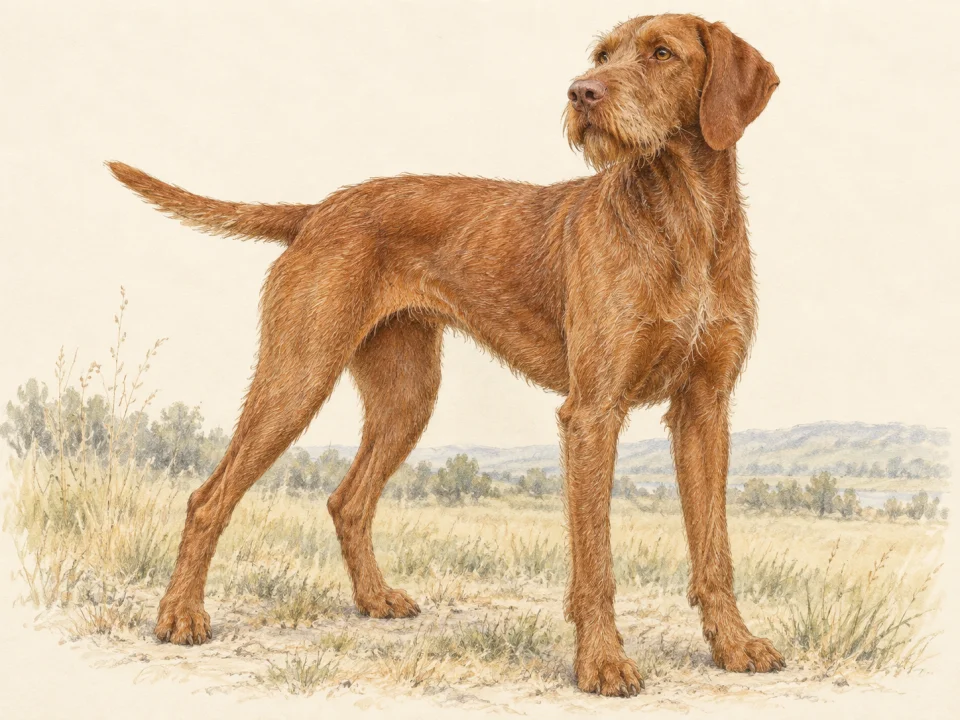
Identify the coat before booking the groom
The breed club describes a harsh outer coat over a protective undercoat, but also explains that individuals can have nearly smooth or much softer, woollier coats. That difference changes the grooming decision. Many wire coats benefit from removal of dead hair by hand-stripping; a soft coat may not strip in the same way. Ask the breeder or an experienced groomer to examine the coat and demonstrate an appropriate technique before buying tools or requesting a standard clip. The club advises against clipping the correct wire coat to maintain its texture. That coat-preservation advice should not override necessary veterinary treatment. Regular brushing and checks after outdoor outings still matter, even when the dog looks naturally untidy.[1]
Give the hunter a safe place to move and a reason to listen
AKC emphasizes both a strong hunting interest and enjoyment of activities with people. Choose secure running opportunities and keep a leash on where pursuit could lead toward traffic or wildlife. In training, use brief, rewarding tasks and change the exercise before repetition becomes frustrating. A retrieving game can include waiting, returning and exchanging the object, rather than only throwing it farther. The aim is cooperation as well as movement. A rough coat does not make this people-oriented dog suited to being left outside alone. Plan companionship and gradual practice with short absences; if the dog struggles, seek help rather than assuming more strenuous exercise will resolve the problem.[2]
HUU and ECLE answer different health questions
The Wirehaired Vizsla Club of America identifies DNA tests for hyperuricosuria, or HUU, and exfoliative cutaneous lupus erythematosus, or ECLE. HUU concerns elevated urinary uric acid and susceptibility to urinary stones. ECLE is a separate immune-mediated skin condition. A clear result for one does not establish the result for the other. The club describes emerging ECLE reports in this breed, so those reports should not be turned into a population-wide prevalence figure or a promise about severity. Ask which tests were performed and retain the laboratory results. A skin change or urinary problem needs veterinary assessment; appearance and a breed description cannot diagnose the cause.[3]
Keep clinical screening alongside the DNA results
AKC’s national-club list names hip and ophthalmologist evaluations for the Wirehaired Vizsla. Ask for dated reports for the parents and compare these with the separate DNA results. A DNA panel does not replace an examination of the eyes or a hip evaluation. Discuss broader family history and any additional screening with the breeder and veterinarian. This makes a more useful record than a single claim that a litter is “fully health tested,” while recognizing that screening cannot guarantee a dog will remain free of disease.[4]
Frequently asked questions
Should every Wirehaired Vizsla be hand-stripped?
No single technique suits every coat. The breed club describes substantial coat variation, including soft coats that do not strip like a correct wire coat. Have the individual coat assessed before choosing a grooming method.
Source [1]Can a Wirehaired Vizsla exercise itself in the yard?
A yard alone does not provide the shared activity and learning this sporting dog needs. Plan active time together and secure containment when the dog is off leash.
Source [2]Does an HUU result also tell me about ECLE?
No. They are different conditions with separate DNA tests. Check the condition named on each laboratory report rather than relying on an overall “clear” label.
Source [3]Do DNA results replace hip and eye evaluations?
No. AKC lists hip and ophthalmologist evaluations for this breed. Request those clinical results separately from the DNA reports.
Source [4]FAQ sources
- Wirehaired Vizsla Club of America — Grooming ↗FAQ reference 1
- American Kennel Club — Wirehaired Vizsla care ↗FAQ reference 2
- Wirehaired Vizsla Club of America — Health ↗FAQ reference 3
- American Kennel Club — Sporting group health testing: Wirehaired Vizsla ↗FAQ reference 4
Sources & methodology
Breed-level measurements and comparison scores provide context. They do not predict an individual dog's health, behaviour or suitability. Open the original publisher pages below to verify the facts and compare any later updates.
- Wirehaired Vizsla Club of America — Grooming ↗Reference 1 · reviewed 2026-09-27
- American Kennel Club — Wirehaired Vizsla care ↗Reference 2 · reviewed 2026-09-27
- Wirehaired Vizsla Club of America — Health ↗Reference 3 · reviewed 2026-09-27
- American Kennel Club — Sporting group health testing: Wirehaired Vizsla ↗Reference 4 · reviewed 2026-09-27
Make it about your dog
Build a profile around your dog's age, experiences and everyday needs.
Meet your dog →Explore local care