
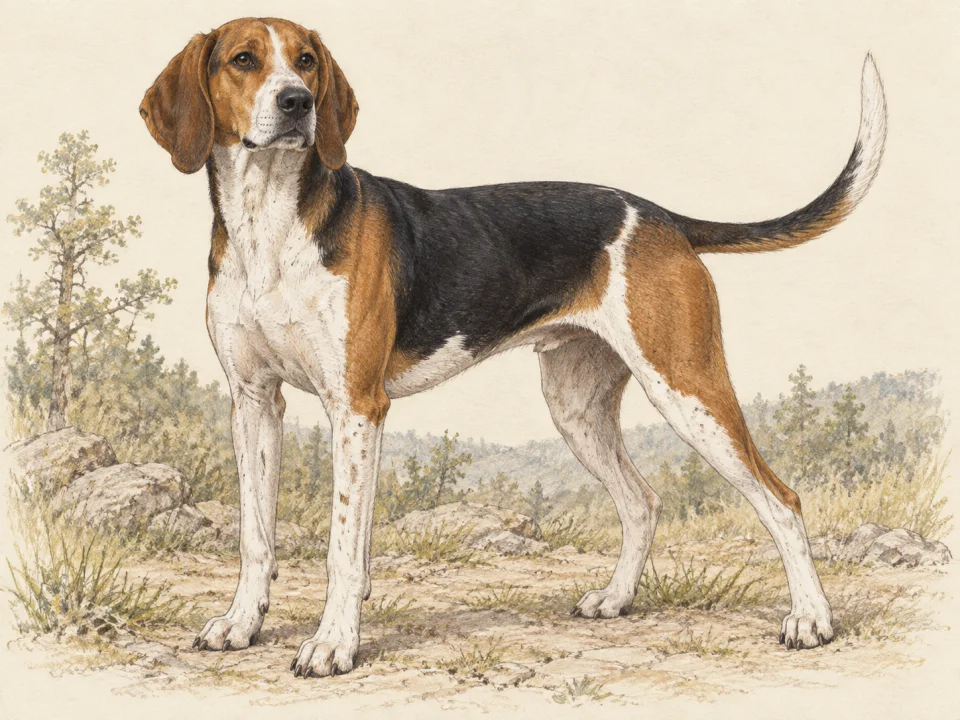
A non-hunting home still needs an outlet for the nose
The national club explicitly says hunting is not essential and identifies tracking and scent work among activities owners can enjoy. The practical question is whether you enjoy doing something with the dog regularly, rather than simply providing a yard. Try an introductory scent-work class or a supervised search game appropriate to the dog’s experience. Pair that with opportunities to move and time with the family. The club also warns that a Walker’s voice may bother neighbors: talk through the household’s tolerance for baying before adoption. Ask a foster carer what actually triggers this dog to vocalize, whether the dog settles indoors, and how it responds when left alone. A breed description cannot answer those individual questions.[2]
Plan the walk before a scent takes over
AKC highlights strong pursuit instincts and advises a leash on walks and hikes. Choose equipment you can hold securely and routes with room to move away from wildlife; do not test recall beside a road. In a fenced exercise area, check the gate before releasing the dog. Reward check-ins during manageable distractions and make lessons varied enough to stay engaging. Keep smaller household animals safely separated until you have an informed assessment of the individual dog. Affection toward people does not establish safety around a running cat. After a wooded outing, include the long ear flaps in your tick check; ear pain, discharge or repeated head shaking deserves veterinary attention, not increasingly vigorous cleaning.[3]
Look at adult proportions, not just a familiar tricolor coat
The AKC standard gives male shoulder height as 22–27 inches and female height as 20–25 inches. It describes weight in relation to height and overall balance. Those measurements help distinguish the scale of this hound from a smaller dog with similar markings, but a photograph is not proof of ancestry. The standard prefers black, white and tan while also permitting white with tan or black spots. Consequently, a dog does not have to show three colors to fit the standard. For a rescue dog of uncertain background, retain the shelter’s uncertainty rather than using coat color to invent a pedigree. Meet the dog and assess actual handling needs before committing to transport equipment or walking arrangements.[1]
Why published weight and lifespan figures differ
The current AKC profile lists 50–70 pounds and a life expectancy of 12–13 years. The national club’s 2019 owner leaflet gives different figures: 65–100 pounds and 10–12 years. These sources do not explain the discrepancy, so combining them into a single “correct” range would hide uncertainty. The breed standard itself relates weight to height and balance rather than setting a fixed weight. For an adult rescue, use a recent measured weight when arranging a crate or vehicle space. Ask the veterinarian about that dog’s body condition rather than feeding toward a catalogue number. For a puppy, ask about the parents’ adult size and family health history. None of these published lifespan estimates predicts how long an individual dog will live.[3]
Separate health screening from a routine vet check
The national association’s published statement names hip evaluation through OFA or PennHIP, an examination by a veterinary ophthalmologist, and an OFA thyroid evaluation through an approved laboratory. It lists elbow evaluation as optional. Request the identifiable results for the parents, not only the statement that they have been vet checked. A routine examination and these specific screening procedures answer different questions. Confirm the club’s current recommendations when choosing a litter, because a stored statement can be revised. Good screening records inform a decision; they do not guarantee a puppy’s future health.[4]
Frequently asked questions
Do I need to hunt to keep a Treeing Walker Coonhound?
No. The national club says hunting is not essential. A suitable companion home still provides regular activity, companionship and an appropriate outlet such as tracking or scent work.
Source [1]Can a well-trained Walker hike off leash?
Reliable responses in a training session do not remove the urge to follow scent. AKC advises keeping this breed leashed on walks and hikes; use secure enclosures for off-leash exercise.
Source [2]Must a Treeing Walker Coonhound be tricolored?
No. The AKC standard prefers the familiar black, white and tan pattern but also permits white with tan or black spots. Markings alone cannot establish a dog’s ancestry.
Source [3]Which screening records should I ask a breeder to show?
Start with the hip, specialist eye and thyroid results named in the national club statement. It lists elbow evaluation as optional. Check the current club guidance as well as the identities and dates on the reports.
Source [4]FAQ sources
- National Treeing Walker Coonhound Association — owner guide, 2019 ↗FAQ reference 1
- American Kennel Club — Treeing Walker Coonhound care ↗FAQ reference 2
- American Kennel Club — Treeing Walker Coonhound breed standard ↗FAQ reference 3
- National Treeing Walker Coonhound Association — health screening statement hosted by AKC ↗FAQ reference 4
Sources & methodology
Breed-level measurements and comparison scores provide context. They do not predict an individual dog's health, behaviour or suitability. Open the original publisher pages below to verify the facts and compare any later updates.
- American Kennel Club — Treeing Walker Coonhound breed standard ↗Reference 1 · reviewed 2026-09-27
- National Treeing Walker Coonhound Association — owner guide, 2019 ↗Reference 2 · reviewed 2026-09-27
- American Kennel Club — Treeing Walker Coonhound care ↗Reference 3 · reviewed 2026-09-27
- National Treeing Walker Coonhound Association — health screening statement hosted by AKC ↗Reference 4 · reviewed 2026-09-27
Make it about your dog
Build a profile around your dog's age, experiences and everyday needs.
Meet your dog →Explore local care