
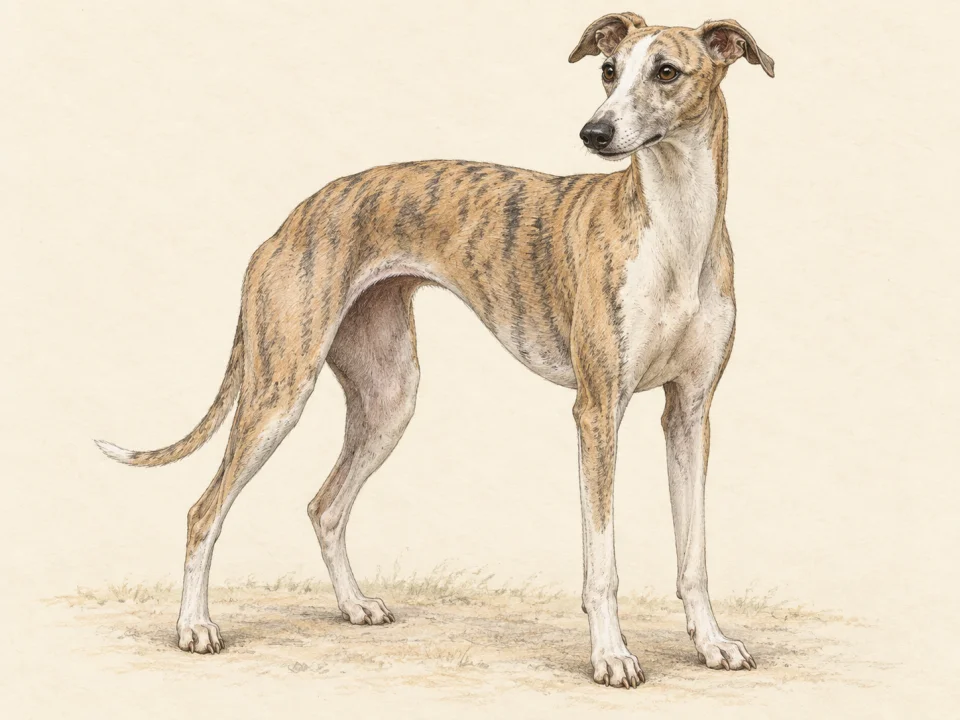
Prepare for the sprint before opening the gate
The Whippet’s history is in chasing game by sight. A calm dog at home may still react quickly to movement. The American Whippet Club recommends a physical fence or leash and warns that an electronic boundary can fail to stop pursuit; it also cannot keep another dog out. Before using a running area, close the gates and check the boundary. Choose companions carefully rather than assuming every busy dog park is suitable. At home, provide a soft bed in a comfortable indoor space. The fine coat offers little protection during prolonged cold exposure, so an unheated outdoor kennel is not an appropriate substitute. For cold outings, consider a well-fitting coat and shorten the outing if the dog is uncomfortable.[1]
Separate daily walks from opportunities to run
AKC describes a sprinter that also needs regular walks. Secure play and organized activities such as lure coursing can offer an outlet, but a young, unconditioned or recovering dog should not be expected to perform like a trained athlete. Ask an activity organizer how beginners are introduced and discuss fitness concerns with your veterinarian. Keep a leash on outside enclosed areas even while practicing recall. Grooming is comparatively simple: regular brushing, occasional bathing and nail care. Simple grooming does not mean the dog needs little company or exercise. Before bringing a Whippet home, identify an actual safe exercise location and how you will reach it on an ordinary workday, not just on weekends.[2]
Read the dates on the parents’ health reports
The Whippet Health Foundation’s June 2026 pre-breeding guidance separates required screenings from additional recommendations. It lists an annual CAER eye examination, an echocardiogram performed by a board-certified cardiologist every two years, and a one-time BAER hearing test. It additionally recommends thyroid testing every two years, a one-time myostatin deficiency test, and an OFA hip or PennHIP evaluation. Ask to see the identity, date, test type and result for each parent. A general statement that the heart was checked does not tell you whether an echocardiogram was performed. These are breeding-screening recommendations; your own dog’s examination schedule should be determined with its veterinarian, and normal results cannot rule out every future illness.[3]
Hearing in everyday life is not a two-ear test
The American Whippet Club notes that a dog with hearing in only one ear may function normally as a companion. Responding to your voice therefore does not establish normal hearing in both ears. BAER testing can distinguish a limitation that casual observation misses. Keep any result with the dog’s other medical records and discuss its practical implications with your veterinarian. This is also a reason to ask for the actual screening report rather than accepting “hears perfectly” as an equivalent test. The club’s generally favorable description of breed health does not remove the need for individual examinations or investigation of new symptoms.[4]
Frequently asked questions
Is an invisible fence suitable for a Whippet?
The American Whippet Club advises against relying on one: a fast pursuit may take the dog beyond it, and it does not exclude other dogs. Use a secure physical enclosure or a leash.
Source [1]Does a Whippet need hours of continuous running?
Being a sprinter does not mean every dog needs prolonged running. Combine regular walks with suitable secure activity, adjusting for age, fitness and health rather than imposing a fixed exercise quota.
Source [2]Does a routine heart check replace the recommended echocardiogram?
Do not assume they are equivalent. The Whippet Health Foundation specifies an echocardiogram by a board-certified cardiologist in its pre-breeding recommendations; confirm what the report actually records.
Source [3]Can a Whippet hear me but still have a hearing limitation?
Yes. Hearing in one ear can be sufficient for apparently normal everyday responses. BAER testing assesses hearing in a way that calling the dog’s name cannot.
Source [4]FAQ sources
- American Whippet Club — About Whippets ↗FAQ reference 1
- American Kennel Club — Whippet care ↗FAQ reference 2
- Whippet Health Foundation — Pre-breeding screening, June 2026 ↗FAQ reference 3
- American Whippet Club — Whippet health ↗FAQ reference 4
Sources & methodology
Breed-level measurements and comparison scores provide context. They do not predict an individual dog's health, behaviour or suitability. Open the original publisher pages below to verify the facts and compare any later updates.
- American Whippet Club — About Whippets ↗Reference 1 · reviewed 2026-09-27
- American Kennel Club — Whippet care ↗Reference 2 · reviewed 2026-09-27
- Whippet Health Foundation — Pre-breeding screening, June 2026 ↗Reference 3 · reviewed 2026-09-27
- American Whippet Club — Whippet health ↗Reference 4 · reviewed 2026-09-27
Make it about your dog
Build a profile around your dog's age, experiences and everyday needs.
Meet your dog →Explore local care