
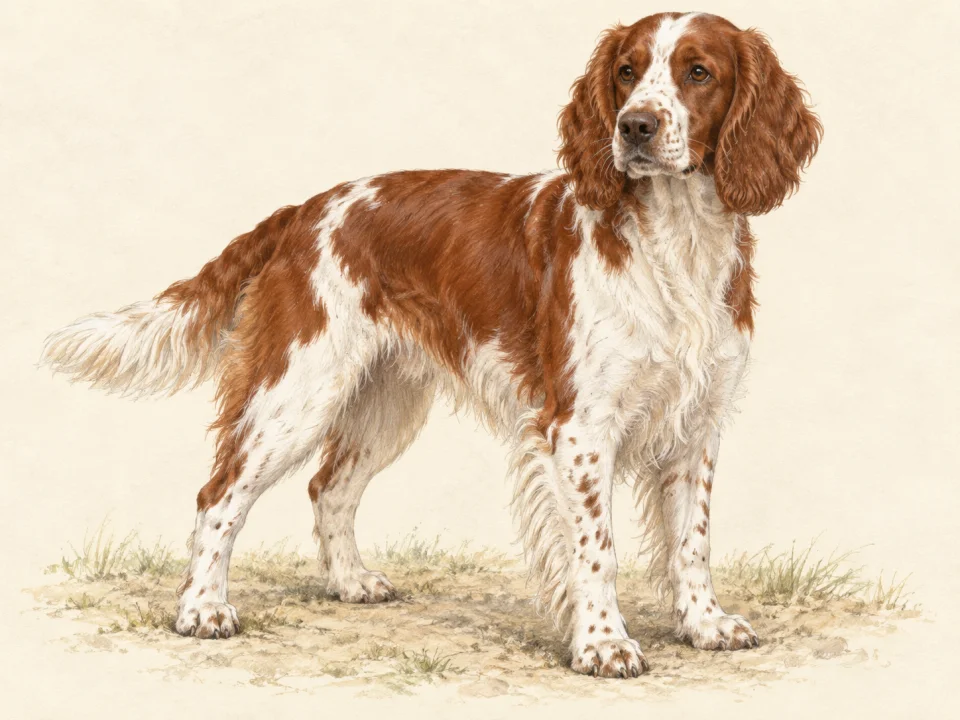
Reserved does not mean that fear should be ignored
The breed standard describes an affectionate, active dog that can be reserved with strangers without being timid or unfriendly. Give an unfamiliar Welsh Springer room to approach rather than making a greeting a test of friendliness. A visitor can initially leave the dog alone while you observe whether it settles comfortably. Persistent fear or difficulty coping deserves individual attention; it should not simply be dismissed as a breed trait. The Welsh is a distinct breed, not a red-and-white color option for an English Springer. When comparing them, spend time with adult dogs and discuss their actual household routines rather than relying on coat color or a general spaniel label.[1]
Start coat care before the first difficult tangle
The club’s grooming guide separates everyday cleanliness from the more detailed trimming used for shows. For a companion, first learn to check the feathering and gently comb small tangles before they become tight mats. A groomer can demonstrate safe handling and an appropriate trim; do not start by copying detailed scissor work around ears and feet from a photograph. The guide recommends introducing handling in short, rewarded steps: touching a paw or ear, meeting a brush, then tolerating a little grooming. Progress according to the puppy’s comfort rather than insisting on an entire session. Ask for help with painful or tight mats instead of pulling through them.[2]
Keep the bird-dog instinct in the walking plan
AKC cautions that the urge to pursue birds and small mammals remains part of this breed’s background. Use a leash outside safe enclosures and practice returning to you before increasing distractions. A walk can include sniffing and a short training game as well as steady movement. Secure play with family also supplies the interaction this dog enjoys. After an outing, check the coat and ears instead of assuming weather-resistant hair needs no care. Routine brushing helps, but odor, redness or discomfort should be discussed with a veterinarian rather than handled by increasingly vigorous cleaning. Adapt exercise to the dog’s condition and age, without assigning every Welsh Springer the same daily mileage.[3]
Compare the parents’ four screening records
The US parent club recommends hip, elbow, ophthalmologist and thyroid evaluations for both parents, with results reported to OFA. Ask for the registered identities so you can compare the published results with the breeder’s documents. Keep a missing record distinct from a normal result, and ask what equivalent testing was used if a parent is registered abroad. The club also encourages a placement discussion about each puppy’s personality. Useful questions include how it responds to unfamiliar people, which handling it has practiced and what daily care it has experienced. Screening records and observations answer different questions; neither guarantees the puppy’s future health or fit with your household.[4]
Frequently asked questions
Is a Welsh Springer an English Springer in red and white?
No. It is a distinct breed with its own standard. Red-and-white coloring is characteristic, but choosing a dog also requires considering its individual behavior and care needs.
Source [1]Does my pet Welsh Springer need a show trim?
Everyday coat cleanliness and comfortable handling come first. Show preparation is more elaborate. Ask a groomer to demonstrate the maintenance needed for your dog’s feathering and lifestyle.
Source [2]Can a friendly Welsh Springer still chase birds?
Yes. Affection toward people does not remove the hunting interest described by AKC. Use secure containment and do not rely on friendliness as evidence of safe off-leash behavior.
Source [3]Which screening results should I look for in the parents?
The US club recommends hip, elbow, ophthalmologist and thyroid evaluations for both parents. Check the actual results and identities; a missing record is not a passing result.
Source [4]FAQ sources
- Welsh Springer Spaniel Club of America — Breed standard ↗FAQ reference 1
- Welsh Springer Spaniel Club of America — Grooming guide, revised July 2023 ↗FAQ reference 2
- American Kennel Club — Welsh Springer Spaniel care ↗FAQ reference 3
- Welsh Springer Spaniel Club of America — Puppy placement and health testing ↗FAQ reference 4
Sources & methodology
Breed-level measurements and comparison scores provide context. They do not predict an individual dog's health, behaviour or suitability. Open the original publisher pages below to verify the facts and compare any later updates.
- Welsh Springer Spaniel Club of America — Breed standard ↗Reference 1 · reviewed 2026-09-27
- Welsh Springer Spaniel Club of America — Grooming guide, revised July 2023 ↗Reference 2 · reviewed 2026-09-27
- American Kennel Club — Welsh Springer Spaniel care ↗Reference 3 · reviewed 2026-09-27
- Welsh Springer Spaniel Club of America — Puppy placement and health testing ↗Reference 4 · reviewed 2026-09-27
Make it about your dog
Build a profile around your dog's age, experiences and everyday needs.
Meet your dog →Explore local care