
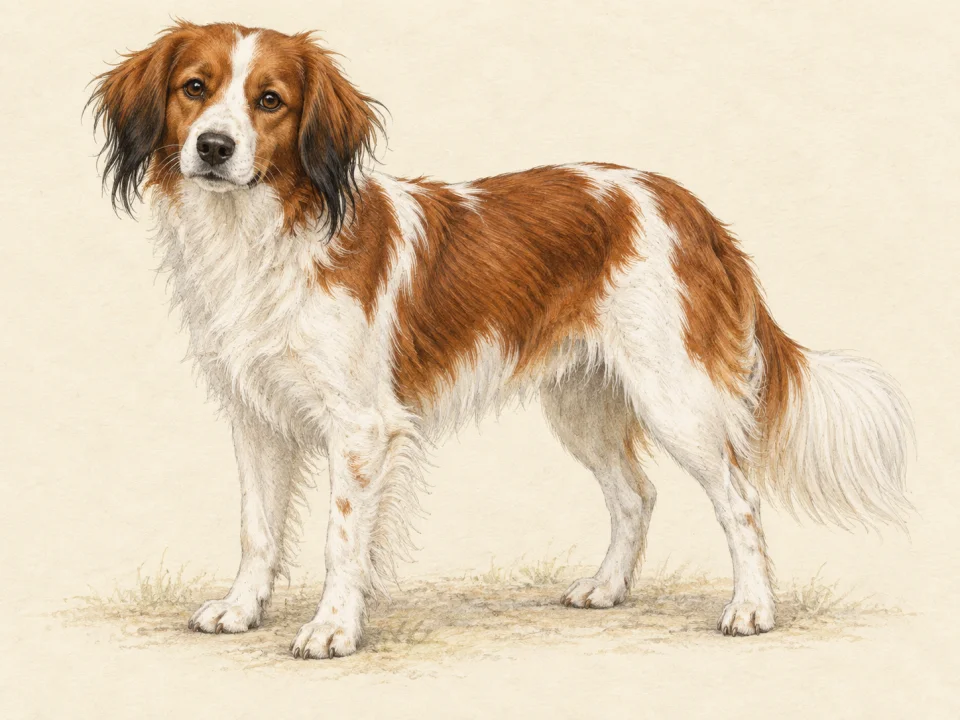
A small sporting dog is still a working companion
The Kooikerhondje combines a cheerful nature with determination and interest in moving animals. Choose the breed for the activities you can share, not simply because it weighs less than many sporting dogs. A useful weekday plan includes movement, a short learning task and quiet recovery. The plan should work on an ordinary workday as well as a free weekend.[1]
Keep lessons clear and low-pressure
A sensitive dog benefits from gentle, consistent teaching. Break a task into a small success, reward it and increase difficulty only when the dog is comfortable. If a lesson becomes confusing, simplify the environment rather than repeating the cue more loudly. Agree on a small set of household signals so different people do not teach contradictory responses.[1]
Practise calm observation before close greetings
Social experience need not mean meeting every person or dog at close range. Let the youngster observe from a comfortable distance, reward attention to the handler and leave room to move away. Watch the individual’s response instead of labeling all hesitation stubbornness. For persistent fear or distress, seek qualified behavioral help rather than escalating the intensity of introductions.[1]
Give the chase instinct a safe boundary
A lively sporting dog may pursue animals even after learning basic recall. Use a leash outside securely enclosed areas and practise returning for a reward in easier settings first. Offer controlled searching or retrieving games as appropriate. Keep play sessions distinct from uncontrolled access to wildlife; enthusiasm for a task does not make an unfenced area safe.[1]
Make weekly grooming easy to repeat
Regular weekly grooming, along with nail, ear and dental care, is a practical baseline. Teach brief cooperative handling before there is a knot or a long nail to address. Keep a comb and rewards together so a small session is easy to start. New discomfort or a skin change should be assessed separately from routine grooming needs.[1]
Use size and screening as planning information
AKC gives a weight range of 20–30 pounds and reference heights of 16 inches for males and 15 for females, with a lifespan of 12–15 years. Recommended screening includes eyes, patellas, hips, and DNA tests for von Willebrand disease type III and hereditary necrotizing myelopathy. Request identifiable results and professional interpretation instead of treating a test name as a guarantee.[1]
Frequently asked questions
Is a Kooikerhondje the same as a Nederlandse Kooikerhondje?
Yes. Kooikerhondje is the shortened name commonly used for the Nederlandse Kooikerhondje.
Source [1]What is a Kooikerhondje’s temperament like?
The breed is typically lively, cheerful and determined, with sensitivity that makes gentle, consistent training useful. An individual dog’s behavior also depends on history, social experience and the situation.
Source [1]Does a Kooikerhondje need more than a short walk?
Plan mental engagement and purposeful activity as well as walks, followed by rest. The exact routine depends on age and health; small size alone does not describe a sporting dog’s needs.
Source [1]Which Kooikerhondje DNA tests should I ask about?
AKC lists von Willebrand disease type III and hereditary necrotizing myelopathy DNA testing, alongside hip, patella and eye evaluations. Ask for results tied to the actual breeding dogs.
Source [1]FAQ sources
Sources & methodology
Breed-level measurements and comparison scores provide context. They do not predict an individual dog's health, behaviour or suitability. Open the original publisher pages below to verify the facts and compare any later updates.
- American Kennel Club — Nederlandse Kooikerhondje breed and care guidance ↗Reference 1 · reviewed 2026-09-27
Make it about your dog
Build a profile around your dog's age, experiences and everyday needs.
Meet your dog →Explore local care