
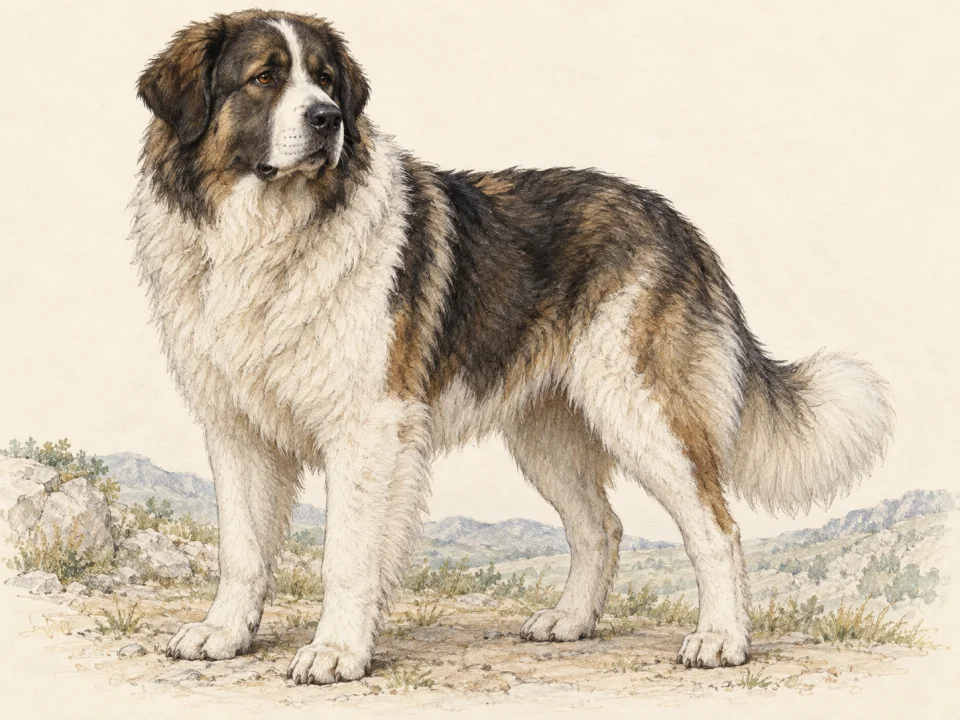
Match a guardian’s role to your actual property
The FCI identifies livestock protection and farmyard guarding as the Tornjak’s work, and distinguishes affection for familiar people from suspicion of strangers. Walk through your property before bringing one home: which gate does a courier use, can a visitor reach the front door without entering the dog’s space, and where will the dog rest while a repair is underway? Calm behavior beside its owner does not establish how the individual responds at an unaccompanied gate. Ask the current carer about those situations rather than testing the dog with a staged intrusion. For adult size, the quick facts reproduce AKC’s broad 23–28-inch and 62–110-pound overview. FCI instead specifies shoulder heights of 65–70 cm for males and 60–65 cm for females, allowing ±2 cm; it provides no numeric weight target. These are different presentations of breed guidance. Measure the actual dog for transport and equipment, and do not feed toward the top of a published range.[1]
Teach predictable routines without provoking guarding
A useful first task is moving to a comfortable resting area when asked, practiced while the surroundings are quiet. Reward the movement and release the dog; add distance and ordinary distractions gradually. This applies AVSAB’s recommendation for reward-based training to a guardian household. Do not stage an intrusion, encourage threatening displays, or rely on punishment to resolve fear around visitors. Training and a physical barrier serve different purposes: keep the dog securely separated when workers need access even while you are teaching a new routine. If the dog struggles with handling or unfamiliar people, obtain qualified behavior help before attempting close introductions. A breed description that says a dog learns quickly is not evidence that every difficult situation is safe to manage alone.[3]
Make adult-sized grooming part of the handover
AKC recommends regular weekly grooming, occasional bathing and ongoing nail, ear and dental care. Ask the breeder or current carer to demonstrate the dog’s grooming routine and how it accepts handling, rather than collecting only a list of brushes. Arrange a non-slip place with enough room to work around the adult dog. Break the work into comfortable sessions if needed; a thick coat should not hide whether the skin is sore or tangles are pulling. Discuss the dog’s actual medical history and available family screening with a veterinarian. The care source offers a broad health description rather than a complete breed-specific testing protocol, so do not turn that into an unsupported claim that Tornjaks need no screening.[2]
Frequently asked questions
Does calm behavior with family prove a Tornjak will accept visitors?
No. The FCI description distinguishes familiarity with household members from wariness toward strangers. Plan controlled access and secure separation rather than assuming those situations are equivalent.
Source [1]Should I test a Tornjak’s guarding by having someone threaten the property?
No. Teach useful everyday routines through rewards and use secure management for arrivals. Seek qualified help for behavior concerns rather than provoking an incident.
Source [2]What should a grooming handover include for an adult Tornjak?
Ask to see the routine, tools and handling the dog already knows. Include coat, nails, ears and teeth, and arrange enough safe space to work comfortably around a large dog.
Source [3]Is 110 pounds the ideal weight for every Tornjak?
No. That is the upper end of AKC’s overview range, not an individual feeding target. FCI gives sex-specific height ranges with a two-centimeter tolerance and no numeric weight target. Ask your veterinarian about the dog’s body condition rather than trying to reach the largest published figure.
Source [1]FAQ sources
- FCI — Tornjak standard No. 355 ↗FAQ reference 1
- American Veterinary Society of Animal Behavior — Humane training position ↗FAQ reference 2
- American Kennel Club — Tornjak care ↗FAQ reference 3
Sources & methodology
Breed-level measurements and comparison scores provide context. They do not predict an individual dog's health, behaviour or suitability. Open the original publisher pages below to verify the facts and compare any later updates.
- FCI — Tornjak standard No. 355 ↗Reference 1 · reviewed 2026-09-27
- American Kennel Club — Tornjak care ↗Reference 2 · reviewed 2026-09-27
- American Veterinary Society of Animal Behavior — Humane training position ↗Reference 3 · reviewed 2026-09-27
Make it about your dog
Build a profile around your dog's age, experiences and everyday needs.
Meet your dog →Explore local care