
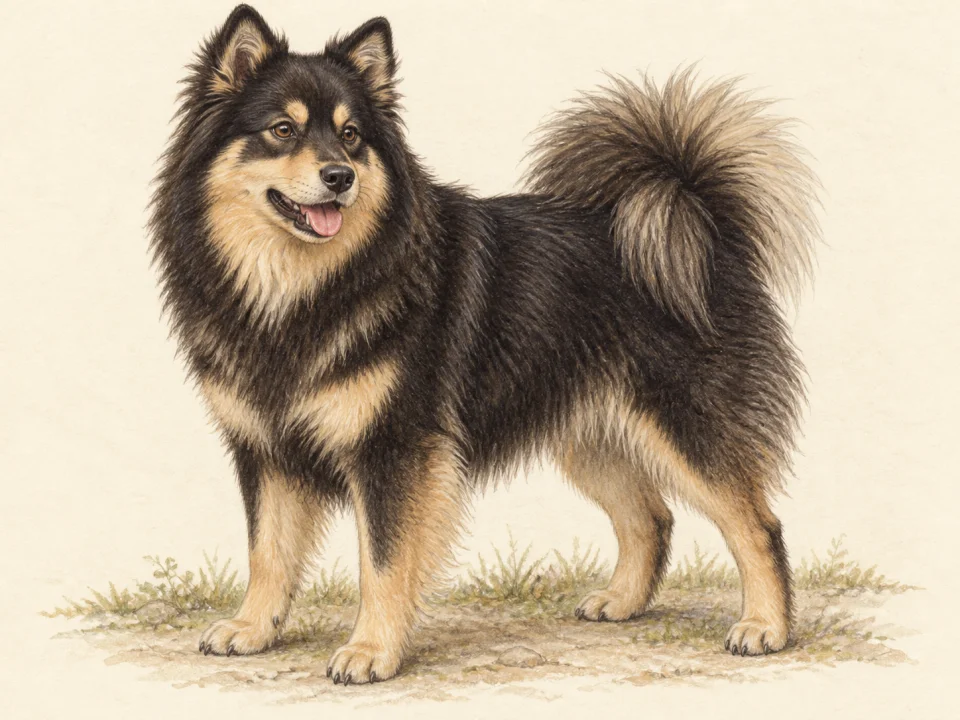
Consider the voice before choosing the home
AKC notes that the Swedish Lapphund retains attention-getting barking from its guarding and herding background. For a household sharing walls, discuss the individual dog’s responses to hallway noise, visitors and outdoor activity before deciding it is a good match. A practical starting point is to reduce repeated access to triggers, then reward turning back to you and settling away from the window. Do not leave the dog outside to rehearse barking for long periods. Training can help, but buying this breed on the expectation of silence is unrealistic. Its desire to participate also means that a fenced yard cannot substitute for time with its people.[1]
Build a routine with both activity and recovery
The Swedish Kennel Club describes a dog that enjoys physical and mental work but can also relax. Use that combination when planning a day: an outing with opportunities to investigate, a short learning task together, then a comfortable place to rest. Tracking-style games or introductory obedience can give an interested owner a starting point without committing to competition. Observe whether your own dog can recover after activity; continually adding excitement is not the only response to restlessness. The club describes successful companions in both urban and rural homes, so judge the available routine rather than the address alone.[2]
Understand the black coat’s seasonal changes
The Nordic Kennel Union notes that old undercoat may look brownish while the dog molts, and that rusty shading can occur in the black coat. Color variation alone therefore does not establish a grooming problem. AKC recommends regular brushing and describes substantial seasonal undercoat loss. Increase attention when loose wool accumulates and seek a groomer’s help if you cannot work through it gently. Keep coat care distinct from skin health: a new irritated patch, discomfort or unusual hair loss should not be dismissed as ordinary seasonal change. The useful question is whether the skin and coat are comfortable and manageable, not whether every strand stays the same shade.[3]
Ask specifically about hips and prcd-PRA
The Swedish breed club identifies hip radiographs and known prcd-PRA status as requirements before breeding in its program. These address different risks: a DNA result for a retinal disorder does not evaluate hip structure. Ask the breeder to explain both parents’ results and which national program applies to the litter. The club publishes hip statistics for a stated birth period and for dogs actually examined; those figures are not a diagnosis for an unexamined puppy or a worldwide disease rate. Your own dog’s movement or vision changes still warrant veterinary assessment even when its parents have screening records.[4]
Frequently asked questions
Is the Swedish Lapphund usually a silent companion?
No. Alert and attention-getting barking is part of the breed description. Assess noise tolerance in your household and plan management and reward-based training rather than expecting silence.
Source [1]Can a black Swedish Lapphund have brownish undercoat?
Yes. The Nordic Kennel Union describes brownish old undercoat during molting and rusty shading. That does not explain every skin or coat change; irritation or unusual hair loss needs separate attention.
Source [2]Does prcd-PRA testing also check for hip dysplasia?
No. The Swedish breed club identifies retinal-disease status and hip radiographs separately. Ask for both kinds of evidence and their interpretation.
Source [3]FAQ sources
- American Kennel Club — Swedish Lapphund care ↗FAQ reference 1
- Nordic Kennel Union — Swedish Lapphund ↗FAQ reference 2
- Swedish breed club — Health ↗FAQ reference 3
Sources & methodology
Breed-level measurements and comparison scores provide context. They do not predict an individual dog's health, behaviour or suitability. Open the original publisher pages below to verify the facts and compare any later updates.
- American Kennel Club — Swedish Lapphund care ↗Reference 1 · reviewed 2026-09-27
- Swedish Kennel Club — Svensk lapphund ↗Reference 2 · reviewed 2026-09-27
- Nordic Kennel Union — Swedish Lapphund ↗Reference 3 · reviewed 2026-09-27
- Swedish breed club — Health ↗Reference 4 · reviewed 2026-09-27
Make it about your dog
Build a profile around your dog's age, experiences and everyday needs.
Meet your dog →Explore local care