
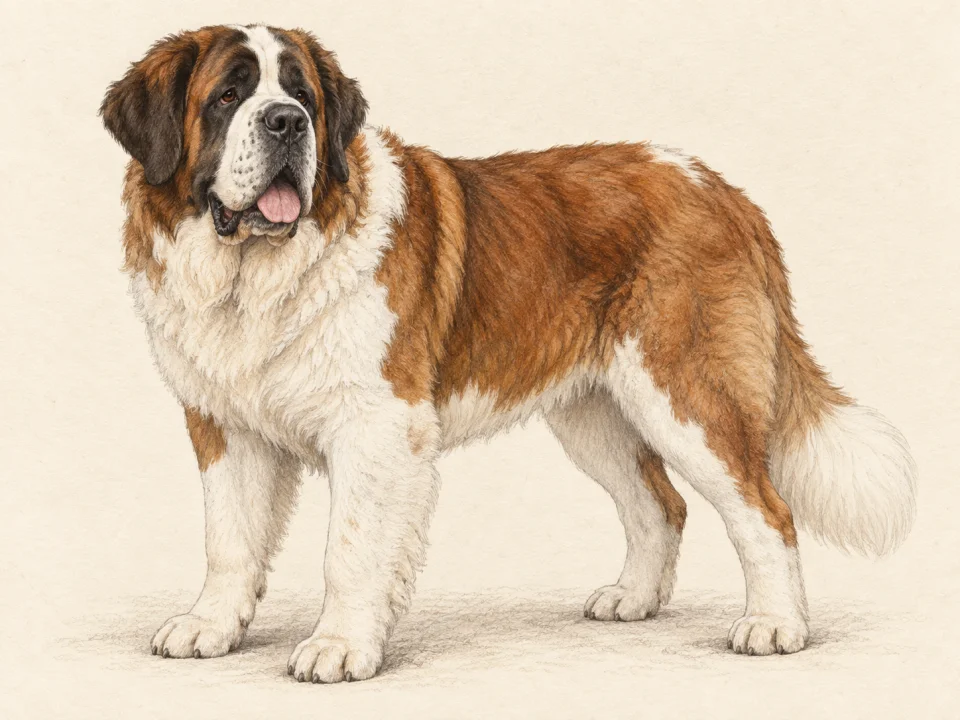
Teach manageable greetings before the dog is enormous
AKC emphasizes early training to prevent jumping, collisions with children and taking food from tables. Practice a rewarded greeting with four paws on the floor and a comfortable resting-place cue before using them during a busy arrival. A Saint’s friendly intention does not prevent an accidental knockdown. Children still need adult supervision and a separate place to play or eat when the dog cannot be managed closely. Both short and long coats need care; choosing the short-haired variety does not eliminate brushing or loose hair. Consider who will groom, walk and transport the adult dog, including when the usual caregiver is unavailable. Meet adults before deciding whether the breed’s everyday physical presence suits your home.[1]
Know the emergency route before a bloat concern
ACVS lists Saint Bernards among breeds commonly affected by gastric dilatation-volvulus, a rapidly progressing emergency. Unproductive retching, a distending abdomen, restlessness, unusual drooling, weakness or collapse warrant immediate veterinary contact and assessment. Do not wait for every sign to appear or try to confirm the diagnosis at home. Save the emergency clinic’s number and route, and decide how you could transport a dog too weak to walk; ask the clinic for handling advice when calling. At a routine appointment, discuss whether preventive gastropexy is appropriate for your dog. ACVS distinguishes preventing stomach rotation from preventing all stomach expansion: a previous gastropexy is not a reason to ignore new concerning signs.[2]
A breeder listing is the start of checking, not the end
The Saint Bernard Club of America explicitly states that its referral listing is not an endorsement or a guarantee of health. Its screening recommendations cover hips, elbows, eyes, cardiac assessment and degenerative myelopathy DNA testing, with autoimmune thyroiditis testing also recommended as optional. Ask to see the parents’ dated results, including the type of cardiac evaluation and who performed it. Review results with your veterinarian if the terminology is unclear. Keep reported family conditions separate from the tests that can actually be performed: a reassuring sales phrase cannot screen for every inherited problem. Ask about ongoing breeder support and the arrangement if your circumstances change and you can no longer keep the dog.[3]
Frequently asked questions
Does a short-haired Saint Bernard avoid grooming and shedding?
No. AKC describes regular coat care for both varieties. Plan brushing and household cleanup rather than choosing coat length as a no-maintenance option.
Source [1]Should I wait if my Saint keeps retching but nothing comes up?
No. Contact an emergency veterinarian immediately, especially with abdominal swelling, distress or weakness. These can be signs of GDV; home observation cannot safely rule it out.
Source [2]Does the national club’s breeder directory guarantee a healthy puppy?
No. The club expressly disclaims that guarantee. Request the parents’ individual screening results and discuss the litter and support arrangements directly with the breeder.
Source [3]FAQ sources
Sources & methodology
Breed-level measurements and comparison scores provide context. They do not predict an individual dog's health, behaviour or suitability. Open the original publisher pages below to verify the facts and compare any later updates.
- American Kennel Club — Saint Bernard care ↗Reference 1 · reviewed 2026-09-27
- American College of Veterinary Surgeons — Gastric Dilatation-Volvulus ↗Reference 2 · reviewed 2026-09-27
- Saint Bernard Club of America — Breeder Referral and health screening ↗Reference 3 · reviewed 2026-09-27
Make it about your dog
Build a profile around your dog's age, experiences and everyday needs.
Meet your dog →Explore local care