
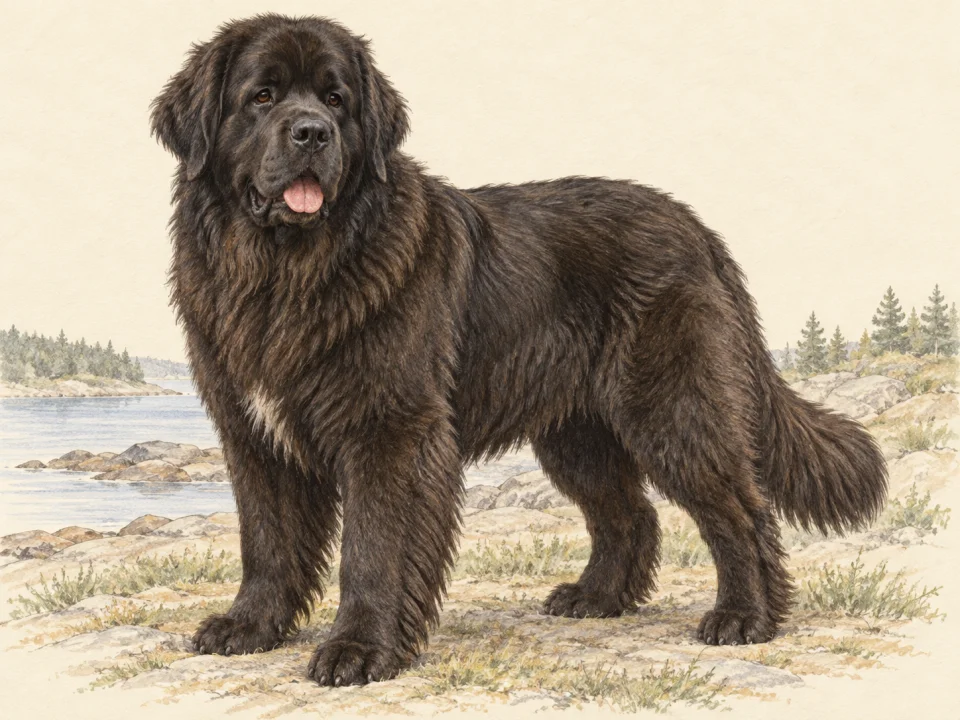
Plan the grooming session around the adult dog
AKC recommends thorough brushing of the heavy coat at least weekly, with more frequent care during shedding. Before bringing a Newfoundland home, decide where an adult can stand or lie comfortably while you work and how you will reach the coat without pulling or forcing a prolonged session. Ask a groomer to demonstrate brushing and combing on the individual coat; a tidy surface can conceal areas you have not worked through. Divide the task into comfortable sessions when needed and record which areas were completed so another caregiver can help. Include cleanup, towels and the route into your vehicle in the plan. Gentle training is especially useful for cooperation: moving onto a mat, waiting at a doorway and accepting handling become significant skills when a dog is too large to reposition casually.[1]
Keep the heart report separate from a general puppy check
The Newfoundland Club of America’s health statement names hip and elbow radiographs, a cystinuria DNA test and a heart examination by a board-certified cardiologist for its CHIC designation. It lists eye, patellar and thyroid assessments as additional recommendations. Ask for identifiable reports for the dogs being discussed and read the test type, result and date rather than relying on the phrase “health tested.” In particular, the statement specifies cardiologist auscultation or echocardiography; an unspecified routine examination does not document that requirement. Bring unclear results to your veterinarian. The records help establish what has been investigated, but they do not replace examination of the puppy or adult you are taking home or predict every future problem.[2]
Keep water enjoyment separate from responsibility for swimmers
A Newfoundland’s association with water work is a reason to explore suitable training, not a reason to assign it responsibility for a person in the water. The Lifesaving Society emphasizes active supervision of children and appropriate lifejackets for boating. Those responsibilities remain with people whether or not a dog is present. For an outing with your dog, decide in advance who is watching the children and who is handling the dog so one task does not silently displace the other. Choose access and an exit that you can manage, and seek qualified instruction for water work rather than improvising rescue exercises with family members. If the dog is hesitant, do not use its breed reputation as a reason to force entry. A pleasant, controlled introduction is more useful than testing whether it will perform like a trained water-working dog.[3]
Frequently asked questions
Can a Newfoundland supervise children around water?
No. Active supervision and water-safety decisions belong to responsible people. The breed’s water-work reputation does not replace a human supervisor, appropriate lifejackets or swimming instruction.
Source [1]What heart screening does the Newfoundland club statement name?
It specifies auscultation or echocardiography by a board-certified cardiologist. Request the actual report and its result instead of treating an unspecified general examination as equivalent.
Source [2]Is occasional surface brushing enough for a Newfoundland coat?
No. AKC recommends thorough regular brushing, with extra care during shedding. Learn how to work through the coat comfortably and plan manageable sessions rather than brushing only the visible surface.
Source [3]FAQ sources
- Lifesaving Society Newfoundland and Labrador — Children and families ↗FAQ reference 1
- Newfoundland Club of America — Health testing statement ↗FAQ reference 2
- American Kennel Club — Newfoundland ↗FAQ reference 3
Sources & methodology
Breed-level measurements and comparison scores provide context. They do not predict an individual dog's health, behaviour or suitability. Open the original publisher pages below to verify the facts and compare any later updates.
- American Kennel Club — Newfoundland ↗Reference 1 · reviewed 2026-09-27
- Newfoundland Club of America — Health testing statement ↗Reference 2 · reviewed 2026-09-27
- Lifesaving Society Newfoundland and Labrador — Children and families ↗Reference 3 · reviewed 2026-09-27
Make it about your dog
Build a profile around your dog's age, experiences and everyday needs.
Meet your dog →Explore local care