
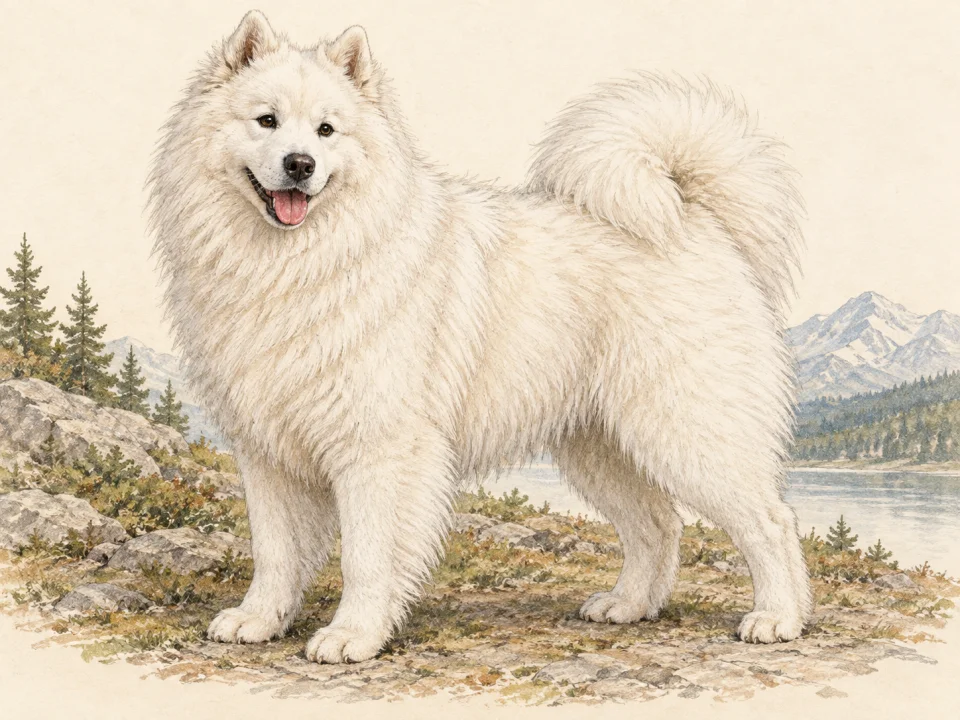
Budget for the undercoat, not just the white surface
The breed club explicitly rejects claims that Samoyeds never shed, stay clean automatically or never need bathing. Before committing to a puppy, arrange to see an adult being groomed and ask to try the tools under guidance. Include brushing, removing loose undercoat, bathing when needed and drying in your time and cost estimate. A quick pass over the outside of the coat does not tell you what is happening underneath. Ask a groomer to demonstrate how to check through the coat comfortably and when a tangle needs professional help. Keep a practical place for wet-weather cleanup and a clean resting area while the dog dries. A realistic care plan should still work during heavy shedding, travel or a busy week; an immaculate photograph does not show that workload.[1]
Cream and biscuit do not mean the coat is dirty
The official standard allows pure white, cream, biscuit, and white with biscuit. Natural color alone is therefore not evidence of poor care or mixed ancestry. The coat also has two different layers: soft, dense undercoat and longer, harsher outer hair. Those distinctions are more useful than seeking the whitest or biggest-looking coat. When comparing dogs, ask about the individual’s normal color and coat condition instead of requesting products to erase normal pigment. If a previously different area changes, describe the change and any accompanying skin discomfort to your veterinarian or groomer rather than assuming every discoloration has the same cause. The breed standard describes appearance; it is not a diagnosis of coat or skin health.[2]
Read the results behind a CHIC number
The Samoyed club’s CHIC page lists hip evaluation, a specialist eye examination, a cardiologist’s examination, and DNA tests for X-linked PRA and RD/OSD. These answer different questions. A DNA report for one condition is not an eye examination, and neither replaces the cardiac record. The same page explains that a CHIC number means the required results were made public, not that every result was normal. For each parent, request the actual findings and dates, and check that the records identify the correct dog. Ask your veterinarian to explain unfamiliar results and confirm current screening requirements with the club or OFA. Keep the puppy’s own veterinary records separate from its parents’ screening: family information is valuable, but cannot guarantee the puppy’s future health.[3]
Frequently asked questions
Do Samoyeds really need no baths because their coat stays clean?
No. The breed club specifically warns against that claim. Grooming and bathing needs depend on the dog and its surroundings; make a realistic plan for the dense coat rather than relying on a self-cleaning promise.
Source [1]Can a Samoyed be cream or biscuit rather than pure white?
Yes. The official standard accepts cream, biscuit, pure white, and white with biscuit. Normal coat color is not a reason to try to whiten the dog.
Source [2]Does a CHIC number mean both parents passed every health test?
No. The Samoyed club explains that CHIC reflects completion and public availability of required results, not necessarily normal findings. Read each parent’s individual reports and ask for help interpreting them.
Source [3]FAQ sources
- Samoyed Club of America — Grooming ↗FAQ reference 1
- AKC — Official Samoyed standard ↗FAQ reference 2
- Samoyed Club of America — What is CHIC ↗FAQ reference 3
Sources & methodology
Breed-level measurements and comparison scores provide context. They do not predict an individual dog's health, behaviour or suitability. Open the original publisher pages below to verify the facts and compare any later updates.
- Samoyed Club of America — Grooming ↗Reference 1 · reviewed 2026-09-27
- AKC — Official Samoyed standard ↗Reference 2 · reviewed 2026-09-27
- Samoyed Club of America — What is CHIC ↗Reference 3 · reviewed 2026-09-27
- Samoyed Club of America — Breed overview ↗Reference 4 · reviewed 2026-09-27
Make it about your dog
Build a profile around your dog's age, experiences and everyday needs.
Meet your dog →Explore local care