
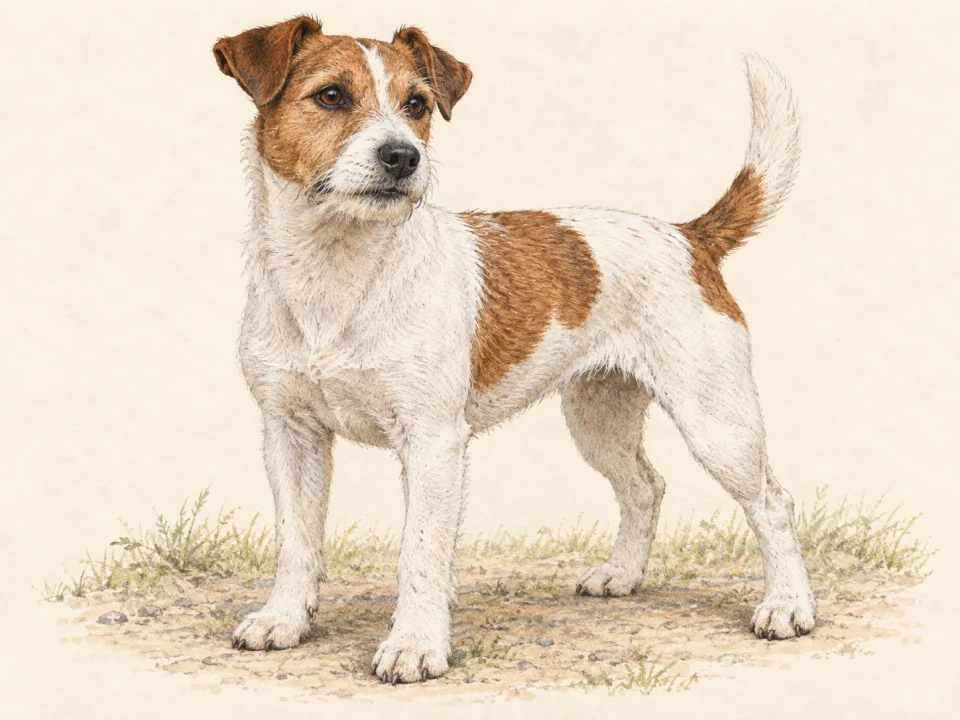
Clarify the breed name before comparing puppies
The AKC Russell standard describes a 10–12-inch dog with a rectangular outline and smooth, broken or rough coat. It is a separate AKC breed from the Parson Russell Terrier. If an advertisement uses Jack Russell as a general label, ask which registry and standard apply and request the parents’ details. A puppy photograph cannot resolve the expected adult size or registration. Coat texture is also not a personality test: a rough-coated puppy is not necessarily calmer than a smooth-coated one. Ask about the individual’s behavior and the routine it has experienced. For practical planning, compare the available space in a carrier or vehicle with adult measurements rather than assuming that all dogs advertised under similar names will fit identically.[1]
Build a day with learning as well as movement
AKC describes an energetic dog that enjoys solving problems and can lose interest in repetitive lessons. Try brief sessions with a clear, achievable task: finding a hidden toy in a safe room, returning to you or waiting while a gate is opened. Reward success and finish before the dog becomes frustrated. Alternate activity with opportunities to settle rather than making exhaustion the only strategy for a quiet evening. Outdoors, check small gaps and the ground beneath the fence before relying on the enclosure. Retained prey drive means socialization is not a guarantee of safety around small animals; manage those encounters rather than using them to test obedience. Match activity to age and condition, and ask for professional help if chasing or arousal is becoming difficult to manage.[2]
Request hearing and eye records, not just a puppy checkup
AKC lists patella evaluation, specialist eye evaluation, BAER hearing testing and primary lens luxation DNA testing for the Russell Terrier. Ask what results are available for the parents and what testing has been done for the puppy. Keep each record under the correct dog’s identity, noting the date and named test. A routine veterinary examination is useful but is not automatically evidence that these separate assessments occurred. Likewise, a DNA result for one eye condition does not describe every possible eye problem. If a breeder provides only the words health tested, ask for the documents and take unfamiliar findings to your veterinarian before drawing conclusions.[3]
Frequently asked questions
Are smooth, broken and rough coats different Russell breeds?
No. All three are included in the AKC Russell Terrier standard. Choose a grooming routine for the actual coat, and assess temperament independently of its texture.
Source [1]Will socialization remove the Russell’s interest in chasing small animals?
Do not assume so. AKC notes retained prey drive. Provide supervised, controlled experiences and secure separation where needed rather than relying on familiarity alone.
Source [2]Which health records should I request?
AKC lists patella and specialist eye evaluations, BAER hearing testing and primary lens luxation DNA testing. Ask for the findings, dates and identity of the dog each record covers.
Source [3]FAQ sources
- American Kennel Club — Russell Terrier standard ↗FAQ reference 1
- American Kennel Club — Russell Terrier care ↗FAQ reference 2
- American Kennel Club — Terrier group health testing requirements ↗FAQ reference 3
Sources & methodology
Breed-level measurements and comparison scores provide context. They do not predict an individual dog's health, behaviour or suitability. Open the original publisher pages below to verify the facts and compare any later updates.
- American Kennel Club — Russell Terrier standard ↗Reference 1 · reviewed 2026-09-27
- American Kennel Club — Russell Terrier care ↗Reference 2 · reviewed 2026-09-27
- American Kennel Club — Terrier group health testing requirements ↗Reference 3 · reviewed 2026-09-27
Make it about your dog
Build a profile around your dog's age, experiences and everyday needs.
Meet your dog →Explore local care