
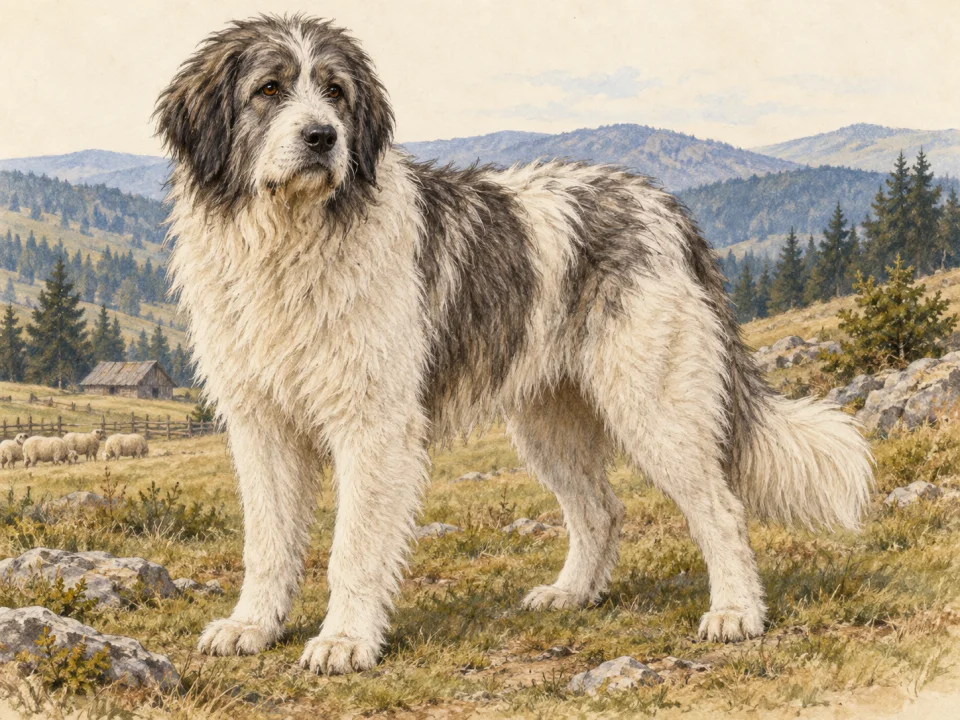
A long coat should not hide the care requirements
The FCI standard describes a harsh, straight outer coat with dense, softer undercoat. The outline of that coat is not the outline of the dog underneath. Before choosing a Mioritic, arrange a practical grooming demonstration that includes reaching the deeper coat comfortably, rather than simply smoothing the surface. Ask how to check behind the ears, beneath the legs and around other areas where friction or debris may create tangles. Break the work into manageable sessions and note which areas have been checked so a missed patch does not disappear under the surrounding hair. If a tangle is tight against the skin or the dog shows discomfort, get professional help rather than pulling or cutting blindly. Photograph an agreed grooming finish and share the routine with anyone who will care for the dog while you are away.[1]
Teach comfortable handling instead of trying to establish rank
AVSAB recommends reward-based training. Grooming cooperation is therefore a skill to teach, not evidence that a dog has accepted someone’s dominance. Begin with brief, comfortable contact, reward participation and increase the task gradually. Practice with the equipment and person who will actually provide care, so a large adult’s first unfamiliar grooming visit is not an avoidable confrontation. The standard’s description of reserve toward strangers makes thoughtful introductions useful beyond the grooming table. Arrange a place where the dog can be comfortably separated before guests arrive, and let introductions proceed at an appropriate pace. Do not require a visitor to reach into the coat or hug the dog because it looks soft. Persistent fear or difficulty with handling needs qualified help, not a stronger physical contest.[2]
Use the breed standard when checking adult height
The September 2022 FCI standard gives a minimum shoulder height of 70 cm for males and 65 cm for females, with ideals of 75 cm and 70 cm respectively. These are minimum and ideal figures, not the ends of a fixed range. We use those FCI measurements in the height card because AKC’s overview lists a different range, including a lower female figure of 22.5 inches. That lower figure does not meet the FCI minimum. The other quick-facts measurements come from AKC’s overview; its 100–130-pound weight range is not a requirement to make a dog heavier. FCI calls for weight proportional to size. For a prospective owner, the useful next step is to meet adult relatives or obtain actual measurements for an adult being adopted, then check whether transport, grooming space and routine handling are practical for that dog.[1]
Frequently asked questions
Does a shaggy appearance mean the coat can be left unchecked?
No. The standard describes substantial outer coat and undercoat. Ask a knowledgeable groomer to demonstrate checks beneath the surface and a routine suited to the individual dog.
Source [1]Should grooming be used to prove dominance over a Mioritic?
No. Use gradual, reward-based handling, consistent with AVSAB guidance. Pain, fear or difficulty with a procedure is a reason to adjust the approach and seek help, not force submission.
Source [2]Does a calm breed description guarantee comfort with strangers?
No. The FCI standard also describes wariness of strangers. Assess the individual and arrange gradual introductions with space to retreat rather than expecting immediate physical affection.
Source [1]What minimum adult height does the FCI specify for the Mioritic?
The 2022 FCI standard specifies 70 cm for males and 65 cm for females at the withers; its ideal heights are 75 cm and 70 cm. An ideal is not an upper height limit, and these figures should not be confused with a directory’s combined range.
Source [1]Sources & methodology
Breed-level measurements and comparison scores provide context. They do not predict an individual dog's health, behaviour or suitability. Open the original publisher pages below to verify the facts and compare any later updates.
- Fédération Cynologique Internationale — Romanian Mioritic Shepherd Dog standard, September 2022 ↗Reference 1 · reviewed 2026-09-27
- American Veterinary Society of Animal Behavior — Humane training guidance ↗Reference 2 · reviewed 2026-09-27
- American Kennel Club — Romanian Mioritic Shepherd Dog overview ↗Reference 3 · reviewed 2026-09-27
Make it about your dog
Build a profile around your dog's age, experiences and everyday needs.
Meet your dog →Explore local care