
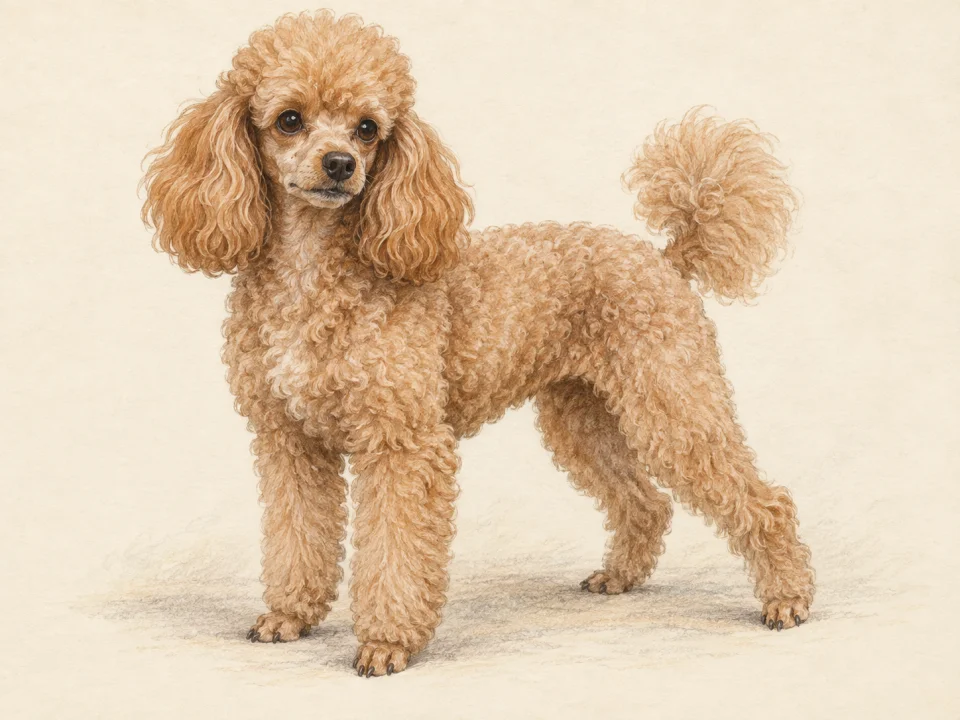
What Toy means
The AKC Toy Poodle limit is 10 inches at the shoulder. The classification does not describe personality or guarantee a particular adult weight.[1]
Be careful with extra-small labels
The Poodle rescue foundation cautions against labels such as “teacup.” Treat the actual dog’s health, development and background as the important information, rather than paying for an extra-small marketing category.[7]
Give a small dog opportunities to learn
Toy Poodles share the breed’s active, attentive character. Positive practice and everyday interaction matter at this size too. Discuss the dog’s experience with its current carer and make space for learning in your schedule.[2]
Coat care is still a commitment
Regular grooming remains necessary even on a small body. Agree on a coat length and between-appointment routine with a professional. Introduce handling calmly and ask for a demonstration rather than attempting unfamiliar clipping around delicate areas.[3]
Ask for Toy-specific health evidence
PCA’s statement identifies prcd-PRA testing, annual eye examinations and patellar evaluation for Toy breeding dogs. Ask for identifiable parental results. Your veterinarian can explain the limits of those records and the appropriate care for your own dog.[4]
Look at your home from the dog’s level
Before arrival, check where the dog will rest, how doors are managed and how other household animals will be introduced. If children live with you, decide which adult will supervise interactions. Talk to the breeder or rescue about the particular dog’s handling experience. Buying small equipment is only one part of making the home ready.
Care arrangements should travel with the dog
Write a short handover for a sitter: current food, familiar routine, veterinary contact and any known sensitivities. Ask how the sitter manages dogs of different sizes rather than assuming that a small dog can join every group. Keep the record updated as you learn what works.
Make room for uncertainty
A puppy’s future routine will develop over time; an adopted adult may have gaps in its history. Keep notes and ask follow-up questions. For a breeder placement, PCA’s code provides a useful framework for written agreements and individual records. Understand what support is available before taking the dog home.[5]
Frequently asked questions
Are Toy Poodles intelligent like larger Poodles?
Toy Poodles share the breed’s reputation for learning and attentiveness. That does not replace individual training or assign a measurable IQ to your dog.
Source [1]Is a teacup Poodle a separate official size?
Not in the AKC’s three-variety system. The Poodle rescue foundation describes “teacup” as a marketing term rather than a recognised extra variety.
Source [2]What health screening is listed for Toy Poodles?
PCA lists prcd-PRA, eye examinations and patellar evaluation. Review the parents’ records with your veterinarian.
Source [3]Does a Toy Poodle guarantee an allergy-free home?
No. Low shedding is not the same as producing no allergens. No dog breed guarantees that a person will not react.
Source [4]FAQ sources
- American Kennel Club — living with a Poodle ↗FAQ reference 1
- Poodle Club of America Rescue Foundation — size labels ↗FAQ reference 2
- Poodle Club of America — December 2024 health statement ↗FAQ reference 3
- American Kennel Club — allergy limitations ↗FAQ reference 4
Sources & methodology
Breed-level measurements and comparison scores provide context. They do not predict an individual dog's health, behaviour or suitability. Open the original publisher pages below to verify the facts and compare any later updates.
- Poodle Club of America — AKC size standard ↗Reference 1 · reviewed 2026-09-09
- American Kennel Club — living with a Poodle ↗Reference 2 · reviewed 2026-09-09
- American Kennel Club — Poodle coat care ↗Reference 3 · reviewed 2026-09-09
- Poodle Club of America — December 2024 health statement ↗Reference 4 · reviewed 2026-09-09
- Poodle Club of America — breeder responsibilities ↗Reference 5 · reviewed 2026-09-09
- American Kennel Club — allergy limitations ↗Reference 6 · reviewed 2026-09-09
- Poodle Club of America Rescue Foundation — size labels ↗Reference 7 · reviewed 2026-09-09
Make it about your dog
Build a profile around your dog's age, experiences and everyday needs.
Meet your dog →Explore local care