
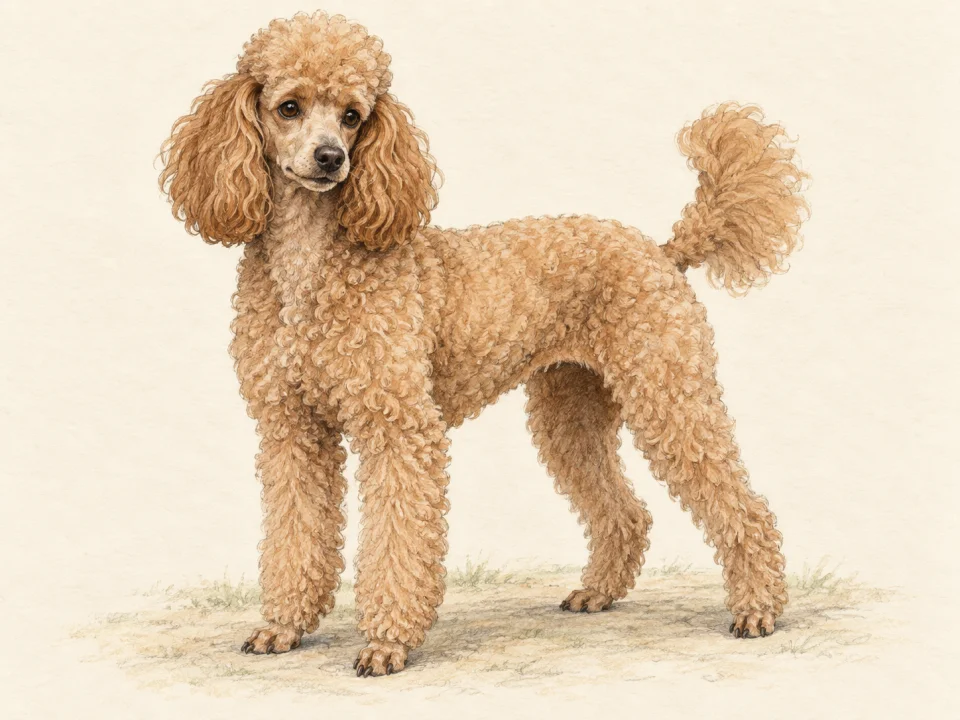
Small, with a specific size definition
In the AKC standard, Miniature Poodles stand over 10 inches and no more than 15 inches at the shoulder. Other registries may use different classifications. Ask which standard a breeder is referring to rather than judging size from an advertising label.[1]
Learning is part of the relationship
The Poodle’s smaller varieties retain the breed’s active, people-oriented character. Provide opportunities for positive training and shared activities. A compact dog still needs your attention and a routine that includes more than being carried from place to place.[2]
Put grooming in the budget
A Miniature’s curly coat needs regular maintenance. A shorter style can simplify the routine but does not eliminate brushing or professional care. Ask a groomer to demonstrate the technique appropriate for your dog and explain what to do if you find a tangle.[3]
Screening differs from the Toy variety
PCA’s current statement includes prcd-PRA testing, eye examinations, patellar evaluation and hip evaluation for Miniatures. Check both parents’ identifiable records with your veterinarian. Do not assume a generic puppy health check covers those breeding-dog examinations.[4]
Plan for the places you actually visit
If you live in a flat, walk through the route from your front door to the street: lifts, shared entrances and busy pavements may all become part of daily life. Ask the current carer what the dog has experienced. Plan who handles daytime breaks and how you will introduce an unfamiliar sitter. A smaller bed saves space, but it does not solve a care gap.
Questions for a breeder or rescue
Request a written description of known health and care needs, the dog’s identification and the support available after placement. PCA’s breeder code calls for health records and clear agreements. For an adopted dog, ask which parts of the history are known and which are uncertain.[5]
Build a shared care notebook
Keep notes on grooming appointments, familiar cues, outings and what helps the dog settle. If several people provide care, agree on a small set of everyday routines. Record observations rather than comparing progress with another Poodle. That gives a future trainer or sitter something practical to work with.
Frequently asked questions
What should I know before getting a Miniature Poodle?
Expect an active learner and an ongoing grooming commitment. Small size does not make the breed a low-attention pet.
Source [1]How is a Miniature Poodle different in size from a Toy?
The AKC Miniature range is over 10 through 15 inches at the shoulder; the Toy limit is 10 inches. These are height boundaries.
Source [2]Which parental tests should I ask about for a Miniature Poodle?
PCA lists prcd-PRA, eyes, patellas and hips. Ask for the actual records and have your veterinarian interpret them.
Source [3]Will a Miniature Poodle definitely avoid triggering allergies?
No. No breed is completely hypoallergenic. Low shedding is one consideration, not a guarantee for an allergic person.
Source [4]FAQ sources
- American Kennel Club — living with a Poodle ↗FAQ reference 1
- Poodle Club of America — AKC size standard ↗FAQ reference 2
- Poodle Club of America — December 2024 health statement ↗FAQ reference 3
- American Kennel Club — allergy limitations ↗FAQ reference 4
Sources & methodology
Breed-level measurements and comparison scores provide context. They do not predict an individual dog's health, behaviour or suitability. Open the original publisher pages below to verify the facts and compare any later updates.
- Poodle Club of America — AKC size standard ↗Reference 1 · reviewed 2026-09-09
- American Kennel Club — living with a Poodle ↗Reference 2 · reviewed 2026-09-09
- American Kennel Club — Poodle coat care ↗Reference 3 · reviewed 2026-09-09
- Poodle Club of America — December 2024 health statement ↗Reference 4 · reviewed 2026-09-09
- Poodle Club of America — breeder responsibilities ↗Reference 5 · reviewed 2026-09-09
- American Kennel Club — allergy limitations ↗Reference 6 · reviewed 2026-09-09
- Poodle Club of America Rescue Foundation — size labels ↗Reference 7 · reviewed 2026-09-09
Make it about your dog
Build a profile around your dog's age, experiences and everyday needs.
Meet your dog →Explore local care