
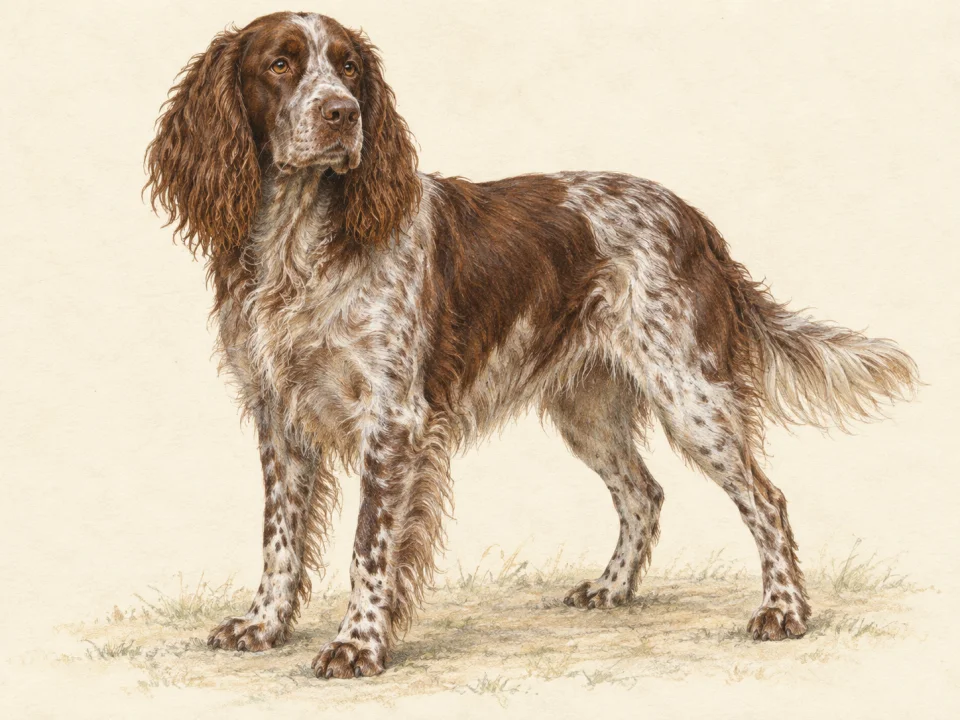
The curls belong to a pointing dog
The FCI places this French breed among continental pointing dogs of spaniel type. Its topknot and long ear hair form the distinctive frame around the face; they are not evidence that the dog is a Poodle cross. AKC describes a bird dog with water-work, pointing, flushing and retrieving abilities. For a prospective home, ask which of those activities the individual has experienced and what it enjoys doing with people. If you do not hunt, discuss suitable training and outdoor activities with someone who knows the breed. Meet an adult after an ordinary day and ask how its needs are met during the working week. Do not infer that a quiet moment indoors means the dog will thrive with little interaction. Nor does a working description establish that a puppy is ready for difficult terrain or demanding swimming.[1]
Give the ears and feet attention after an outing
AKC recommends regular brushing and particular attention to mats around the ears. The FCI standard also describes curly hair between the toes. After a walk through vegetation, check these areas for caught material before it becomes tangled. Let a groomer demonstrate comfortable handling and which maintenance your dog actually needs. Keep the ear flap and surrounding hair distinct from the ear canal: if there is discomfort, odor or discharge, ask a veterinarian to assess it rather than trying to clean more deeply. A simple post-outing routine can include checking the coat, looking at the feet and noting any area the dog resists having touched. Share those observations with the professional caring for the dog. The aim is to preserve comfortable skin and movement beneath the curls, not merely a recognizable hairstyle.[2]
Frequently asked questions
Is the Pont-Audemer Spaniel a pointing dog despite its name?
Yes. The FCI classifies it as a continental pointing dog of spaniel type. Its name does not limit its working role to flushing alone.
Source [1]Does its water-dog background make every swimming outing safe?
No. Working ability does not establish an individual dog’s readiness or the safety of a particular location. Plan activity for the dog’s experience and conditions rather than assuming the coat makes cold or difficult water harmless.
Source [2]Where should I check for tangles on a Pont-Audemer Spaniel?
Give particular attention to the long ear furnishings during regular brushing, as AKC advises. Also check the coat and feet after vegetation-heavy outings, and get help with painful or close-to-skin tangles instead of pulling through them.
Source [2]FAQ sources
Sources & methodology
Breed-level measurements and comparison scores provide context. They do not predict an individual dog's health, behaviour or suitability. Open the original publisher pages below to verify the facts and compare any later updates.
- Fédération Cynologique Internationale — Pont-Audemer Spaniel standard, 2023 ↗Reference 1 · reviewed 2026-09-27
- American Kennel Club — Pont-Audemer Spaniel ↗Reference 2 · reviewed 2026-09-27
Make it about your dog
Build a profile around your dog's age, experiences and everyday needs.
Meet your dog →Explore local care