
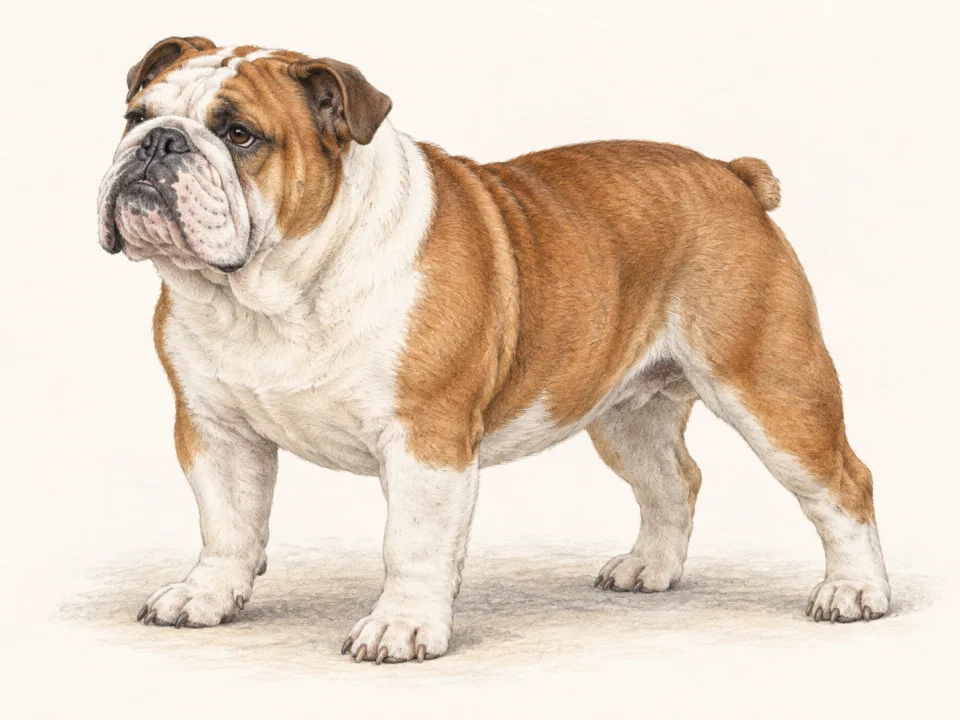
Make warm-weather care part of the decision
AKC warns that heat and humidity can make breathing difficult for Bulldogs. Before choosing the breed, consider whether you can provide a comfortably cool indoor environment and move outings away from unsuitable conditions. Do not interpret an eager walk or noisy breathing as proof that the dog can safely continue. Discuss the individual’s breathing and activity tolerance with your veterinarian.[1]
Use moderate movement rather than complete inactivity
A mellow disposition does not mean the dog benefits from spending every day without activity. Suitable walks and gentle play can form a routine, adjusted to weather, age and health. Watch how the dog moves and recovers. Ask for individualized guidance if ordinary activity becomes harder; neither pushing through difficulty nor labeling the dog lazy addresses a possible health concern.[1]
Check folds as skin, not just facial character
The cited grooming guidance highlights moisture and food trapped in facial folds. Ask your veterinarian to demonstrate an appropriate cleaning and drying routine and identify products suitable for the individual. Inspect gently and seek advice for irritation instead of repeatedly applying household remedies. Include the ears and tail area in routine checks, and keep anything used for skin care away from the eyes.[1]
Plan access around pools and difficult steps
AKC identifies pools and stairs as hazards for the breed. Prevent unsupervised access and assess routes through your home before problems arise. A Bulldog should not be expected to swim safely merely because it approaches water willingly. Consider how you will manage transport or an awkward step with a substantial adult, rather than assuming you can always lift the dog easily.[1]
Teach exchanges without turning meals into a contest
Bulldogs often enjoy chewing and tug games. Practice releasing an appropriate toy in exchange for a reward, and end games while interaction remains manageable. Let the dog eat in a quiet place without children interfering. If guarding or unsafe behavior appears, seek qualified help; deliberately provoking competition over food is not a necessary test of manners or trust.[1]
Ask what the health assessments actually cover
The cited panel includes patella evaluation, a cardiac exam and a radiographic evaluation for tracheal hypoplasia. Request identifiable reports and ask your veterinarian about their scope and any further assessment the individual needs. AKC lists a reference lifespan of 8–10 years. A screening result is useful evidence, but it does not replace ongoing attention to breathing, movement, skin and general comfort.[1]
Frequently asked questions
Does an easygoing Bulldog need exercise?
Yes, suitable moderate activity remains part of care. Adjust walks and play to health and weather, and discuss difficulty with a veterinarian rather than pushing the dog to continue.
Source [1]Can I leave a Bulldog near a pool if it likes water?
No. The cited guidance identifies pools as a hazard. Prevent unsupervised access; willingness to enter water is not evidence of safe swimming ability.
Source [1]What should I do about facial-fold irritation?
Ask your veterinarian about appropriate cleaning, drying and assessment. Do not repeatedly improvise household treatments or treat persistent irritation as normal for the breed.
Source [1]Which tests appear in the cited Bulldog health panel?
Patella evaluation, cardiac examination and a radiographic evaluation for tracheal hypoplasia are listed. Ask what each report establishes and what other assessment is appropriate for the individual.
Source [1]FAQ sources
- American Kennel Club — Bulldog breed and care guidance ↗FAQ reference 1
Sources & methodology
Breed-level measurements and comparison scores provide context. They do not predict an individual dog's health, behaviour or suitability. Open the original publisher pages below to verify the facts and compare any later updates.
- American Kennel Club — Bulldog breed and care guidance ↗Reference 1 · reviewed 2026-09-27
Make it about your dog
Build a profile around your dog's age, experiences and everyday needs.
Meet your dog →Explore local care