
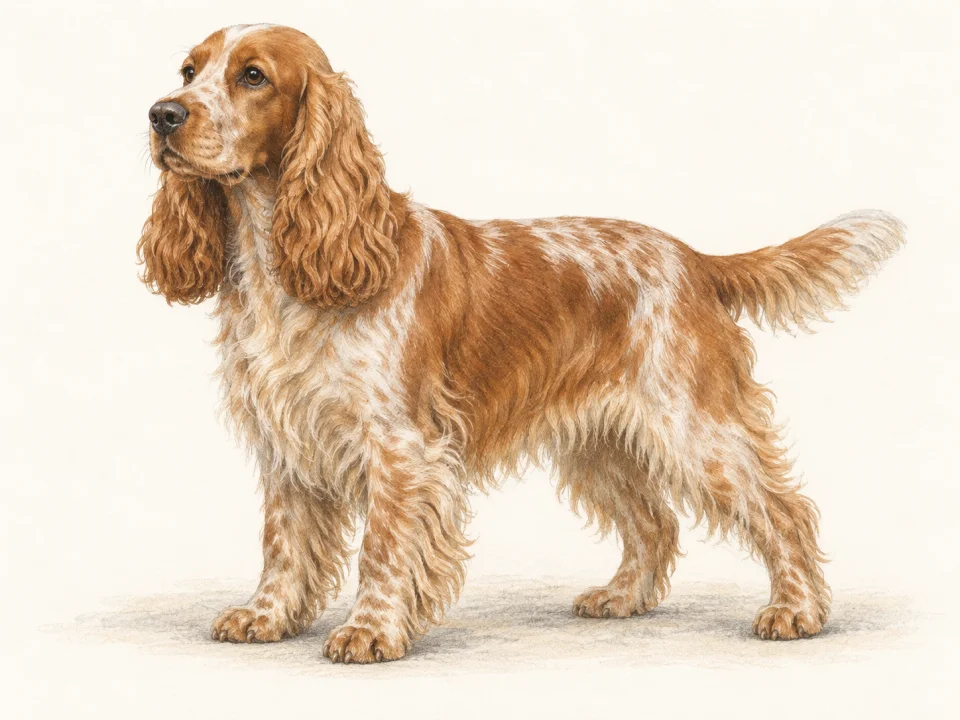
A compact sporting dog is still a sporting dog
The breed standard describes a dog able to work through dense cover, flushing birds and retrieving game. Its compact build should not be confused with a preference for a sedentary life. When choosing an English Cocker, ask whether the family behind the dog has been bred and worked principally for field or show activities, then ask about the actual parents and puppy rather than treating that label as a complete personality assessment. A useful household plan provides opportunities to explore with control and learn with a person, alongside rest. Decide where those activities will take place and who will provide them on an ordinary workday. The standard’s weight ranges describe desired breed proportions; they are not a feeding target for every dog. Judge body condition and diet with veterinary guidance rather than trying to reach the upper end of a chart.[3]
Make a grooming handover more specific than “brush weekly”
AKC recommends regular thorough brushing and combing, with attention to areas needing trimming such as the feet and around the ears. Before the first appointment, ask a groomer to demonstrate how to reach through the coat comfortably and which areas you should leave to them. For a shared-care household, write down three things after each session: areas combed, tangles that remain and any discomfort noticed. That simple handover can prevent two carers from assuming the other has dealt with a problem. Ear care is a separate task from making the ear hair look tidy: ask your veterinarian what routine is appropriate for this dog. Do not turn a cosmetic grooming session into an attempt to treat a painful ear. A neat outer coat alone does not tell you whether the dog is comfortable.[1]
Ask for named results, including the tests relevant to field-bred dogs
The ECSCA breeder-information page recommends prcd-PRA, familial nephropathy (FN) and adult-onset neuropathy (AON) DNA tests for both show- and field-bred English Cockers; it additionally recommends AMS and EIC DNA tests for field-bred dogs. It separately lists hearing, eye, thyroid, hip and patella assessments. Before comparing two litters, make a record for each parent with the test name, result, date and identifying details. Keep an absent result distinct from a normal one, and ask a veterinarian to interpret the documents and their limits. This avoids comparing a large unnamed DNA panel with a set of specific examinations as if they were equivalent. Screening informs breeding and purchase discussions; it does not guarantee a puppy’s future health or replace that puppy’s own care.[2]
Frequently asked questions
Does an English Cocker’s willingness to work with people make off-leash recall automatic?
No. AKC notes strong hunting instincts and recommends leashed walks and a fenced yard. A cooperative disposition does not replace learning and safe management around birds or other distractions.
Source [1]Which additional DNA tests does the US club recommend for field-bred English Cockers?
Its breeder-information page lists AMS and EIC in addition to prcd-PRA, FN and AON. Ask for identifiable reports and professional interpretation; DNA testing does not replace the separately listed physical and clinical assessments.
Source [2]Should every male English Cocker weigh 34 pounds?
No. The standard gives 28–34 pounds as a desired range and places proper build above weight alone. The right condition for an individual requires assessment, not a goal of reaching the range’s top.
Source [3]Can a tidy-looking ear coat replace ear checks?
No. Grooming the hair and checking ear health are different jobs. Include ear checks in the care routine and have a veterinarian assess discomfort or suspected infection.
Source [1]FAQ sources
Sources & methodology
Breed-level measurements and comparison scores provide context. They do not predict an individual dog's health, behaviour or suitability. Open the original publisher pages below to verify the facts and compare any later updates.
- American Kennel Club — English Cocker Spaniel ↗Reference 1 · reviewed 2026-09-27
- English Cocker Spaniel Club of America — Understanding Health Clearances ↗Reference 2 · reviewed 2026-09-27
- Official English Cocker Spaniel Standard, effective November 2023 ↗Reference 3 · reviewed 2026-09-27
Make it about your dog
Build a profile around your dog's age, experiences and everyday needs.
Meet your dog →Explore local care