
Use the hunting background to plan secure walks
AKC describes a dog that traditionally ranges ahead of a hunter following moose and makes decisions at a distance. That helps explain why learning a cue indoors does not establish reliable recall around wildlife. Choose a secure walking setup and practice responses in manageable settings before increasing distractions. On a wooded route, decide where you can turn back or create distance if the dog becomes intensely interested in something. Do not let an affectionate relationship become the only reason to remove the leash. Keep learning varied and rewarding rather than repeating the same exercise until attention fades. For a prospective adult, ask about its actual walking behavior, previous hunting experience and ability to settle afterward; the answers are more useful than a general promise that the breed is intelligent.[2]
Look through the gray coat when assessing care needs
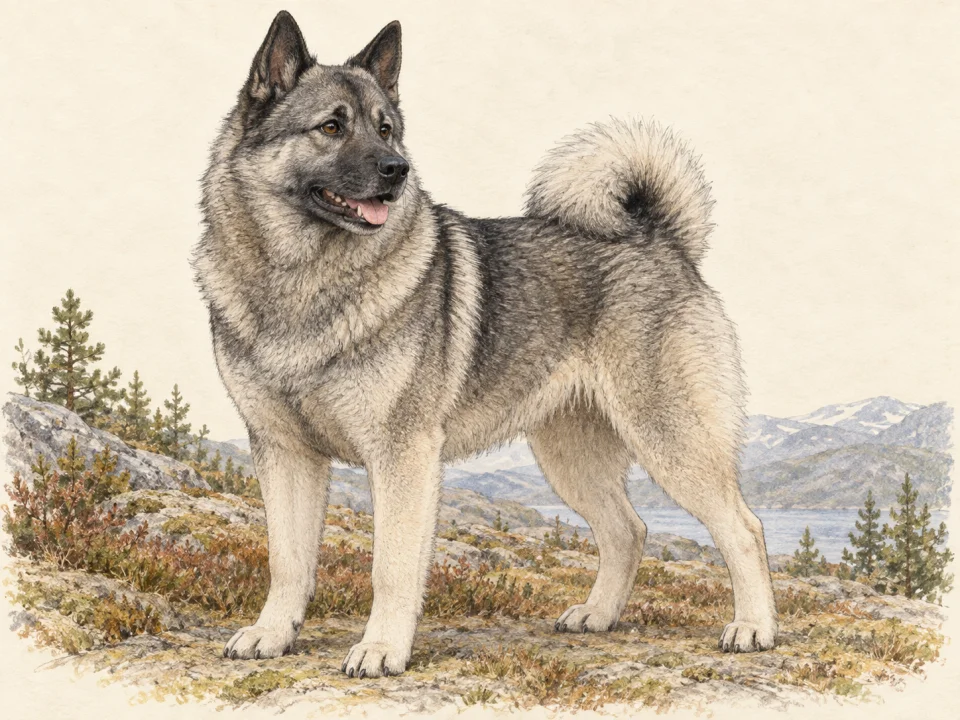
The FCI standard describes coarse outer hair with black tips over a soft, light-gray undercoat. That combination creates the familiar shaded appearance, but also means a glance at the outline is not the whole story of the dog underneath. AKC warns of substantial undercoat shedding. Learn a comfortable brushing routine and allow extra time during those periods instead of waiting for loose hair to fill the house. At veterinary visits, ask for a hands-on body-condition assessment and guidance on food amounts. Keep treats included in the daily food record so different family members do not unknowingly add several extra portions. Use the dog’s assessed condition and activity to guide the conversation, rather than trying to judge healthy weight solely through a full coat or from a single breed-average number.[1]
Ask for evaluated hips and a dated eye examination
The Norwegian Elkhound Association of America’s published statement recommends evaluated hip radiographs and an examination by a board-certified veterinary ophthalmologist for breeding dogs. It also recommends recurring eye examinations while a dog remains in a breeding program. Request the actual report, the dog’s identity and the examination date for each parent. A general description that the line is hardy does not answer those questions. If a breeder refers to an older health statement or a registry record, ask how it relates to the current dogs and discuss any uncertainty with your veterinarian. Screening does not guarantee that every future condition has been excluded, and new symptoms should be investigated on their own merits.[3]
Frequently asked questions
Does a Norwegian Elkhound’s loyalty guarantee off-leash recall?
No. AKC describes an independent hunting dog with an instinct to range and explore. Use secure management around wildlife and assess the individual’s training rather than treating affection as a safety guarantee.
Source [1]Why does the gray coat have different shades?
The FCI standard describes black-tipped outer hairs and a lighter undercoat, with lighter areas on parts of the body. The shaded coat is characteristic; it is not a substitute for checking skin, coat condition or body condition.
Source [2]What should I request beyond “healthy parents”?
Ask for identifiable hip evaluation reports and dated eye examinations, as recommended in the breed association’s statement. Have unclear findings explained rather than assuming a general examination covers each named screening.
Source [3]FAQ sources
- American Kennel Club — Norwegian Elkhound ↗FAQ reference 1
- Fédération Cynologique Internationale — Norwegian Elkhound Grey standard ↗FAQ reference 2
- Norwegian Elkhound Association of America — Health statement ↗FAQ reference 3
Sources & methodology
Breed-level measurements and comparison scores provide context. They do not predict an individual dog's health, behaviour or suitability. Open the original publisher pages below to verify the facts and compare any later updates.
- Fédération Cynologique Internationale — Norwegian Elkhound Grey standard ↗Reference 1 · reviewed 2026-09-27
- American Kennel Club — Norwegian Elkhound ↗Reference 2 · reviewed 2026-09-27
- Norwegian Elkhound Association of America — Health statement ↗Reference 3 · reviewed 2026-09-27
Make it about your dog
Build a profile around your dog's age, experiences and everyday needs.
Meet your dog →Explore local care