
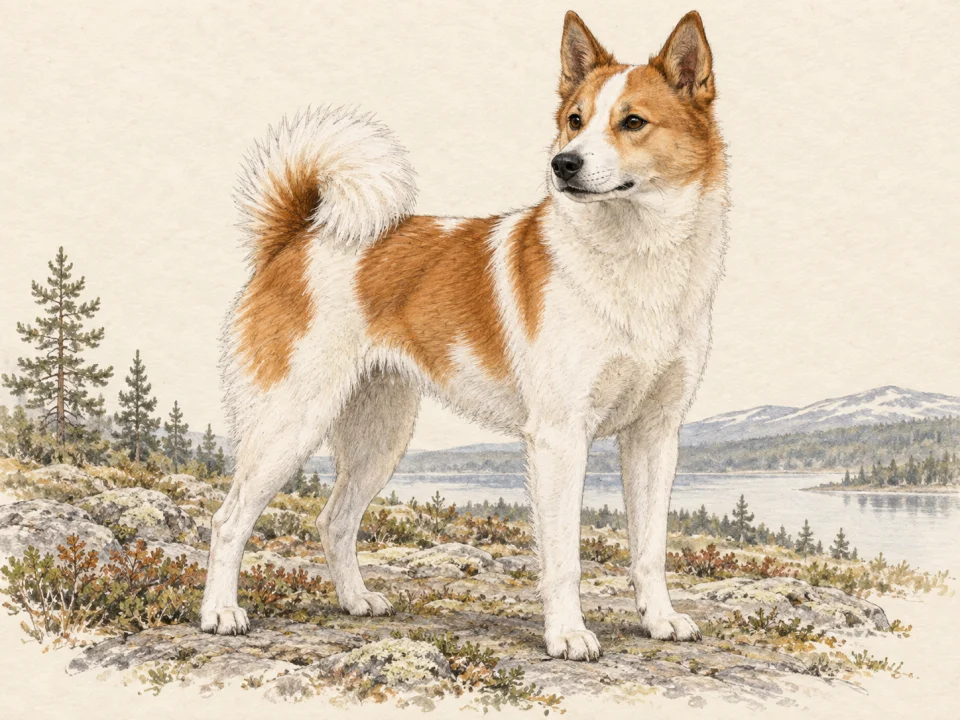
Understand the Swedish hunting background
The FCI standard identifies Sweden as the country of origin and describes use primarily on large forest grouse, with capability for other game as well. It records that the breed was once declared extinct after registrations disappeared, then recovered from surviving dogs and returned to the registry in 1967. That history should not be simplified into a claim that every present-day dog has the same working experience. Ask a breeder or rescue whether the individual has hunted, lived in a busy household or spent time around other pets. For a companion home, compare those experiences with what you can provide on an ordinary weekday. A dog that moves confidently through woodland may still need gradual learning around elevators, traffic or a crowded entrance. Choose outings with manageable access and a secure way to keep the dog with you rather than assuming its small size makes wildlife encounters easy.[1]
Prepare both outdoor activity and an indoor alternative
AKC describes an energetic, playful dog and suggests walks, secure play and learning activities. Plan an indoor option for days when the usual outing is impractical: a simple search game or a short lesson gives you a way to engage together without treating poor weather as the end of the routine. Ask about the individual’s vocal responses to arrivals, movement outside and unfamiliar sounds, particularly if you share walls with neighbors. Observe how readily the dog can settle after an activity instead of judging suitability only during exciting play. The coat also needs a practical routine despite being short. AKC recommends regular weekly grooming; learn to work through the dense undercoat comfortably and make nail and ear checks familiar. Keep notes on the activities and handling the dog knows so a new caregiver can continue them. The useful measure is a sustainable day for this dog and household, not whether the dog matches every reassuring word in a breed description.[2]
Use the adult dog’s measurements, not just the label “small”
The FCI standard gives ideal shoulder heights of 45 cm for males and 42 cm for females, with 2 cm of tolerance either way. That describes the breed’s proportions, not the size of every dog or the amount of exercise it needs. The AKC weight reference in the fact panel reaches 30 pounds, which puts this dog in PupNudge’s medium filter even though the standard calls it a small spitz. These labels serve different purposes. For a carrier or car restraint, measure the actual adult and follow the equipment maker’s fit instructions. For a puppy, ask about the parents’ adult dimensions instead of treating a catalogue range as a guaranteed growth chart.[1]
Ask about hip and specialist eye evaluations
AKC lists hip evaluation and ophthalmologist evaluation among recommended health tests for this breed. Before choosing a litter, ask which parents were examined and request the identifiable results. Record the date and type of examination; a general statement that the dogs are healthy does not tell you whether either evaluation took place. Ask the breeder about known health concerns in the family and discuss unfamiliar findings with your veterinarian. These records can inform a decision but cannot screen for every possible condition. If adopting an adult with incomplete records, keep the missing history explicit and arrange an individual veterinary assessment rather than assuming that an uncommon breed has no health risks.[2]
Frequently asked questions
Is the Norrbottenspets a Norwegian breed?
The FCI standard lists its origin as Sweden. Its history belongs to northern Scandinavia, but the official country-of-origin entry is Swedish.
Source [1]Was the breed actually lost and recreated from scratch?
The FCI history says it was declared extinct after registrations ceased, but surviving dogs were subsequently found. It returned to the registry in 1967; this is different from saying no dogs remained.
Source [1]Does its short coat mean no regular grooming?
No. It has a dense undercoat beneath the short outer coat, and AKC recommends weekly grooming. Learn an appropriate routine for the individual rather than judging the work from hair length alone.
Source [2]What health-screening records should I request for a Norrbottenspets litter?
AKC lists hip and ophthalmologist evaluations. Ask for results identifying the parents, the examination type and date; general reassurance about health does not establish that these checks were done.
Source [2]FAQ sources
- Fédération Cynologique Internationale — Norrbottenspets standard ↗FAQ reference 1
- American Kennel Club — Norrbottenspets ↗FAQ reference 2
Sources & methodology
Breed-level measurements and comparison scores provide context. They do not predict an individual dog's health, behaviour or suitability. Open the original publisher pages below to verify the facts and compare any later updates.
- Fédération Cynologique Internationale — Norrbottenspets standard ↗Reference 1 · reviewed 2026-09-27
- American Kennel Club — Norrbottenspets ↗Reference 2 · reviewed 2026-09-27
Make it about your dog
Build a profile around your dog's age, experiences and everyday needs.
Meet your dog →Explore local care