
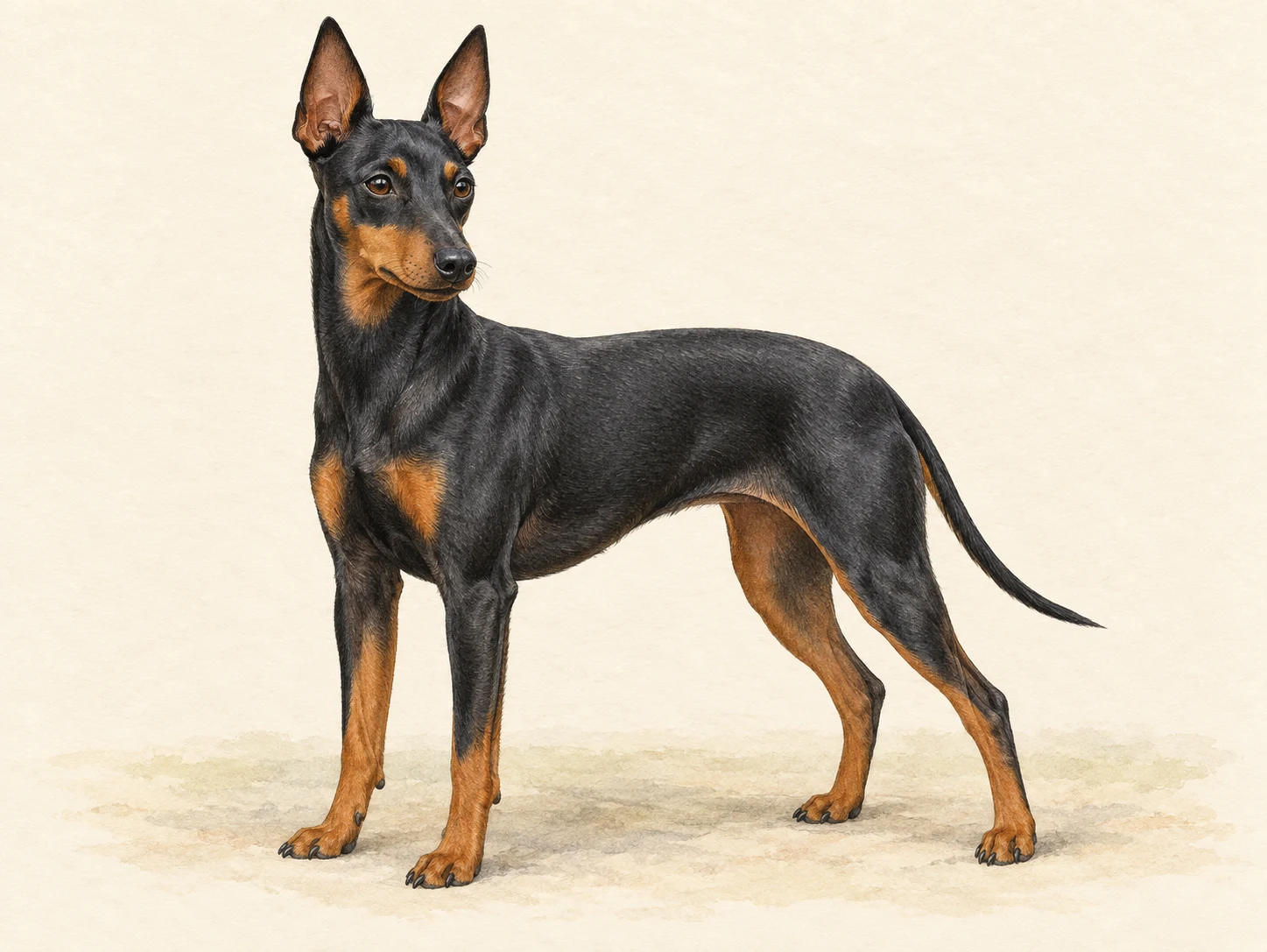
A Toy variety, not a miniature dog with different instincts
Under the AKC standard, a Toy Manchester weighs no more than 12 pounds and has naturally erect ears. Size and ear options distinguish it from the Standard variety; the standard does not describe a separate, less athletic temperament for Toys. For a prospective owner, the useful comparison is between the actual dogs and the care each needs. Ask to see how an adult responds to an ordinary walk and to quiet time afterward. If you already have a larger dog, plan introductions around compatible play and the ability to separate them, rather than assuming shared enthusiasm makes every interaction suitable. Small size can make transport easier, but it is not a substitute for checking carrier fit or teaching comfortable handling.[1]
Ask for the named JDCM result, not just “DNA tested”
The Canadian and American Manchester Terrier Clubs report that a genetic test is available for juvenile dilated cardiomyopathy in Toy Manchesters. An old description saying that researchers are still trying to develop a test should not end the conversation. Ask which condition was tested, which dog the certificate identifies and what the result means. Keep the laboratory name, sample date and result together so your veterinarian can interpret the record. A broad claim that a dog has been DNA tested does not answer whether this particular condition was included. The Royal Kennel Club’s March 2025 announcement also distinguishes clear, carrier and affected results for its JDCM and xanthinuria schemes. Those results address named inherited conditions; they are not an all-purpose certificate of lifelong health. Take unfamiliar or concerning findings to your veterinarian rather than deciding medical care from a result label alone.[3]
Plan life at floor level as well as outings in your arms
AKC describes an active dog that benefits from walks, play and positive training. A practical day should therefore include chances to explore and learn on the ground, not only accompany a person in a carrier. Practice one useful skill at a time, such as entering the travel carrier voluntarily, and reward progress without harsh corrections. Before leaving the dog with someone new, demonstrate the walking equipment and how to approach or lift the dog comfortably. A short coat makes grooming comparatively straightforward: AKC suggests weekly wiping or a hound glove and occasional baths. Use that time to notice changes and build cooperative handling. The aim is a small companion whose needs are understood, rather than one whose size makes its preferences easy to overlook.[2]
A JDCM certificate is only one part of the records
The American club’s February 2022 recommendations for Toys also cover autoimmune thyroiditis, Legg-Calve-Perthes disease, von Willebrand’s disease and type II xanthinuria. Its cardiac, eye and patella evaluations appear in a separate optional list. This distinction helps you ask a precise question: which named results exist for each parent, and which are missing? A JDCM DNA result should not be used to imply that an orthopedic evaluation or a different DNA test was performed. Keep copies with the dog’s identifying information and dates; let the breeder and veterinarian explain any unfamiliar terminology or finding. Confirm current club guidance before choosing a litter, because the published statement is dated 2022.[5]
Frequently asked questions
Is a genetic test for Toy Manchester juvenile cardiomyopathy available?
Yes. The Canadian and American Manchester Terrier Clubs report an available test. Request the named result and the dog’s identifying details rather than accepting an unspecified “DNA tested” claim; ask your veterinarian to interpret it.
Source [1]Can a Toy Manchester weigh exactly 12 pounds?
Yes. The AKC limit is no more than 12 pounds; the Standard variety starts above that weight. The boundary describes the varieties and should not be used as a reason to underfeed an individual dog.
Source [2]Does a clear JDCM result mean a puppy cannot have another health problem?
No. A clear result concerns the tested variant for that condition. It does not replace an examination, other appropriate screening or veterinary assessment of new symptoms.
Source [3]Does the Standard Manchester health checklist cover every Toy recommendation?
No. The club separates the varieties. Its 2022 Toy list includes JDCM, Legg-Calve-Perthes, thyroid, von Willebrand’s disease and type II xanthinuria checks. Ask for the Toy-specific list and identifiable reports rather than treating one DNA certificate as all screening.
Source [4]FAQ sources
- Canadian Manchester Terrier Club — Juvenile Dilated Cardiomyopathy ↗FAQ reference 1
- American Kennel Club — Manchester Terrier breed standard ↗FAQ reference 2
- Royal Kennel Club — JDCM and xanthinuria DNA testing schemes, March 2025 ↗FAQ reference 3
- American Manchester Terrier Club — health statement dated February 28, 2022 ↗FAQ reference 4
Sources & methodology
Breed-level measurements and comparison scores provide context. They do not predict an individual dog's health, behaviour or suitability. Open the original publisher pages below to verify the facts and compare any later updates.
- American Kennel Club — Manchester Terrier breed standard ↗Reference 1 · reviewed 2026-09-27
- American Kennel Club — Manchester Terrier (Toy) ↗Reference 2 · reviewed 2026-09-27
- Canadian Manchester Terrier Club — Juvenile Dilated Cardiomyopathy ↗Reference 3 · reviewed 2026-09-27
- Royal Kennel Club — JDCM and xanthinuria DNA testing schemes, March 2025 ↗Reference 4 · reviewed 2026-09-27
- American Manchester Terrier Club — health statement dated February 28, 2022 ↗Reference 5 · reviewed 2026-09-27
Make it about your dog
Build a profile around your dog's age, experiences and everyday needs.
Meet your dog →Explore local care