
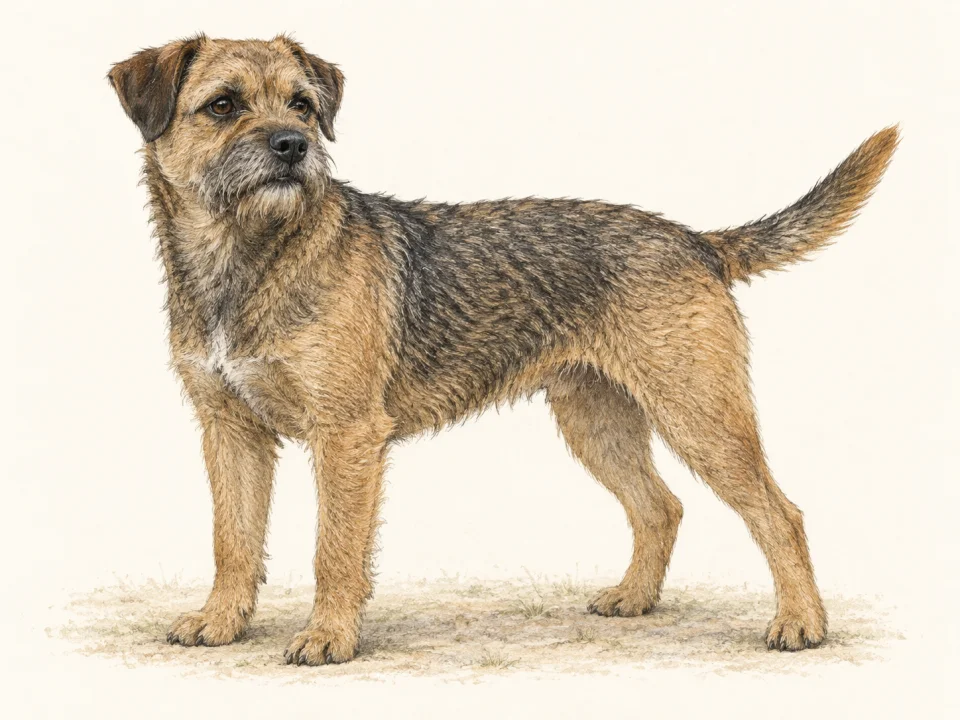
How long do Border Terriers live?
AKC gives a life expectancy of 12–15 years. Treat it as a breed reference rather than a personalized forecast. Reaching 12 does not mean a dog has only three years left, and being younger than 12 does not establish good health. If you are considering an adult Border Terrier, ask whether its age is documented or estimated and request its own care history; do not use the breed range to calculate remaining years.[1]
If your Border Terrier is getting older: prepare a useful conversation
Make a short note about your own dog before asking what its age means. Record the date and a concrete comparison with its usual routine: which part of a familiar walk it completed, whether meals were left unfinished, or whether settling at night changed. Include when the difference began and bring existing treatment records. This is a conversation aid, not a home test of life expectancy. Ask your veterinarian what should be assessed and what to monitor next; do not dismiss a new concern solely because the dog is within the published lifespan range.
Judge the terrier behind the compact body
AKC references males at 13–15.5 pounds and females at 11.5–14 pounds. The breed’s sturdy build and relatively long legs suit active exploring, not simply lap time. Ask about the individual’s routine and interests when planning a household fit. Measure before buying equipment, and keep body condition separate from trying to reach the top of a reference range.[1]
Inspect the lower fence line
Digging is a practical consideration for this terrier. Check loose soil and the base of gates as carefully as the fence height, and supervise a new dog’s use of the yard. Secure any weak area before allowing free movement. Teaching an alternative activity can help, but should not be treated as proof that an interesting smell beneath the boundary will be ignored.[1]
Do not confuse dog sociability with small-animal safety
A Border may get along with other dogs while still wanting to pursue a running cat or squirrel. Use a leash outside secure enclosures and assess introductions to household animals individually. Give small pets protected spaces. A friendly encounter or obedience lesson does not establish that every chase situation will be safe without supervision.[1]
Keep independent learning constructive
Use short reward-based lessons that explain a practical action clearly, such as exchanging an object or returning attention. Increase distractions gradually and expect to practise in different settings. Harsh correction is not a substitute for teaching. If a task fails during an exciting outing, make the next attempt easier rather than interpreting independent behavior as a reason to escalate pressure.[1]
Distinguish brushing from seasonal coat work
The hard outer coat lies over a softer undercoat. Routine brushing may be fairly light, but shedding periods require more attention to loose hair and appropriate stripping. Ask a breed-familiar groomer to demonstrate the method and tools before attempting a larger session. A wire texture should not be treated like a silky coat, and discomfort is a reason to stop and seek help.[1]
Which health records should you ask to see?
The AKC panel names patella, hip, cardiac and eye evaluations, plus a DNA test for spongiform leukoencephalomyelopathy (SLEM). Those are different assessments, not interchangeable versions of one “healthy dog” certificate. A SLEM result does not replace the other reports or predict lifespan.[1]
- Ask which dog each report describes: the puppy, its mother or its father. Save the identifying details and test date beside the result.
- Request the SLEM laboratory report, not only a statement that DNA testing was done. Ask the breeder and your veterinarian to explain the result and its relevance to the puppy.
- List the patella, hip, cardiac and eye documents individually. If one is missing, record “not provided” and ask why; do not silently turn missing information into a normal result.
- For an adopted adult with incomplete breeding records, request the available veterinary history and discuss what assessment is useful now. Do not make up ancestral results or assume missing paperwork rules out a suitable home.
Frequently asked questions
What is the lifespan of a Border Terrier?
AKC lists 12–15 years. This reference range does not predict an individual dog’s lifespan. Its history and current health matter when planning care.
Source [1]Can a Border Terrier that likes other dogs still chase cats?
Yes. Dog sociability does not remove hunting interest in smaller moving animals. Manage introductions and maintain secure control outdoors.
Source [1]Why should the bottom of a Border Terrier’s fence be checked?
Digging can create escape routes beneath an otherwise adequate fence. Inspect gates and loose ground regularly rather than relying only on height.
Source [1]Is ordinary brushing always enough for the wiry coat?
Routine care is relatively light, but seasonal loose hair may need appropriate stripping. Get a breed-familiar demonstration instead of improvising a technique that causes discomfort.
Source [1]Which DNA test appears in the recommended health panel?
The cited AKC panel lists SLEM testing, alongside patella, hip, cardiac and eye evaluations. Ask for identifiable results and professional interpretation when needed.
Source [1]FAQ sources
Sources & methodology
Breed-level measurements and comparison scores provide context. They do not predict an individual dog's health, behaviour or suitability. Open the original publisher pages below to verify the facts and compare any later updates.
- American Kennel Club — Border Terrier breed and care guidance ↗Reference 1 · reviewed 2026-10-03
Make it about your dog
Build a profile around your dog's age, experiences and everyday needs.
Meet your dog →Explore local care