
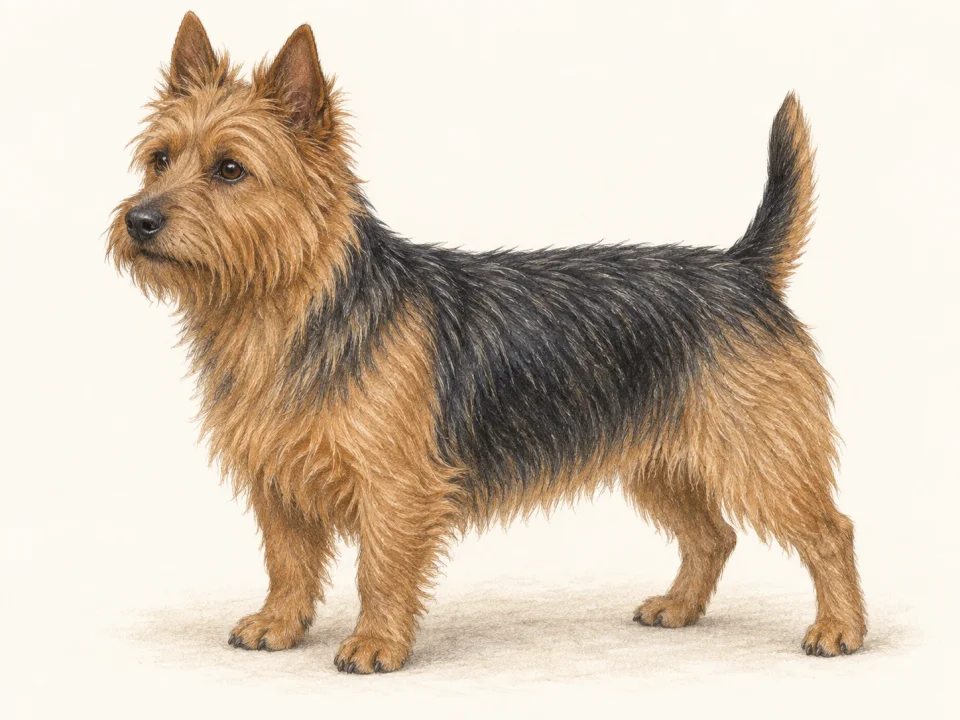
Small does not mean a passive companion
AKC lists the Australian Terrier at 10–11 inches and 15–20 pounds. Its longish body and rough coat distinguish it from simply imagining a miniature version of a larger working dog. Consider the daily schedule as well as dimensions: this is an active terrier that needs opportunities to investigate, play and learn rather than spend the whole day being carried.[1]
Protect the chase boundary
The breed retains a strong interest in small animals. Keep walks on leash and free play inside a secure enclosure, even when recall has gone well in easier conditions. Check gaps at ground level and how gates close. A sudden squirrel can change the situation faster than a handler expects, so training and a physical boundary should support each other.[1]
Keep lessons short enough to stay interesting
Australian Terriers can lose interest in repetitive drills. Teach a practical skill in a short rewarded session, then change activity while the dog is still engaged. Use the same cue consistently rather than making the task unpredictable. A toy exchange, waiting at the door or returning attention during a walk gives curiosity a shared purpose without demanding endless repetition.[1]
Introduce another dog deliberately
Do not assume a small, cheerful dog will welcome every new canine housemate. Assess the individuals, arrange supervised introductions and provide separate rest and feeding spaces when needed. Watch actual behavior rather than relying on breed reputation. A household should have a workable separation option before a new dog arrives, not only after the first difficult interaction.[1]
Keep the harsh coat practical and comfortable
Weekly brushing is the usual AKC baseline, with bathing when needed rather than a fixed frequent wash. Pay attention to hair around the eyes and ask a knowledgeable groomer about safe maintenance instead of improvising with tools close to the eye. Include nails and teeth in care sessions. Persistent itching or discomfort needs assessment rather than simply another bath.[1]
Ask for the listed records and wider history
AKC gives a lifespan reference of 11–15 years and recommends patella, eye and thyroid evaluations. Its health discussion also identifies Legg-Calve-Perthes disease as a topic for breeder questions. Request records linked to the tested dogs and discuss uncertainties with a veterinarian. A sturdy appearance and simple coat care do not prove that every inherited or future health issue has been excluded.[1]
Frequently asked questions
How big is an Australian Terrier?
AKC lists 10–11 inches in height and 15–20 pounds. Measure the individual for equipment and judge body condition separately from the reference range.
Source [1]Can an Australian Terrier run loose if it knows recall?
Use a leash outside secure enclosures. The breed’s chasing instinct can interrupt a practiced response, so recall training should not replace containment.
Source [1]Why does an Australian Terrier stop engaging in long training sessions?
The breed can become bored with repetition. Try shorter reward-based lessons with clear goals and manageable distractions rather than extending the same drill.
Source [1]Does the harsh coat need frequent bathing?
The cited guidance recommends weekly brushing and bathing when necessary. Ask for individual grooming advice if the skin is irritated instead of assuming more washing is the solution.
Source [1]FAQ sources
Sources & methodology
Breed-level measurements and comparison scores provide context. They do not predict an individual dog's health, behaviour or suitability. Open the original publisher pages below to verify the facts and compare any later updates.
- American Kennel Club — Australian Terrier breed and care guidance ↗Reference 1 · reviewed 2026-09-27
Make it about your dog
Build a profile around your dog's age, experiences and everyday needs.
Meet your dog →Explore local care