
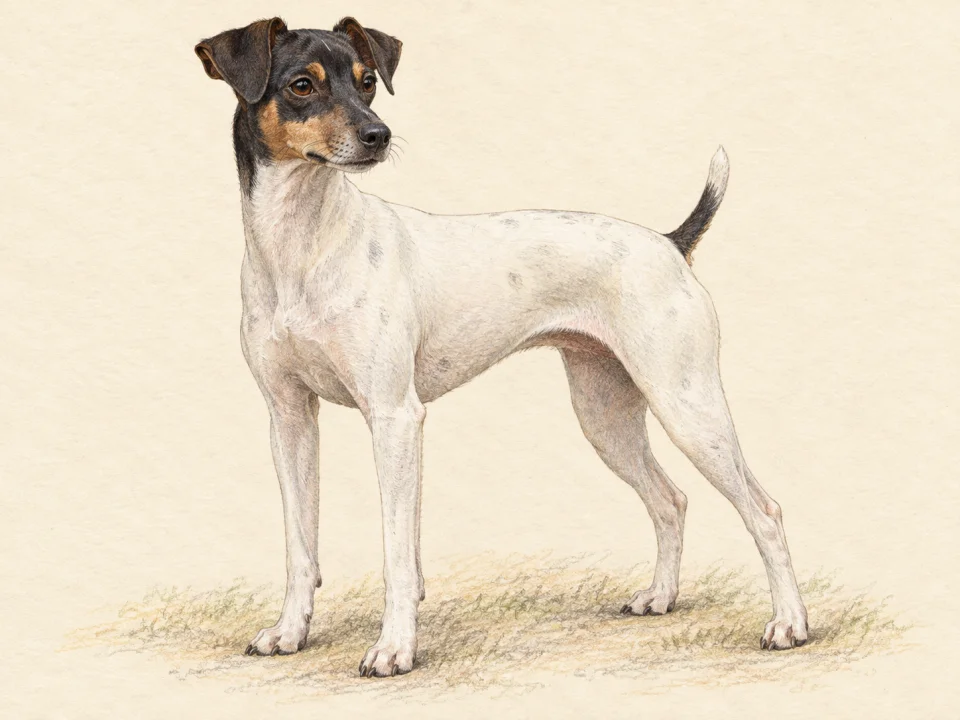
Recognize Nihon Teria without relying on a seller’s nickname
The FCI standard calls this breed Nihon Teria and describes its development in Japan, including its life as a lapdog in port cities such as Kobe and Yokohama. Its compact proportions are approximately square, with a smooth coat described as about 2 mm long. The head can combine black, tan and white, while the body is white with permitted markings. These details help distinguish the breed description from a vague advertisement for a small terrier. When comparing dogs, keep the registered name, the dog’s actual records and the seller’s informal description separate. A photograph resembling the standard does not verify parentage, health or the conditions in which a puppy was raised. Nor does a difference from a show description make a companion unworthy of a home.[1]
Check the doorway before planning off-leash adventures
AKC recommends a lead or fenced space because a Japanese Terrier may eagerly run off. That matters even when the dog is affectionate and attentive indoors. For a household considering this breed, a useful first exercise is to walk the route from the resting area to the outside: identify the door that opens straight to a street, the gate a visitor may leave open and the person responsible for securing each transition. This is a practical home check, not a test in which the dog is released to see what happens. Provide walks, play and opportunities to learn in a safe setting; AKC lists activities such as rally, obedience and agility, but participation should suit the individual. The short coat needs comparatively little grooming: AKC recommends weekly gentle brushing and baths as needed. Do not confuse a small coat-care commitment with a small overall care commitment. Time spent teaching routines and sharing activity still belongs in the adoption decision.[2]
Frequently asked questions
Is Nihon Teria another name for the Japanese Terrier?
Yes. The FCI uses Nihon Teria for the Japanese Terrier. Check the named breed and records rather than treating every small terrier advertised with a Japanese connection as the same breed.
Source [1]Can I assume a Japanese Terrier will stay nearby without a leash?
No. AKC advises a lead or a fenced area because the breed may run off. Familiarity at home is not proof of reliable recall near roads or other distractions.
Source [2]FAQ sources
- FCI — Japanese Terrier standard No. 259, 2016 ↗FAQ reference 1
- American Kennel Club — Japanese Terrier ↗FAQ reference 2
Sources & methodology
Breed-level measurements and comparison scores provide context. They do not predict an individual dog's health, behaviour or suitability. Open the original publisher pages below to verify the facts and compare any later updates.
- FCI — Japanese Terrier standard No. 259, 2016 ↗Reference 1 · reviewed 2026-09-27
- American Kennel Club — Japanese Terrier ↗Reference 2 · reviewed 2026-09-27
Make it about your dog
Build a profile around your dog's age, experiences and everyday needs.
Meet your dog →Explore local care