
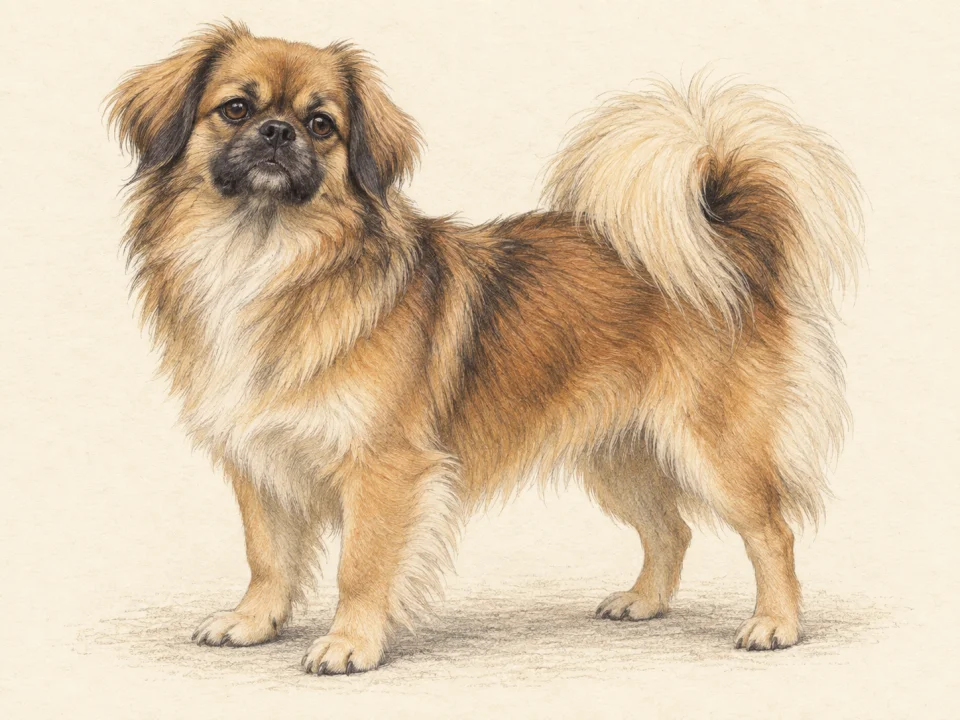
Provide a lookout that is safe to use
The breed club describes a dog that enjoys an elevated view as well as close contact with its people. Offer a stable, accessible resting place with a view rather than leaving an open window or an exposed balcony within reach. Check the route up and down, particularly for a puppy or older dog. If watching passersby becomes a repeated barking activity, provide a quieter alternative away from that view. The club describes a dog about ten inches tall and nine to fifteen pounds, but small size does not make rough handling acceptable. Teach children to invite interaction while seated and let the Tibbie move away; do not make being carried the default form of play.[1]
Comb the ear fringes, not just the visible back
AKC identifies the area behind the ears as a place that can mat, with the rear fringes also needing attention. During regular coat care, gently check those areas with a comb instead of judging the whole coat by its smooth-looking surface. Introduce handling of the feet and nail care in short, comfortable sessions early. The breed’s natural outline does not need an elaborate haircut, and it still sheds. Explain your intended coat care to a groomer rather than assuming a standard salon trim is appropriate. A small companion also needs activity and learning: choose walks, sniffing opportunities and brief enjoyable lessons around the individual’s comfort, not around an assumption that every Tibbie wants to jog.[2]
Keep eye examinations distinct from PRA3 DNA testing
The club’s published 2016 health statement lists specialist eye examination and patella evaluation as CHIC recommendations. It lists PRA3 DNA testing separately as optional, and recommends baseline bile-acid screening while explicitly saying that the latter is not definitive. This distinction is useful when reviewing a puppy’s paperwork: ask which result came from a physical examination, which from a genetic test, and which was a screening blood test. A PRA3 result is not a general certificate of normal eyes, and a bile-acid result should not be interpreted at home as a complete diagnosis. Confirm current recommendations with the club and your veterinarian, especially where older documents use earlier registry terminology.[3]
Frequently asked questions
Is a Tibetan Spaniel a sporting spaniel?
No. The American breed club describes it as a companion breed and records its AKC placement in the Non-Sporting Group. Its name should not be used to assume a gundog’s working role.
Source [1]Which coat areas need particular attention on a Tibbie?
Check behind the ears and the rear fringes for tangles. Regular gentle combing is more useful than judging the coat only by the surface along the back.
Source [2]Does a PRA3 DNA result replace an eye examination?
No. The club’s health statement lists the DNA test separately from the specialist eye examination. Ask your veterinarian to interpret the scope of each result.
Source [3]FAQ sources
- Tibetan Spaniel Club of America — About the breed ↗FAQ reference 1
- American Kennel Club — Tibetan Spaniel care ↗FAQ reference 2
- Tibetan Spaniel Club of America — Health recommendations, March 2016 ↗FAQ reference 3
Sources & methodology
Breed-level measurements and comparison scores provide context. They do not predict an individual dog's health, behaviour or suitability. Open the original publisher pages below to verify the facts and compare any later updates.
- Tibetan Spaniel Club of America — About the breed ↗Reference 1 · reviewed 2026-09-27
- American Kennel Club — Tibetan Spaniel care ↗Reference 2 · reviewed 2026-09-27
- Tibetan Spaniel Club of America — Health recommendations, March 2016 ↗Reference 3 · reviewed 2026-09-27
Make it about your dog
Build a profile around your dog's age, experiences and everyday needs.
Meet your dog →Explore local care