
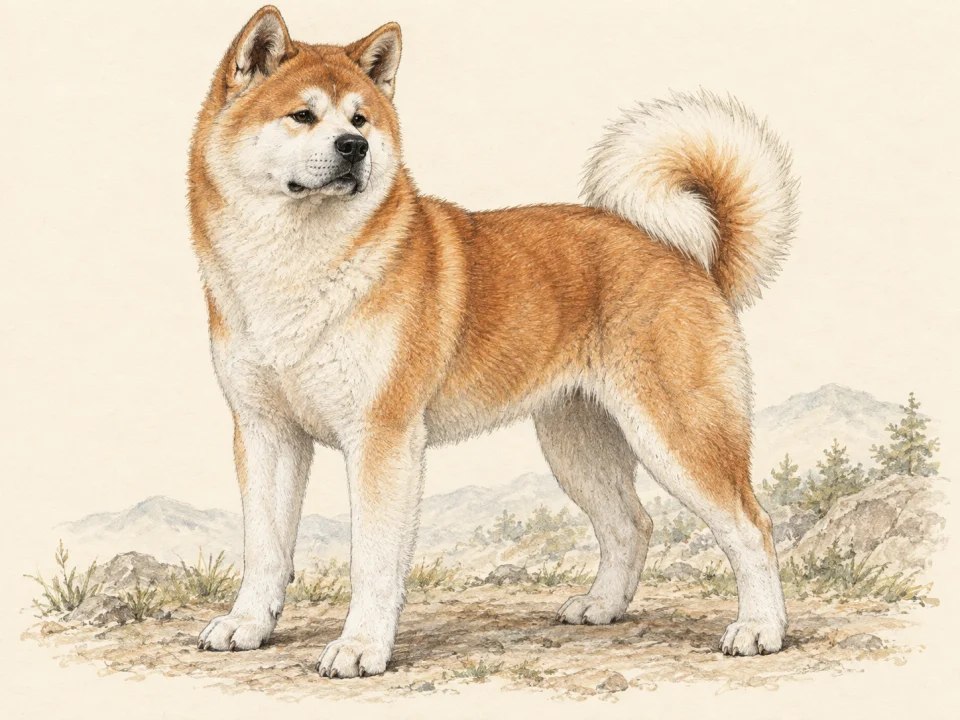
Check the name and the pedigree together
JACA explains that registries use the name Akita differently across countries. In the United States, AKC uses Japanese Akitainu for this breed and Akita for the American Akita. A description such as Japanese-style is not equivalent to a pedigree identifying the dog’s ancestry. If that distinction matters to your puppy search, request the parents’ registered names, registry and pedigree information before committing. For an imported dog, establish which naming system the paperwork follows. A coat color, an online photograph or a verbal claim that the parents were imported does not settle the question. If adopting a dog with unknown ancestry, keep that uncertainty explicit and assess the individual rather than forcing a definite breed label.[1]
Visitor greetings and dog introductions need room to decline
The breed standard describes reserve around strangers and notes that some Japanese Akitainu may not tolerate other dogs, particularly those of the same sex. This is a reason to plan introductions, not a prediction that every individual will behave alike. Arrange a quiet retreat before visitors arrive and prevent people from crowding or reaching over the dog. On a walk, leave enough distance to turn away from an approaching dog; a greeting is optional. For a household that already has animals, obtain an individual assessment and plan reliable separation rather than assuming a puppy will grow into universal sociability. The useful goal is calm behavior with safe distance, not accepting every person or playing with every dog.[2]
Prepare for the coat change before loose undercoat fills the house
AKC describes heavy seasonal undercoat shedding and recommends routine brushing, with more attention for long coats that can mat. Start with short, comfortable grooming sessions while the coat is manageable, and ask a groomer to demonstrate tools on the individual dog. During a heavy shed, check whether your normal brush is actually removing loose undercoat rather than passing over the top. Arrange professional help if the coat becomes tight or handling is difficult. Grooming practice is also training: AKC recommends positive, brief and varied lessons because repetitive sessions can lose this breed’s interest. Work on accepting a few brush strokes or a paw inspection, reward cooperation, then stop before it becomes a struggle.[3]
A useful health folder contains several kinds of evidence
JACA’s January 2025 statement recommends screening breeding dogs’ eyes, hips, thyroid, tooth enamel, patellas and elbows. The enamel test concerns an ACP4-gene mutation associated with amelogenesis imperfecta; it is not a general test for every dental problem. The statement calls for eye examinations annually through age six and every two years afterward, so look at the date as well as the result. It also discusses sebaceous adenitis and uveodermatologic syndrome, noting that genetic tests for those conditions were unavailable when the statement was written. Do not interpret a clear commercial DNA panel as excluding those diseases. Ask about family history alongside the identifiable screening reports, and have new skin, eye or other health changes assessed on their own merits.[4]
Frequently asked questions
Is a Japanese Akitainu the same breed as an American Akita?
They are distinguished as separate breeds in the registries described by JACA, although country-specific names can be confusing. In AKC usage, Japanese Akitainu and Akita are different names for the two. Check the registry and pedigree.
Source [1]Should a Japanese Akitainu meet every dog to become socialized?
No. The standard acknowledges that some individuals are intolerant of other dogs. Plan safe, controlled experiences at a comfortable distance rather than forcing greetings or assuming unrestricted group play will be suitable.
Source [2]Does a clear DNA panel mean the parents have completed all recommended screening?
No. JACA’s 2025 statement includes clinical eye, hip, thyroid, patella and elbow screening as well as the enamel DNA test. Each report answers a different question, and none guarantees a disease-free puppy.
Source [3]FAQ sources
Sources & methodology
Breed-level measurements and comparison scores provide context. They do not predict an individual dog's health, behaviour or suitability. Open the original publisher pages below to verify the facts and compare any later updates.
- Japanese Akitainu Club of America — identifying a Japanese Akitainu ↗Reference 1 · reviewed 2026-09-27
- American Kennel Club — Japanese Akitainu breed standard ↗Reference 2 · reviewed 2026-09-27
- American Kennel Club — Japanese Akitainu care and training ↗Reference 3 · reviewed 2026-09-27
- Japanese Akitainu Club of America — health statement approved January 24, 2025 ↗Reference 4 · reviewed 2026-09-27
Make it about your dog
Build a profile around your dog's age, experiences and everyday needs.
Meet your dog →Explore local care