
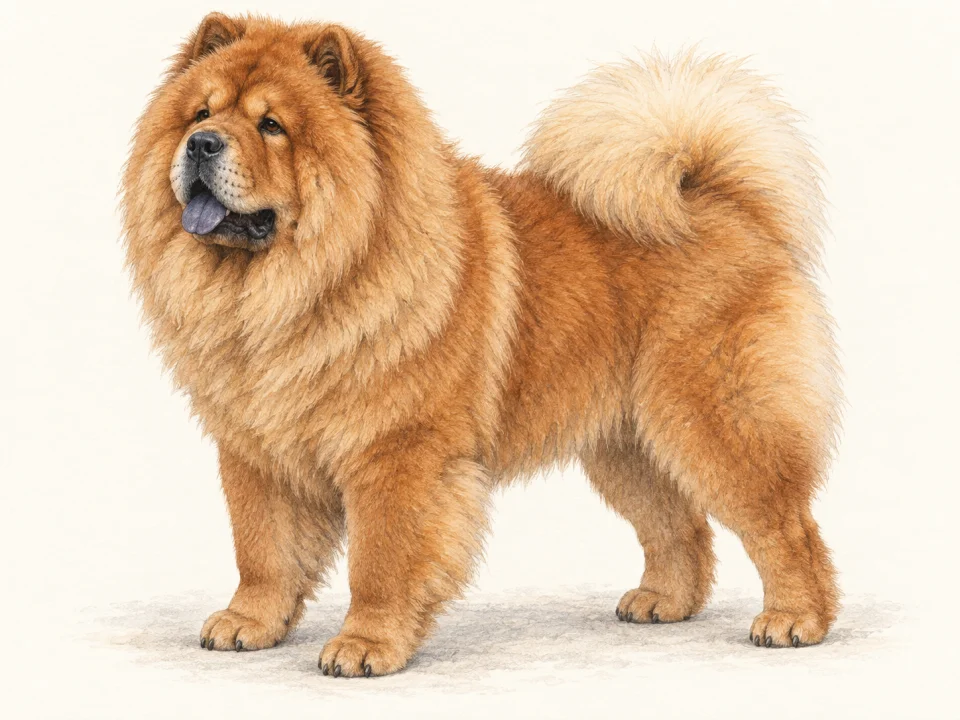
Respect reserve rather than demanding instant friendship
AKC describes loyalty to familiar people and aloofness with strangers. Let introductions proceed calmly and give the dog room to observe without being handled by everyone who admires its coat. Ask about the individual’s social experience before adoption. A dignified appearance cannot tell you how comfortable that dog will be with visitors, unfamiliar dogs or a crowded environment.[1]
Brush both coat varieties beneath the surface
Rough and smooth Chows both have dense double coats. AKC recommends thorough brushing at least twice weekly, with particular attention to areas prone to tangling such as the head and puppy coat. Have a groomer demonstrate comfortable access to the undercoat. Smoothing the outer hair alone can leave mats hidden beneath, so inspect systematically rather than judging completion from appearance.[1]
Include drying and handling in the grooming plan
The cited care guidance emphasizes thorough drying after baths. Before choosing a Chow, consider where washing and drying can be done comfortably and how the dog will learn to accept the process. Use short positive handling sessions between major grooming tasks. Nails, eyes and ears need regular attention too; an elaborate coat should not crowd those smaller checks out of the routine.[1]
Schedule moderate activity around weather
AKC cautions that Chows do not tolerate high heat and humidity well. Choose suitable walking conditions and moderate play, adjusting effort to age and health. Do not use the heavy coat or sturdy build as evidence that a dog can safely keep going in difficult weather. Ask your veterinarian about the individual’s limitations and respond to changes in comfort or tolerance.[1]
Make patience a training skill
The cited training guidance favors positive, consistent reinforcement and warns against harsh methods. Keep cues clear, reward an achievable response and practice regularly. If the dog does not respond, reassess difficulty, distraction and motivation instead of repeating a confrontation. All caregivers should follow the same rules for greetings and handling so independence is managed through predictable learning rather than escalating pressure.[1]
Request screening reports for joints, eyes and thyroid
AKC lists patella, hip, elbow, ophthalmologist and thyroid evaluations. Obtain the actual reports and discuss their meaning with a veterinarian. The health discussion also includes skin allergies, so a completed panel does not explain every possible concern. New irritation needs assessment rather than an automatic dietary change. The cited lifespan reference of 8–12 years is not a prediction for an individual.[1]
Frequently asked questions
Does a smooth-coated Chow need little brushing?
It still has a dense double coat. AKC recommends thorough brushing at least twice weekly for both varieties, reaching beneath the outer hair.
Source [1]Should strangers be encouraged to hug a reserved Chow?
No. Arrange calm introductions and allow space. Assess the individual’s comfort rather than expecting immediate physical contact.
Source [1]Can a Chow exercise normally in high heat and humidity?
The cited guidance warns of poor tolerance. Adapt outings to suitable conditions and individual health, and discuss limitations with your veterinarian.
Source [1]Which health evaluations appear in the cited panel?
Patella, hip, elbow, ophthalmologist and thyroid evaluations. Request identifiable reports and interpretation rather than a blanket assurance of health.
Source [1]FAQ sources
- American Kennel Club — Chow Chow breed and care guidance ↗FAQ reference 1
Sources & methodology
Breed-level measurements and comparison scores provide context. They do not predict an individual dog's health, behaviour or suitability. Open the original publisher pages below to verify the facts and compare any later updates.
- American Kennel Club — Chow Chow breed and care guidance ↗Reference 1 · reviewed 2026-09-27
Make it about your dog
Build a profile around your dog's age, experiences and everyday needs.
Meet your dog →Explore local care