
Choose companionship as part of the exercise plan
AKC describes Collies as active dogs that want to participate with their people. Suitable walks, secure play and learning tasks can provide a dependable routine. A yard helps with space but should not become long-term isolation; the cited guidance links boredom with barking. Ask how the individual spends time alone and what activity helps it settle comfortably afterward.[1]
Plan coat care for rough or smooth
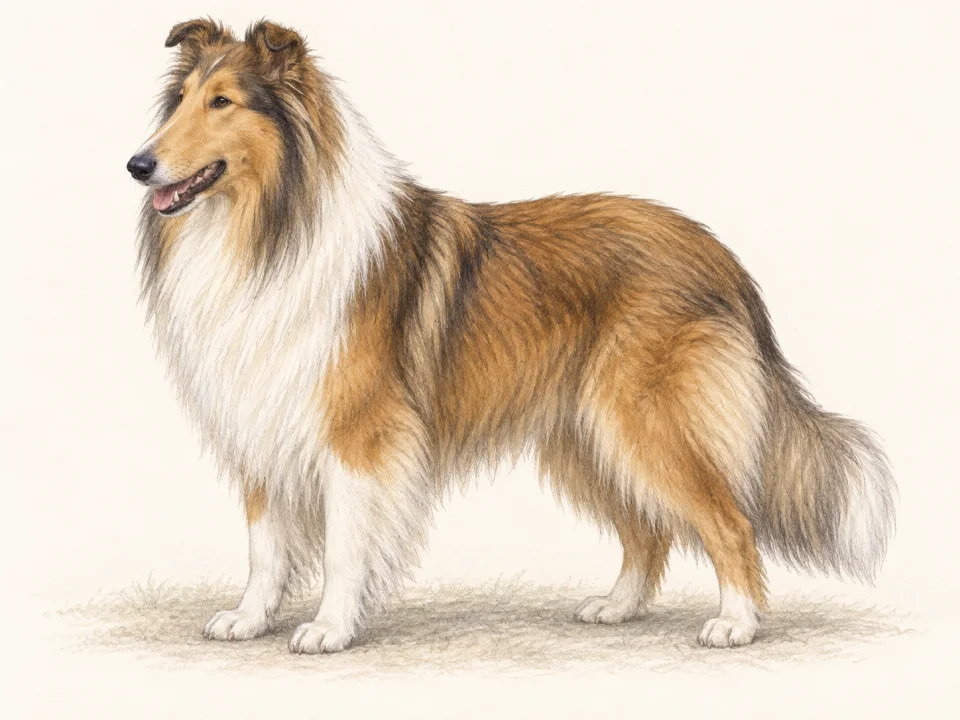
The rough variety needs thorough attention to prevent tangles, including behind the ears and around elbows. AKC describes weekly brushing down to the skin. Smooth Collies also have an undercoat and need regular brushing, particularly while shedding. Ask a groomer to demonstrate a comfortable method for the actual coat rather than choosing smooth solely on the assumption that maintenance disappears.[1]
Give a family reputation sensible boundaries
A Collie may enjoy family life, but adults still need to supervise interactions with children and provide undisturbed rest. Reference weights are 60–75 pounds for males and 50–65 for females, so an excited greeting can be physically significant. Teach calm approaches and manageable play. A favorable breed reputation cannot establish that every child-dog interaction will be comfortable or safe.[1]
Keep learning after puppy classes
The cited training guidance supports positive methods and continued learning beyond early classes. Select useful tasks, reward clear responses and gradually introduce distractions. Appropriate dog sports or searching games can offer variety, but household handling and recall deserve practice too. A quick learner still needs consistent information from different caregivers; intelligence is not a substitute for teaching what a cue means.[1]
Keep the MDR1 result available for veterinary decisions
AKC identifies medication sensitivity associated with MDR1 in some Collies. Ask about the individual’s testing and share the result with veterinary professionals before treatment decisions. Do not choose doses or discontinue prescribed care from breed information alone. Keeping an accessible copy with other records is more useful than assuming every Collie has the same sensitivity or that an appearance can establish genetic status.[1]
Separate puppy eye examinations from DNA reports
The cited guidance calls for an early specialist eye examination and lists DNA tests for PRA-rcd2, MDR1, DMS and CEA. Ask which examinations and tests were done, when, and for which dog. Have uncertain results interpreted professionally. A DNA report for one condition is not equivalent to examining the eyes, and the 12–14-year lifespan reference does not guarantee future health.[1]
Frequently asked questions
Does a smooth Collie avoid shedding and brushing?
No. Smooth Collies have an undercoat and need regular grooming, especially while shedding. Their routine differs from a rough coat but is not maintenance-free.
Source [1]Is yard access enough activity and company?
Not by itself. AKC emphasizes shared activity and warns against long periods relegated to the yard. Plan interaction as well as exercise space.
Source [1]What should I do with an MDR1 test result?
Keep it with the dog’s records and share it with veterinary professionals for treatment decisions. Do not change prescribed medication or doses on your own.
Source [1]Does a CEA DNA report replace the puppy eye examination?
No. The cited guidance discusses specialist eye examination and DNA screening separately. Ask for both kinds of relevant records and professional interpretation.
Source [1]FAQ sources
- American Kennel Club — Collie breed and care guidance ↗FAQ reference 1
Sources & methodology
Breed-level measurements and comparison scores provide context. They do not predict an individual dog's health, behaviour or suitability. Open the original publisher pages below to verify the facts and compare any later updates.
- American Kennel Club — Collie breed and care guidance ↗Reference 1 · reviewed 2026-09-27
Make it about your dog
Build a profile around your dog's age, experiences and everyday needs.
Meet your dog →Explore local care