
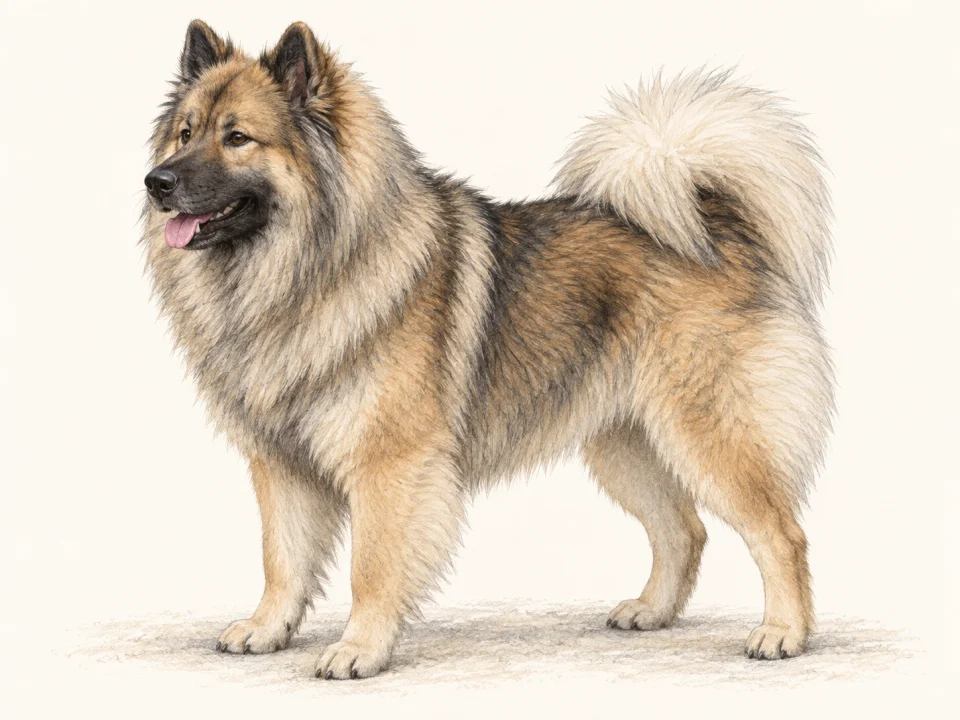
A companion breed needs a place in the household
The FCI standard traces the Eurasier’s development to crosses involving Chow Chow, Wolfspitz and later Samoyed, beginning in Germany in 1960. Its stated role is companionship, with close family contact and consistent, understanding training central to that role. The ancestry is useful history, but choosing an individual by assigning it imagined percentages of three breeds’ personalities is not useful. Instead, examine the routine you can offer: where the dog will spend the day, who shares care and how absences will be handled. A sheltered outdoor enclosure does not by itself provide a companion dog’s domestic life. For an adult placement, ask about its actual experience of time apart and new carers. A calm appearance during one meeting does not establish how it will cope with a different routine.[2]
Give introductions a goal other than being touched by everyone
AKC describes Eurasiers as potentially reserved with unfamiliar people and recommends gentle, positive training. For a household, a reasonable introduction goal is comfortable participation at the dog’s own pace, not a requirement to accept every stranger’s attention immediately. Agree with visitors that they will allow space and follow the handler’s instructions. Ask a trainer how to build pleasant, manageable experiences with people and normal surroundings. Do not label persistent fear or distress as merely a breed trait and leave it unaddressed; seek qualified help when needed. Conversely, a dog choosing quiet observation rather than enthusiastic greeting should not be forced into contact to prove that socialization has worked. Discuss the individual’s behavior and recovery in context rather than judging it by one greeting.[1]
Prepare for undercoat shedding before it starts
AKC describes a relatively modest bathing requirement alongside much heavier grooming during periods when the undercoat is shed. Those are different commitments: little odor does not mean little loose hair. Ask a groomer to show how to work through the coat comfortably and how to recognize areas needing more attention. Keep tools and a suitable place ready so care can be divided into manageable sessions when shedding increases. Record any tender areas or tangles you cannot safely address rather than repeatedly pulling at them. Include the coat under the tail and around the legs in the demonstration, not just the easily reached back. The individual’s coat and comfort determine the practical schedule; a calendar alone cannot tell you that grooming is complete.[1]
Frequently asked questions
Was the Eurasier developed as a working sled dog?
The FCI standard identifies it as a companion dog. Its ancestry includes several breeds, but ancestry should not be used to assign a different purpose or a fixed personality to an individual.
Source [1]Must a well-socialized Eurasier eagerly greet every stranger?
No. Comfortable behavior does not have to mean enthusiastic contact. Use gradual, positive experiences and get help for fear or distress instead of forcing greetings.
Source [2]Does infrequent bathing mean the Eurasier needs little brushing?
No. AKC describes additional grooming during undercoat shedding. Bathing frequency and the work of removing loose coat are separate considerations.
Source [2]FAQ sources
- FCI Standard No. 291 — Eurasier, 2020 English edition ↗FAQ reference 1
- American Kennel Club — Eurasier ↗FAQ reference 2
Sources & methodology
Breed-level measurements and comparison scores provide context. They do not predict an individual dog's health, behaviour or suitability. Open the original publisher pages below to verify the facts and compare any later updates.
- American Kennel Club — Eurasier ↗Reference 1 · reviewed 2026-09-27
- FCI Standard No. 291 — Eurasier, 2020 English edition ↗Reference 2 · reviewed 2026-09-27
Make it about your dog
Build a profile around your dog's age, experiences and everyday needs.
Meet your dog →Explore local care