
Define the job rather than relying on the word shepherd
The FCI describes a dog used to defend herds in the Carpathian mountains. That is not the same task as moving sheep through a course on a handler’s directions. Tell a breeder or rescue exactly what you need: a household companion, a dog living around stock, or a particular working role. Ask what experience the individual already has and which situations remain unfamiliar. In a household, decide how visitors and tradespeople can enter without an uncontrolled greeting. On a smallholding, identify where the dog can be safely separated during deliveries, veterinary work or the introduction of new animals. A history of guardian work does not make every dog ready for unsupervised responsibility on arrival. Arrange a gradual introduction with knowledgeable help rather than setting up a test and hoping instinct will supply all the answers.[1]
Judge adult condition beneath the coat
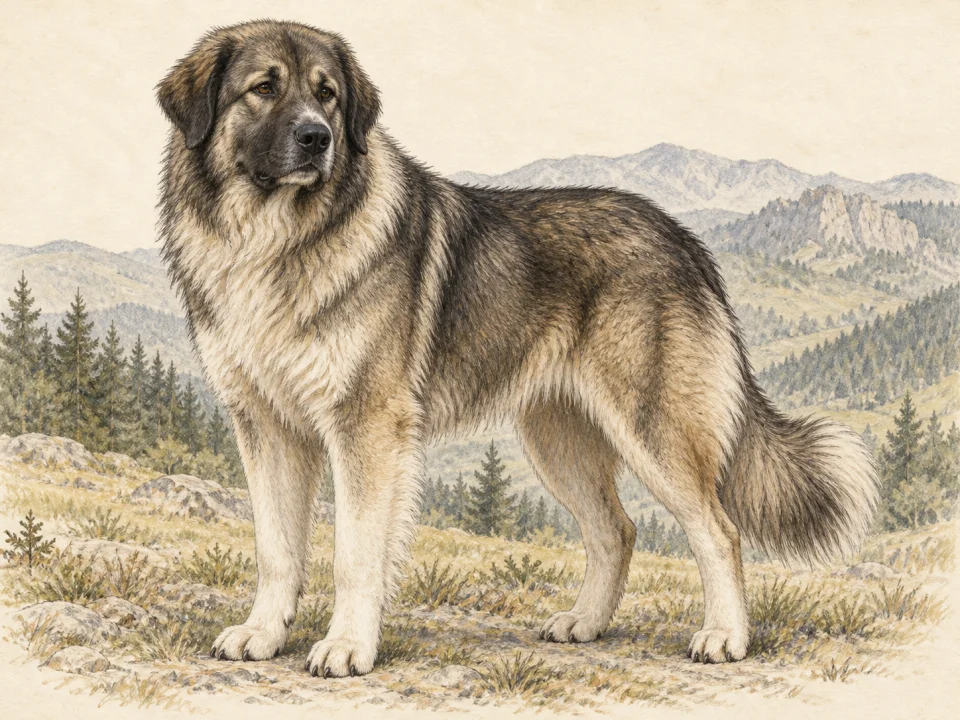
The 70–100-pound quick-facts range comes from AKC’s breed overview. The FCI standard instead sets weight in proportion to the dog’s size, with no numerical weight band. For height it gives ideals of 65–73 cm for males and 59–67 cm for females, each with a 2 cm tolerance. These distinctions matter when a seller uses a heavier adult as evidence of a better guardian. The FCI calls for a powerful dog that is not heavy; it does not prescribe one target weight for every adult. The dense undercoat and longer neck, leg and tail furnishings can obscure the outline in a photograph. Ask your veterinarian to show you how to assess body condition by touch and track changes alongside weight, rather than trying to make the dog match a promotional image. At grooming sessions, part the longer areas to check for tangles and trapped debris instead of brushing only the visible surface. Ask an experienced groomer to demonstrate a comfortable technique. If your dog finds a previously easy check painful or has a change in movement, arrange veterinary assessment rather than assuming a mountain breed should tolerate it.[1]
Ask for records instead of accepting a hardiness claim
The AKC profile describes the breed’s working environment and traditional care, but ancestry and historical survival are not individual health examinations. For a puppy, ask for the parents’ documented assessments, known family health problems and the puppy’s veterinary history. For an adult, request available treatment and vaccination records and arrange a veterinary review. Discuss a complete diet appropriate to the individual’s life stage with your veterinarian; a description of what working dogs historically ate is not a balanced feeding plan for your dog. Avoid buying on the promise that a naturally developed breed needs no screening or routine care. Where evidence is missing, identify the gap rather than converting it into a clean bill of health.[2]
Frequently asked questions
Does shepherd in the name mean it is primarily a flock-driving dog?
The FCI standard emphasizes defending livestock and guarding. Ask about the individual’s trained skills instead of inferring a particular herding task from the name.
Source [1]Does the FCI standard require every adult to reach a fixed weight?
No. It describes weight in proportion to size and a powerful but not heavy build. Use an individual body-condition assessment rather than a single number as a feeding target.
Source [1]Does a naturally developed working background prove freedom from inherited disease?
No. That history does not establish an individual dog’s health. Request documented findings and family history, and discuss appropriate assessment with your veterinarian.
Source [2]FAQ sources
Sources & methodology
Breed-level measurements and comparison scores provide context. They do not predict an individual dog's health, behaviour or suitability. Open the original publisher pages below to verify the facts and compare any later updates.
- Fédération Cynologique Internationale — Romanian Carpathian Shepherd standard, 2015 ↗Reference 1 · reviewed 2026-09-27
- American Kennel Club — Romanian Carpathian Shepherd breed information ↗Reference 2 · reviewed 2026-09-27
Make it about your dog
Build a profile around your dog's age, experiences and everyday needs.
Meet your dog →Explore local care