
Translate guardian independence into household preparation
AKC describes a dog developed to watch livestock without continuous human direction. In a companion home, that history is a reason to teach the routines you need, not to assume the dog already understands them. Decide how arrivals, deliveries and visits will work before relying on a large dog’s judgment at the gate. Provide a secure place to wait and use controlled introductions with help when needed. If a dog struggles with a situation, record what happened and discuss it with a qualified trainer rather than attributing every response to stubbornness. Outdoor space also needs a workable boundary and supervision plan. The question for a prospective owner is whether these routines can be maintained by everyone who cares for the dog. A calm first meeting is useful information about that moment; it does not answer every future handling question.[1]
Check the coat and every nail, including the rear dewclaws
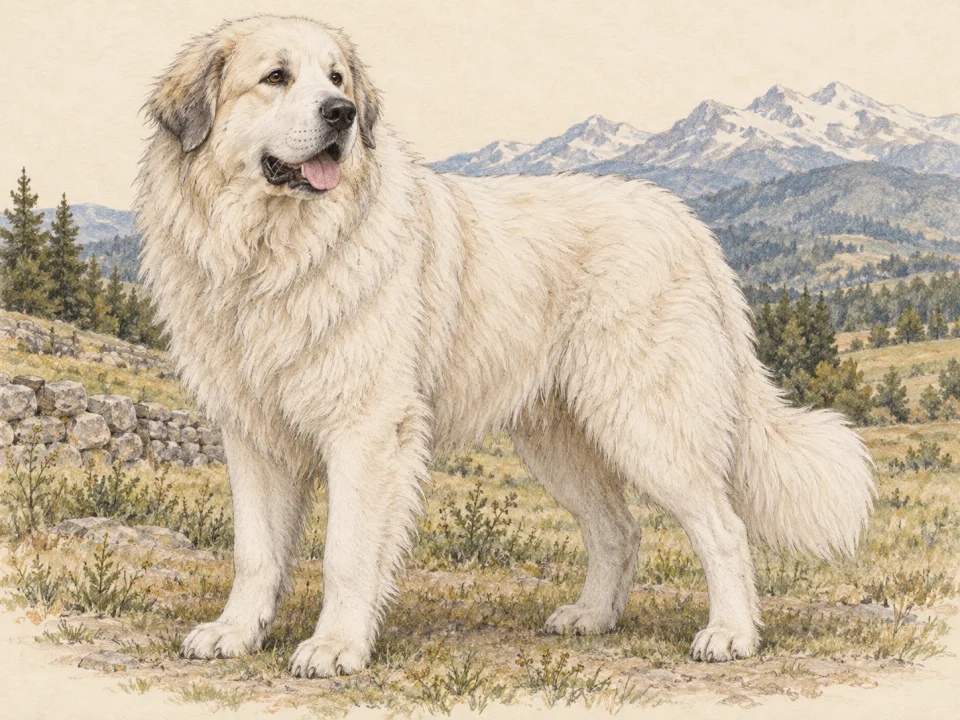
The standard describes double dewclaws on each rear leg as a breed characteristic, along with a dense undercoat beneath the longer outer hair. Include those extra nails in your grooming inspection and ask a veterinarian or groomer to demonstrate their care. Do not assume that walking has taken care of every nail. Work through the coat gently rather than judging its condition from the white surface alone; the neck ruff and feathering need attention too. Gray, badger and tan markings are allowed by the standard, so color patches do not by themselves make a dog uncharacteristic of the breed. When discussing body condition, feel and assess the individual with veterinary guidance: the standard itself notes that coat can disguise the bone and muscle beneath it. A fuller silhouette is not evidence that more weight is desirable.[2]
Ask which additional health assessment was performed
The GPCA’s February 2022 statement describes hip and patella evaluations plus one assessment from an additional list for CHIC eligibility. That list includes several different clinical or genetic assessments. A statement that a dog completed the scheme therefore does not tell you which additional test was chosen. Request the actual dated reports for both parents and ask the club about current requirements. The same letter separately strongly recommends testing for neuronal degeneration and dwarfism; keep those recommendations distinct from the eligibility rules stated in that document. This distinction makes a breeder discussion concrete: identify the tests completed, their results and any remaining questions, with a veterinarian’s help where interpretation is needed.[3]
Frequently asked questions
Are double dewclaws on the rear legs unusual for a Great Pyrenees?
They are described as a normal breed characteristic in the AKC standard. Include them in nail-care checks and ask for a demonstration of safe maintenance.
Source [1]Does the 2022 GPCA health scheme mean every optional test was completed?
No. The statement describes one additional test from a list, alongside hip and patella evaluations. Read the individual reports and verify current guidance rather than assuming all listed tests were done.
Source [2]FAQ sources
- AKC Official Standard — Great Pyrenees ↗FAQ reference 1
- Great Pyrenees Club of America — Health Statement, February 2022 ↗FAQ reference 2
Sources & methodology
Breed-level measurements and comparison scores provide context. They do not predict an individual dog's health, behaviour or suitability. Open the original publisher pages below to verify the facts and compare any later updates.
- American Kennel Club — Great Pyrenees ↗Reference 1 · reviewed 2026-09-27
- AKC Official Standard — Great Pyrenees ↗Reference 2 · reviewed 2026-09-27
- Great Pyrenees Club of America — Health Statement, February 2022 ↗Reference 3 · reviewed 2026-09-27
Make it about your dog
Build a profile around your dog's age, experiences and everyday needs.
Meet your dog →Explore local care