
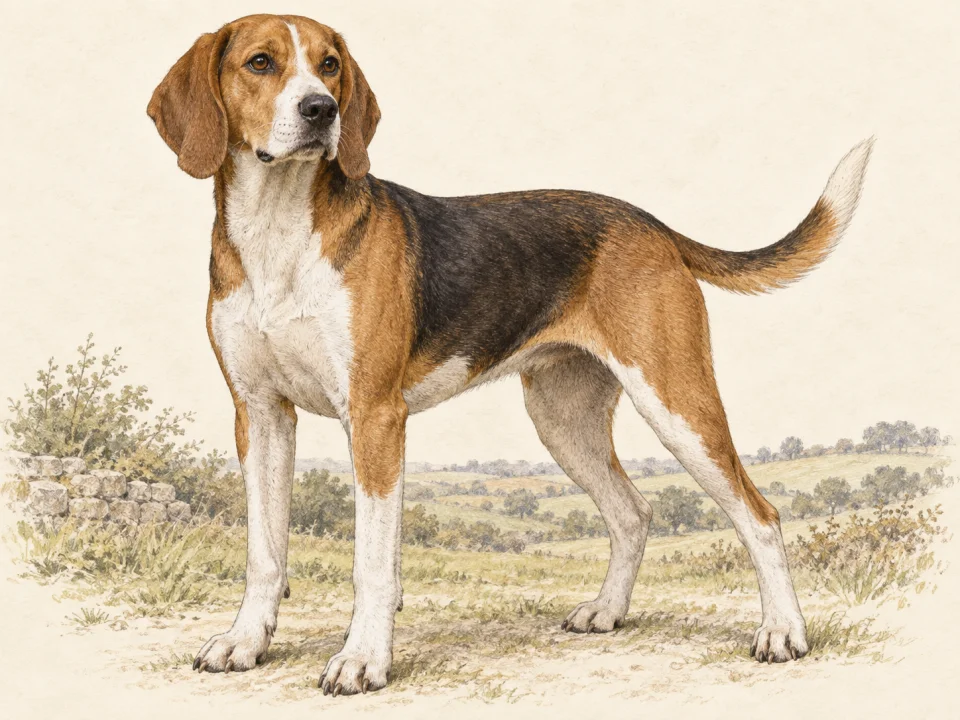
Pack compatibility is part of the history, not an introduction shortcut
The AKC standard emphasizes a hound able to work close to other dogs, with endurance valued over sheer speed. That helps explain why the Harrier should be assessed as a working pack breed rather than simply a Beagle in a bigger body. It does not mean every individual can immediately share a home with every resident dog. Ask about prior group living, supervised meetings and any situations that have caused tension. Arrange separate resting and feeding spaces while learning how the dogs interact. A breed standard describes an ideal; it is not a behavioral assessment of the dog in front of you. The same distinction applies to build: the standard calls for strength without heaviness, so increasing weight is not a way to improve a pet’s working appearance. Have condition assessed for the individual.[1]
Choose a routine that gives the nose something to do safely
AKC describes a dog bred for hours of following quarry and recommends leash walks and securely fenced off-leash areas. Build the routine around shared activity you can maintain, with suitable scent-based learning or supervised sport if it interests you. Discuss conditioning before demanding work instead of copying a hunting day into a pet’s schedule. On a walk, decide where the dog may investigate and where a closer position is necessary, then teach those transitions patiently. A familiar route is not automatically safe without a leash when wildlife can appear. Coat maintenance is comparatively straightforward: AKC suggests weekly brushing with a soft brush or hound glove, alongside ear and nail care. Keep those inspections in the routine after activity so a sore area does not go unnoticed beneath the assumption that a short coat needs no attention.[2]
Keep the health letter’s age visible in your questions
The club statement dated October 2014 names hip and eye assessments for its CHIC requirements at that time. Treat it as a documented starting point, and confirm current criteria with the club or OFA rather than assuming old terminology and requirements have stayed unchanged. Ask for the actual parental reports, their dates and identifying details. A short statement that the parents were tested leaves the findings unclear. Discuss any uncertain result with a veterinarian and keep the available family history with the puppy’s records; these documents inform decisions but cannot promise lifelong health.[3]
Frequently asked questions
Is speed the Harrier standard’s main working priority?
The AKC standard explicitly gives endurance more importance than pure speed. That describes working function, not a prescribed distance for every pet.
Source [1]Can a Harrier be loose on walks because it is friendly with people?
Friendliness does not establish reliability around quarry. AKC recommends leash walks and securely fenced areas for off-leash activity.
Source [2]FAQ sources
- AKC Official Standard — Harrier ↗FAQ reference 1
- American Kennel Club — Harrier ↗FAQ reference 2
Sources & methodology
Breed-level measurements and comparison scores provide context. They do not predict an individual dog's health, behaviour or suitability. Open the original publisher pages below to verify the facts and compare any later updates.
- AKC Official Standard — Harrier ↗Reference 1 · reviewed 2026-09-27
- American Kennel Club — Harrier ↗Reference 2 · reviewed 2026-09-27
- Harrier Club Health Statement — October 2014 ↗Reference 3 · reviewed 2026-09-27
Make it about your dog
Build a profile around your dog's age, experiences and everyday needs.
Meet your dog →Explore local care