
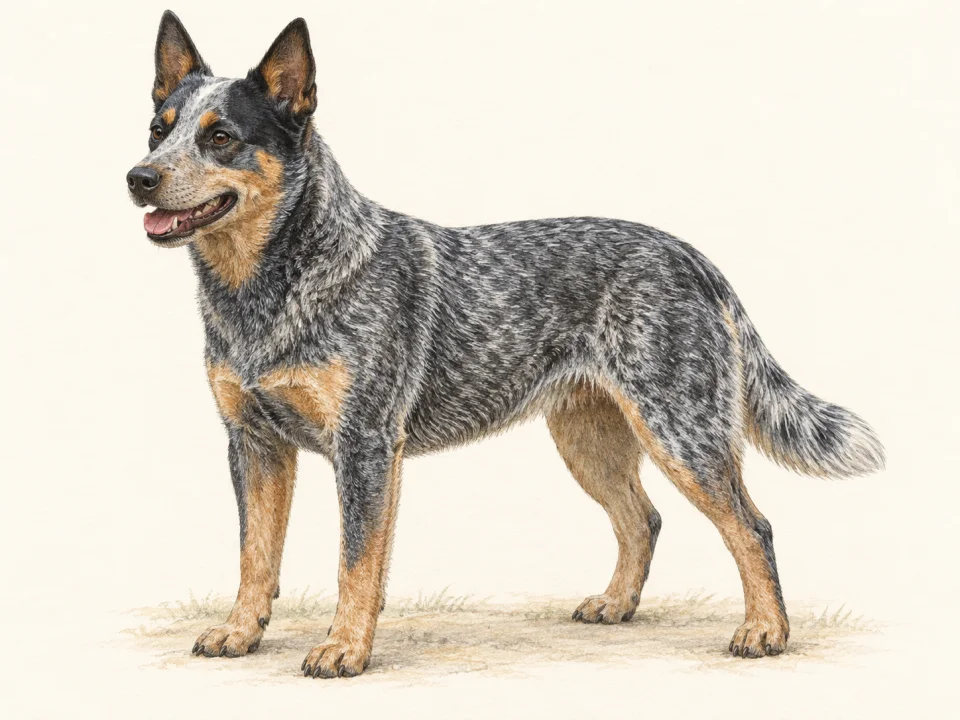
Blue and Red Heeler describe the same breed
Blue Heeler, Red Heeler and Queensland Heeler are names used for the Australian Cattle Dog. They do not describe separate activity levels or automatically different temperaments. AKC lists males at 18–20 inches, females at 17–19 inches, and a weight range of 35–50 pounds. Judge suitability from the dog’s history and needs rather than selecting solely by coat color.[1]
A brief walk rarely describes the whole commitment
The breed’s working drive calls for sustained engagement. Consider appropriate training or dog activities alongside physical exercise, with demands matched to development and health. Write down who provides the routine on workdays and when plans change. Do not choose a puppy on the assumption that a yard and occasional long outings will automatically provide a satisfying substitute for a working schedule.[1]
Teach attention before movement becomes exciting
Practise orienting to the handler, waiting and returning for a reward in a quiet setting. Add movement and other distractions gradually while maintaining a safe boundary. A dog bred to respond to livestock motion may need thoughtful management around fast-moving household activity. Supervise children and other pets, and interrupt difficult situations by changing the setup rather than rehearsing a chase.[1]
Give intelligence a clear learning structure
A capable learner still needs consistent cues and achievable steps. Choose a useful skill, reward the desired action and raise the challenge gradually. Include rest as part of the routine so engagement does not become a demand for endless activity. If progress stalls, assess the task and setting before labeling the dog stubborn or simply adding more physical exercise.[1]
Expect seasonal work from the smooth double coat
Weekly brushing generally handles routine coat care, but the undercoat sheds heavily at seasonal changes. Increase brushing then and work through the coat rather than only smoothing the surface. Check feet and nails after active outings. A tough working appearance does not make discomfort irrelevant; a change in gait or reluctance to be handled needs separate attention.[1]
Ask about hearing as well as visible health
AKC lists a lifespan of 12–16 years. Recommended screening includes hips, elbows, eye examination, BAER hearing testing and DNA tests for primary lens luxation and PRA-prcd. Request dated records tied to the tested dogs. A puppy reacting to a household noise is not equivalent to a documented hearing assessment, and clear results do not rule out every future illness.[1]
Frequently asked questions
Are Blue Heelers and Red Heelers different breeds?
Both names refer to Australian Cattle Dogs, describing coat color. Color alone does not establish an individual’s temperament or exercise needs.
Source [1]Is a short daily walk enough for an Australian Cattle Dog?
The cited AKC guidance describes a high-drive working dog needing more engagement than a brief walk and yard time. Plan suitable mental and physical activities matched to age and health.
Source [1]What hearing test should an Australian Cattle Dog breeder provide?
Ask about BAER testing, alongside the recommended joint, eye and DNA screening. A casual response to sound at home is not the same as a documented hearing assessment.
Source [1]Does the smooth coat mean little shedding?
No. The breed has a double coat and sheds its undercoat seasonally. Weekly routine brushing generally needs to increase during those periods.
Source [1]FAQ sources
Sources & methodology
Breed-level measurements and comparison scores provide context. They do not predict an individual dog's health, behaviour or suitability. Open the original publisher pages below to verify the facts and compare any later updates.
- American Kennel Club — Australian Cattle Dog breed and care guidance ↗Reference 1 · reviewed 2026-09-27
Make it about your dog
Build a profile around your dog's age, experiences and everyday needs.
Meet your dog →Explore local care