
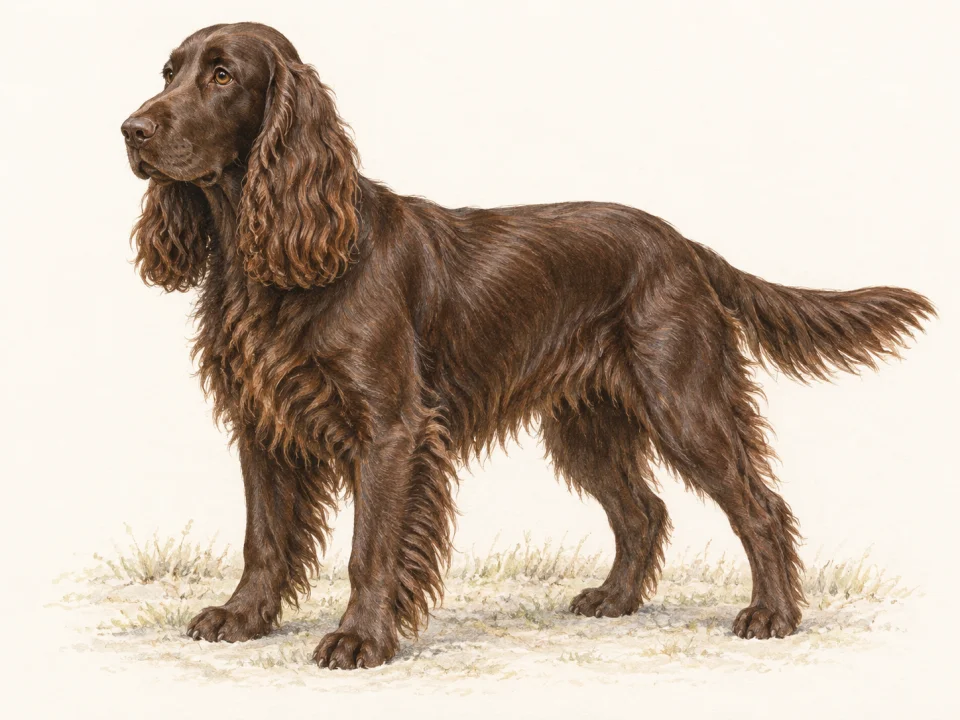
Preserve a practical coat rather than adding a spaniel haircut by default
The Field Spaniel standard describes a single coat with moderate feathering and trimming that keeps a natural appearance. It explicitly regards excessive coat that would hinder field work as undesirable. This is useful context when booking grooming: do not assume the same styling routine applies to every spaniel. Explain that the dog is a Field Spaniel and ask what brushing, combing and limited tidying are appropriate for its actual coat. After an outing, attend to the feathering on the underside and legs as well as the back; agree with the groomer on how to handle tangles you cannot comfortably remove. The standard’s ideal height is 18 inches for males and 17 for females, with a one-inch allowance either way. Those figures describe breed proportions, not a reason to overlook the individual’s reach, coat condition or ability to tolerate a grooming session.[2]
Use food motivation to clarify a lesson, not to lengthen it
AKC notes the breed’s enthusiasm for food and responsiveness to reward. That can help an owner make the desired behavior clear, but a supply of treats is not a complete training plan. Choose one observable response to practice, decide what will earn the reward and finish while the dog can still participate comfortably. If several people train or feed the dog, agree on how rewards fit into the daily food plan with veterinary guidance. This avoids each person assuming that someone else has accounted for the extras. AKC also describes both activity and downtime as part of life with a Field Spaniel. A reputation for being docile does not substitute for suitable outings or learning opportunities. Ask a breeder or rescue to describe the individual’s ordinary day and response to unfamiliar situations, rather than expecting the word “gentle” to predict every interaction. Use considerate, reward-based instruction and get help with persistent fear, discomfort or confusion.[1]
Frequently asked questions
Does the Field Spaniel have the same coat type as every other spaniel?
No. Its standard explicitly describes a single coat, with moderate feathering and a natural appearance. Discuss breed-appropriate maintenance with the groomer rather than assuming a generic spaniel clip.
Source [1]Are 17 and 18 inches strict limits for Field Spaniel height?
They are ideal heights in the standard: 17 inches for females and 18 for males. The standard accepts a one-inch deviation either way.
Source [1]Does a docile Field Spaniel still need active time?
Yes. AKC describes an active sporting breed that benefits from physical activity and mental engagement as well as time relaxing with the family.
Source [2]FAQ sources
- Official Field Spaniel Standard, effective June 2020 ↗FAQ reference 1
- American Kennel Club — Field Spaniel ↗FAQ reference 2
Sources & methodology
Breed-level measurements and comparison scores provide context. They do not predict an individual dog's health, behaviour or suitability. Open the original publisher pages below to verify the facts and compare any later updates.
- American Kennel Club — Field Spaniel ↗Reference 1 · reviewed 2026-09-27
- Official Field Spaniel Standard, effective June 2020 ↗Reference 2 · reviewed 2026-09-27
Make it about your dog
Build a profile around your dog's age, experiences and everyday needs.
Meet your dog →Explore local care