
Cooperation is something to develop, not something to skip teaching
The FCI standard describes a dog that keeps contact with the hunter and warns against forceful training. Neither statement proves that a puppy already understands your recall cue. Start by observing what the individual knows, then teach the response you need in a manageable setting. For a new owner, useful questions for an instructor are how to reward checking in, how to introduce distractions and when physical management remains necessary. A field instinct and a learned household cue are different things. Choose an instructor who can explain the steps without relying on harsh handling, rather than assuming the breed’s reputation will compensate for an unclear lesson.[2]
Agree on what happens after the doorbell
AKC describes announcing visitors as part of the breed’s farm role and notes initial reserve with strangers. Make a household arrival plan before inviting everyone to meet the dog at once: who answers the door, where the dog waits and how an introduction begins. A calm place to observe can make that sequence more manageable than a crowded doorway. This is a practical arrangement to discuss with a trainer, not a guarantee that every Drent has the same response. Ask the breeder or rescue about the particular dog’s experience with visitors. Being described as a family companion does not replace supervision or give guests permission to force contact.[1]
Use the coat description to plan an after-outing check
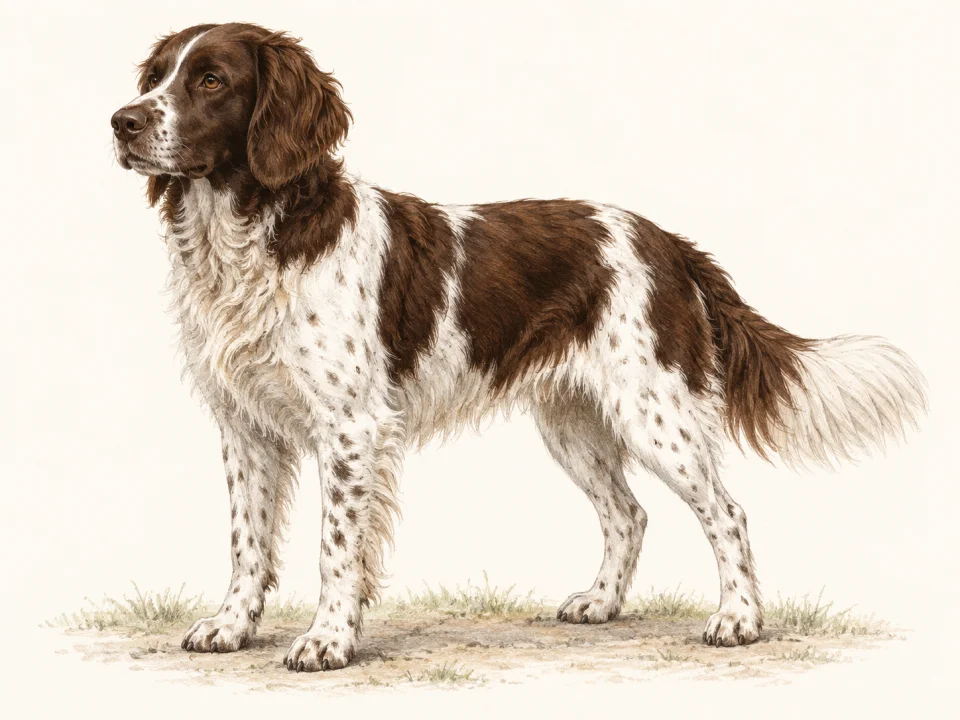
The FCI standard describes undercoat and longer feathering around the ears, legs and tail; the apparent long-haired outline does not mean every body area has the same length. After an outing, inspect those feathered areas and the feet rather than brushing only the easy surface along the back. Ask an experienced groomer to demonstrate comfortable care and identify what should be handled professionally. For equipment planning, use the standard’s sex-specific size references and then measure the individual: males are listed at 30–35 kg and females at 25–31 kg. Reference ranges are useful context, but the dog’s actual fit and condition determine practical decisions about a harness, transport and ongoing care.[2]
Frequently asked questions
Does a Drent’s tendency to work with a hunter mean recall needs no teaching?
No. A working tendency does not establish understanding of your cue. Teach and practice the response, and use appropriate management around distractions.
Source [1]Should a Drent be expected to greet all visitors immediately?
No. AKC describes initial reserve and a tendency to announce arrivals. Ask about the individual and arrange gradual, controlled introductions.
Source [2]Does the FCI standard describe a single coat?
It explicitly describes an undercoat beneath the body coat, with feathering in several areas. Plan grooming around the actual coat and get a comfortable technique demonstrated.
Source [1]FAQ sources
- FCI Standard No. 224 — Drentsche Patrijshond, 2016 ↗FAQ reference 1
- American Kennel Club — Drentsche Patrijshond ↗FAQ reference 2
Sources & methodology
Breed-level measurements and comparison scores provide context. They do not predict an individual dog's health, behaviour or suitability. Open the original publisher pages below to verify the facts and compare any later updates.
- American Kennel Club — Drentsche Patrijshond ↗Reference 1 · reviewed 2026-09-27
- FCI Standard No. 224 — Drentsche Patrijshond, 2016 ↗Reference 2 · reviewed 2026-09-27
Make it about your dog
Build a profile around your dog's age, experiences and everyday needs.
Meet your dog →Explore local care