
Meet the individual behind the retriever label
AKC describes a loyal dog that can be reserved rather than immediately outgoing with strangers. Do not assume every retriever will enjoy the same crowded social routine. Ask about the individual’s response to visitors, unfamiliar dogs and new environments. Arrange calm introductions and allow space, while maintaining clear handling rather than expecting friendly intentions to solve every meeting.[1]
Turn retrieving into cooperation
Teach bringing an appropriate object toward you, exchanging it and waiting for the next cue in an uncomplicated setting. These practical steps can make a shared game more manageable than repeated uncontrolled chasing. The breed has a strong working background, so combine suitable physical activity with attention and learning. Choose sessions appropriate to the dog’s condition instead of maximizing repetitions.[1]
Do not confuse a water-resistant coat with water safety
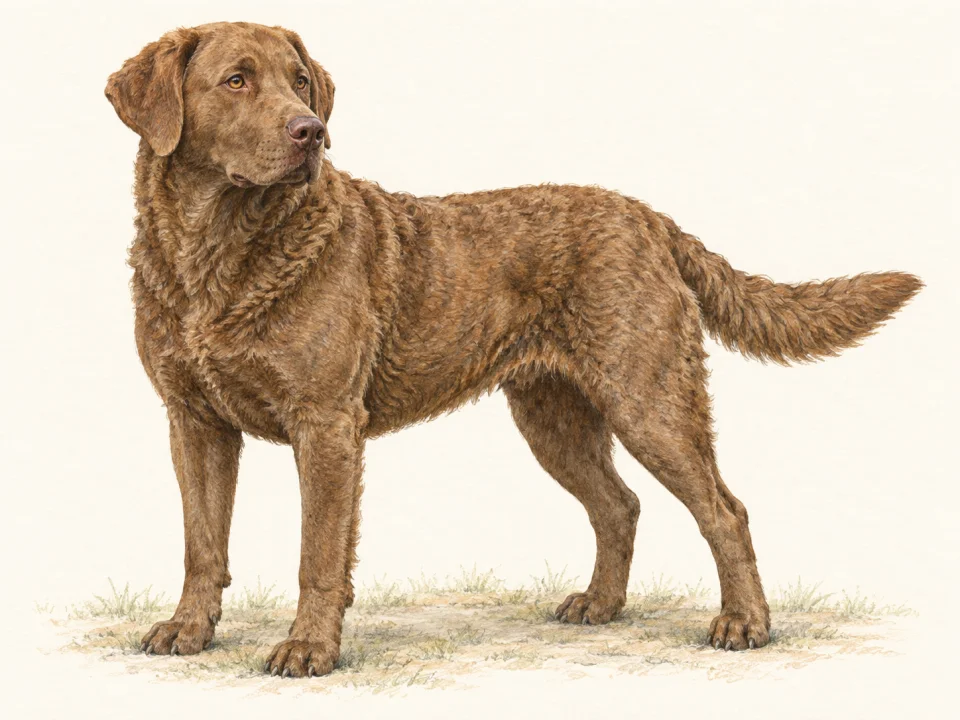
The characteristic oily, wavy coat supports the breed’s water-working background, but it cannot establish that a particular outing is safe. Assess conditions, provide suitable access and an easy exit, and supervise the individual. Learn its experience and fitness before increasing difficulty. Enthusiasm for entering water does not remove the need to monitor effort and end an unsuitable session.[1]
Keep the double coat on a simple care schedule
AKC describes a harsh outer layer over a soft undercoat and recommends roughly weekly brushing. The breed sheds despite the relatively short coat. Use routine care to notice debris or uncomfortable areas after outings, and include nails, ears and teeth. Ask for advice about appropriate bathing rather than treating the coat’s natural feel as something that must be repeatedly scrubbed away.[1]
Plan around a substantial athletic adult
The cited reference gives males at 65–80 pounds and females at 55–70 pounds. Before choosing a Chessie, consider who will manage everyday walks, transport and care during an injury or disrupted schedule. Build a weekday plan with meaningful activity and recovery. Being able to fit the dog in a vehicle is only one part of accommodating an energetic adult.[1]
Request the exercise-induced collapse result alongside other records
AKC lists hip, elbow and ophthalmologist evaluations plus DM, PRA-prcd and EIC DNA tests. Ask for the separate reports and veterinary interpretation of their scope. A clear result for one condition does not establish unrestricted fitness for strenuous activity. The 10–13-year lifespan reference is background information, while changes in exercise tolerance or movement need attention on their own merits.[1]
Frequently asked questions
Is every Chesapeake as outgoing with strangers as people expect of retrievers?
No. AKC describes a dog that may be reserved with strangers. Assess the individual and use calm, controlled introductions.
Source [1]Does its water-resistant coat make every swim safe?
No. Conditions, access, fitness and supervision still matter. The coat is a breed characteristic, not a guarantee of water safety.
Source [1]Does the Chesapeake’s short coat shed?
Yes. It has a soft undercoat beneath the harsher outer coat. AKC recommends about weekly brushing to manage loose hair.
Source [1]Which DNA tests are named in the cited panel?
DM common-variant, PRA-prcd and exercise-induced collapse tests, alongside hip, elbow and eye evaluations. Obtain the actual reports and professional interpretation.
Source [1]FAQ sources
Sources & methodology
Breed-level measurements and comparison scores provide context. They do not predict an individual dog's health, behaviour or suitability. Open the original publisher pages below to verify the facts and compare any later updates.
- American Kennel Club — Chesapeake Bay Retriever breed and care guidance ↗Reference 1 · reviewed 2026-09-27
Make it about your dog
Build a profile around your dog's age, experiences and everyday needs.
Meet your dog →Explore local care