
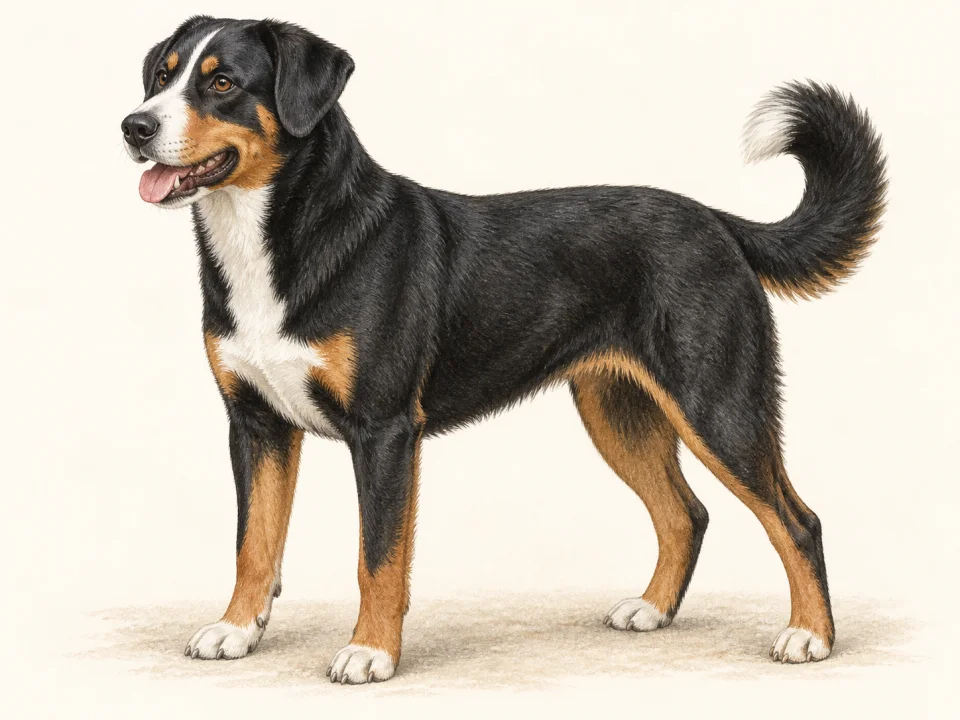
Identify the Swiss breed before comparing needs
The Appenzeller is one of four Swiss Sennen breeds and is also called the Appenzeller Mountain Dog or Appenzell Cattle Dog. AKC lists it at 20–22 inches and 48–70 pounds. Do not infer the same size or care requirements as another tricolor Swiss dog. Confirm identity and individual measurements before selecting equipment or making assumptions about adult activity.[1]
Put a real task into the ordinary week
The breed’s working background favors a home that can provide substantial activity and mental engagement. Plan suitable training, searching or other shared tasks alongside exercise. Identify what happens on busy workdays as well as free weekends. A dog can have a large yard and still lack purposeful engagement; the available space does not itself create a sustainable daily routine.[1]
Account for watchfulness before visitors arrive
An Appenzeller can be reserved with strangers and attentive to territory. Introduce new situations at a manageable distance, reward calm responses and provide a secure alternative resting area. Do not ask a visitor to force contact. A consistent arrival routine is more useful than expecting the dog to decide correctly about every unfamiliar person without guidance or a boundary.[1]
Teach clearly without harsh handling
The AKC guidance warns that harsh handling is a poor fit for this breed. Use clear reward-based steps and keep expectations consistent between household members. Practise a practical action such as returning to a mat or waiting at a gate before adding excitement. When a lesson breaks down, reduce the challenge rather than assuming more pressure will clarify the task.[1]
Give the double coat a regular inspection
Weekly brushing helps remove loose hair from the firm outer coat and dense undercoat. After outdoor activity, check ears and coat for caught debris and, where relevant, ticks. Ask your veterinarian about suitable prevention for your location. Teach short cooperative care sessions so checking a paw or ear remains familiar rather than becoming a struggle only when something is uncomfortable.[1]
Keep sparse health guidance in perspective
AKC lists a lifespan of 13–15 years but does not supply a named screening panel in the consulted entry. Ask for current breed-club recommendations, parent health records and family history, then review them with a veterinarian. A brief description of general health cannot establish that an individual is risk-free. Keep those unanswered questions visible when comparing breeders or considering an adult dog.[1]
Frequently asked questions
Is Appenzeller Mountain Dog another name for Appenzeller Sennenhund?
Yes. Appenzeller Mountain Dog and Appenzell Cattle Dog are alternative names for this Swiss breed.
Source [1]Is an Appenzeller suitable for a low-activity apartment routine?
The cited AKC guidance describes a high-energy working dog and cautions against that fit. Evaluate the actual daily activity and training you can provide, not simply whether the dog fits indoors.
Source [1]What training approach suits an Appenzeller?
Use consistent, respectful reward-based instruction and gradual distractions. The source cautions against harsh handling; clear teaching and manageable situations are more useful.
Source [1]Which health tests are listed in the cited entry?
The entry does not name a screening panel. Request current breed guidance and identifiable health records rather than interpreting the missing list as proof that no screening is relevant.
Source [1]FAQ sources
Sources & methodology
Breed-level measurements and comparison scores provide context. They do not predict an individual dog's health, behaviour or suitability. Open the original publisher pages below to verify the facts and compare any later updates.
- American Kennel Club — Appenzeller Sennenhund breed and care guidance ↗Reference 1 · reviewed 2026-09-27
Make it about your dog
Build a profile around your dog's age, experiences and everyday needs.
Meet your dog →Explore local care