
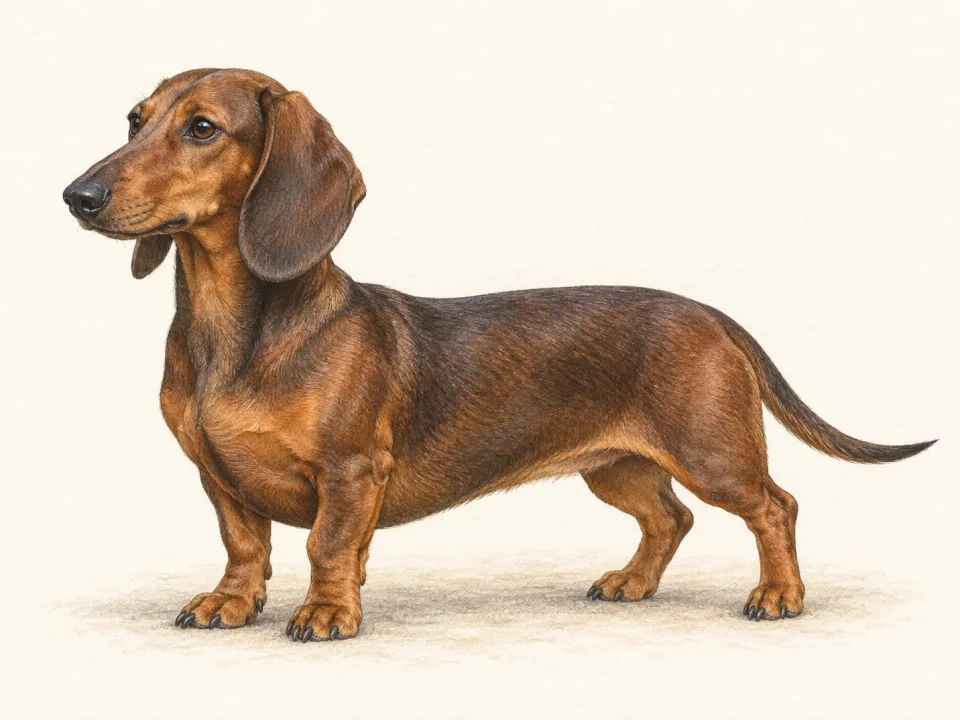
Think like a scent hound
Dachshunds were developed to work with determination and use their noses. That history can appear as persistence, alert barking and a strong interest in smells. Plan secure, supervised ways to investigate rather than expecting a small companion to ignore every scent.[1]
Put back health into the home plan
PDSA highlights intervertebral disc disease as an important breed risk. Ask your veterinarian how to manage the individual dog’s weight, activity and signs of pain. Sudden weakness, difficulty walking or pain needs prompt veterinary attention, not an online exercise plan.[1]
Make everyday access deliberate
Review repeated routes to beds, sofas, cars and outdoor areas with your vet. Place food, water and resting spaces where the dog can reach them comfortably. A ramp is useful only when its angle, surface and the dog’s willingness make it safe; supervision still matters.
Exercise the dog in front of you
PDSA gives different starting points for standard and miniature varieties and recommends daily exercise. Treat a published duration as general context. Age, fitness, health, weather and veterinary advice should shape pace and distance.[1]
Reward patient learning
PDSA recommends early, reward-based training. Keep sessions short enough for success, practise around gradually increasing distractions and use management where a cue is not yet reliable. A trainer can help translate a goal into steps without using fear or force.[1]
Coat type changes the grooming routine
Smooth, long-haired and wire-haired Dachshunds do not have identical coat needs. Ask the current carer or a groomer to demonstrate brushing and coat care for the individual variety. Check nails and ears as part of a calm handling routine.[1]
Keep weight visible, not assumed
PDSA advises accounting for treats within the daily food allowance. Ask your vet to show you how to assess body condition and agree how often to review it. Weighing portions is more reliable than estimating by eye, especially when food also supports training.[1]
Prepare questions before choosing a dog
Ask for identifiable health-screening records, family history, current veterinary information and the dog’s daily routine. Discuss breed-relevant testing with your veterinarian. A registration label, colour or seller description does not establish health or temperament.[2]
Frequently asked questions
What are common health problems in Dachshunds?
PDSA highlights intervertebral disc disease among the breed’s health risks. Discuss screening, weight and signs of pain with your veterinarian.
Source [1]How much exercise does a Dachshund need?
PDSA gives a general daily minimum of one hour for standard Dachshunds and half an hour for miniature varieties. Adapt this with your vet for the individual dog.
Source [1]Are Dachshunds easy to train?
They can be determined and independent. PDSA recommends early reward-based training, patience and consistent expectations.
Source [1]Do all Dachshunds need the same grooming?
No. Smooth, long-haired and wire-haired varieties have different coat-care needs. Ask a groomer to demonstrate care for the individual coat.
Source [1]FAQ sources
- PDSA — Dachshund care and health ↗FAQ reference 1
Sources & methodology
Breed-level measurements and comparison scores provide context. They do not predict an individual dog's health, behaviour or suitability. Open the original publisher pages below to verify the facts and compare any later updates.
- PDSA — Dachshund care and health ↗Reference 1 · reviewed 2026-09-09
- The Kennel Club — Dachshund health ↗Reference 2 · reviewed 2026-09-09
Make it about your dog
Build a profile around your dog's age, experiences and everyday needs.
Meet your dog →Explore local care