
A weekend hiking partner still needs a weekday life
AKC does not recommend this breed for first-time owners and describes a need for interactive activity rather than being turned out alone in a yard. Before contacting a breeder or rescue, write out a real workday: who takes the dog out, what shared task follows, and who provides care when that person is unavailable. Then ask an experienced owner to challenge the plan. “We hike on Sundays” leaves most of the week unanswered. Likewise, a large garden says nothing about how the dog will spend time with you. Ask to meet adult dogs during an ordinary routine, not only during an impressive sport demonstration.[1]
Choose training you both have a reason to continue
The AKC account highlights independent thinking and loss of interest in repetitive tasks. Tracking or trailing may be an avenue to explore with an experienced instructor; repeating a familiar sit dozens of times is a different kind of demand. For an introductory session, choose one useful outcome, prepare an easy setup, reward progress and finish while engagement remains. Keep a short note of what held attention and what caused disengagement so the next lesson changes something meaningful. This is a suggested planning approach, not a claim of a tested training protocol. Discuss realistic expectations before choosing the breed for a role requiring prolonged repetitive responses.[1]
Read the size standard correctly before buying equipment
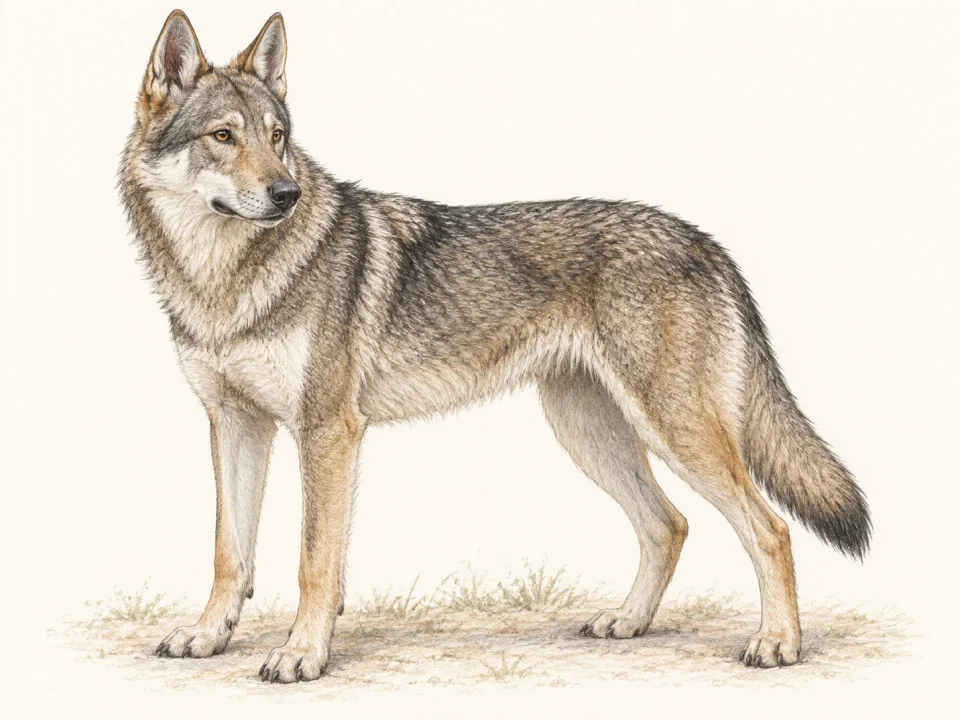
FCI Standard No. 332 sets minimum height at 65 cm for males and 60 cm for females, with minimum weights of 26 kg and 20 kg respectively. These figures are not a maximum size range. Do not order a crate or vehicle restraint on the assumption that an adult will stop growing at the minimum. Obtain the measurements of the actual adult, or discuss likely dimensions with the breeder when planning for a puppy. The same standard describes a pronounced difference between summer and winter coats. Equipment that fits over one coat condition deserves another check when the winter undercoat develops.[2]
Bring concrete questions to the breeder conversation
Ask how the particular dogs behave around small animals, what containment they use, and which daily activities they find sustainable. AKC notes possible prey drive, so a general description of loyalty is not an answer to a question about living with a cat. Separately request identifiable health reports: the listed assessments include hips, elbows, heart, dentition, DM and pituitary-dwarfism DNA tests. A DNA repository entry is also listed, but storing a sample is not itself a negative disease-test result. Ask which document answers which question. Have a veterinarian interpret results and plan care rather than inferring health from working ability or wolf-like appearance.[1]
Frequently asked questions
Does the standard mean a male Vlciak will weigh no more than 57 pounds?
No. The FCI figure is a minimum of 26 kg, about 57.3 pounds. It is not a maximum adult weight. Measure the individual when choosing equipment.
Source [1]Why might this intelligent dog dislike repeated drills?
AKC describes independent thinking and boredom with repetition. Discuss training expectations and choose meaningful, varied tasks rather than assuming intelligence guarantees enthusiasm for repeated commands.
Source [1]Is a DNA repository record the same as a clear genetic test?
No. A record of a stored sample does not establish a negative result for a named disease. Request the actual test reports and professional interpretation.
Source [1]FAQ sources
Sources & methodology
Breed-level measurements and comparison scores provide context. They do not predict an individual dog's health, behaviour or suitability. Open the original publisher pages below to verify the facts and compare any later updates.
- American Kennel Club — Czechoslovakian Vlciak care and training ↗Reference 1 · reviewed 2026-09-27
- FCI Standard No. 332 — Czechoslovakian Wolfdog ↗Reference 2 · reviewed 2026-09-27
Make it about your dog
Build a profile around your dog's age, experiences and everyday needs.
Meet your dog →Explore local care