
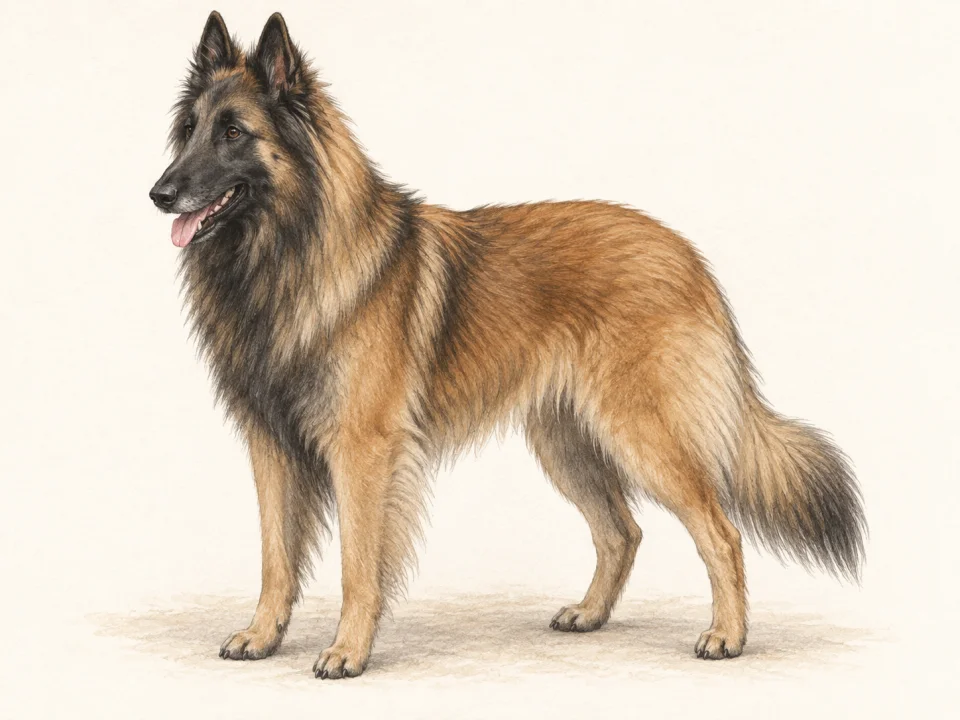
The elegant outline comes with a working commitment
AKC references males at 24–26 inches and 55–75 pounds, females at 22–24 inches and 45–60 pounds. The Tervuren’s abundant coat and proud posture can attract attention, but its working drive should lead the decision. Ask how the individual spends an ordinary day and whether your household can sustain meaningful engagement beyond the initial excitement of a new dog.[1]
Turn a task into an achievable game
The source describes a play-oriented dog that can be sensitive to harsh methods. Use rewards to make the desired action clear, starting with a small success before adding difficulty. A simple searching task or controlled toy exchange can be useful learning. Do not assume a game always works instantly; if the dog disengages, simplify the setup and reassess the reward.[1]
Budget active time rather than an abstract promise
The breed needs considerable appropriate physical and mental activity with its people. Identify what happens on workdays, during bad weather and when the usual handler is away. A secure yard can host an activity, but cannot deliver instruction or companionship by itself. Match intensity to age and health instead of reading a description of stamina as permission to push a youngster.[1]
Teach the quiet transitions too
A dog that enjoys mastering tasks still needs to learn how activities end. Practise moving to a resting place and rewarding calm behavior after an easy session. Keep household cues consistent and introduce distractions gradually. A planned transition helps avoid turning every moment near the owner into another high-arousal game, particularly when guests or children are moving through the space.[1]
Maintain the undercoat beneath the furnishings
AKC recommends thorough brushing once or twice weekly in ordinary periods, with more work during shedding. Pay attention to areas where long hair meets equipment and to the neck and hindquarter furnishings. Use suitable tools gently and check the skin rather than tidying the surface alone. Painful tangles need appropriate assistance, not repeated pulling to preserve the appearance.[1]
Know what the health panel includes
The lifespan reference is 12–14 years. AKC lists hip, elbow, eye and thyroid evaluations in the recommended panel. Request actual identifiable reports, and ask about wider family history, including concerns that are not settled by one normal test. Keep veterinary assessment of the individual separate from a breeder’s general description of the line as active or healthy.[1]
Frequently asked questions
What teaching style suits a Belgian Tervuren?
The cited guidance favors positive, engaging training for this sensitive, play-oriented breed. Use achievable reward-based steps rather than harsh methods or assuming intelligence makes instruction unnecessary.
Source [1]Does a Tervuren need only physical exercise?
No. It benefits from mental work and shared activities as well as movement. Plan a sustainable routine with people, including recovery and calm transitions.
Source [1]How often should a Tervuren be brushed?
AKC describes thorough brushing once or twice weekly, with extra work during shedding. Check the undercoat and long furnishings rather than only the outer surface.
Source [1]Which evaluation is included alongside hips, elbows and eyes?
The cited AKC panel also includes a thyroid evaluation. Request identifiable results and professional interpretation where needed.
Source [1]FAQ sources
Sources & methodology
Breed-level measurements and comparison scores provide context. They do not predict an individual dog's health, behaviour or suitability. Open the original publisher pages below to verify the facts and compare any later updates.
- American Kennel Club — Belgian Tervuren breed and care guidance ↗Reference 1 · reviewed 2026-09-27
Make it about your dog
Build a profile around your dog's age, experiences and everyday needs.
Meet your dog →Explore local care