
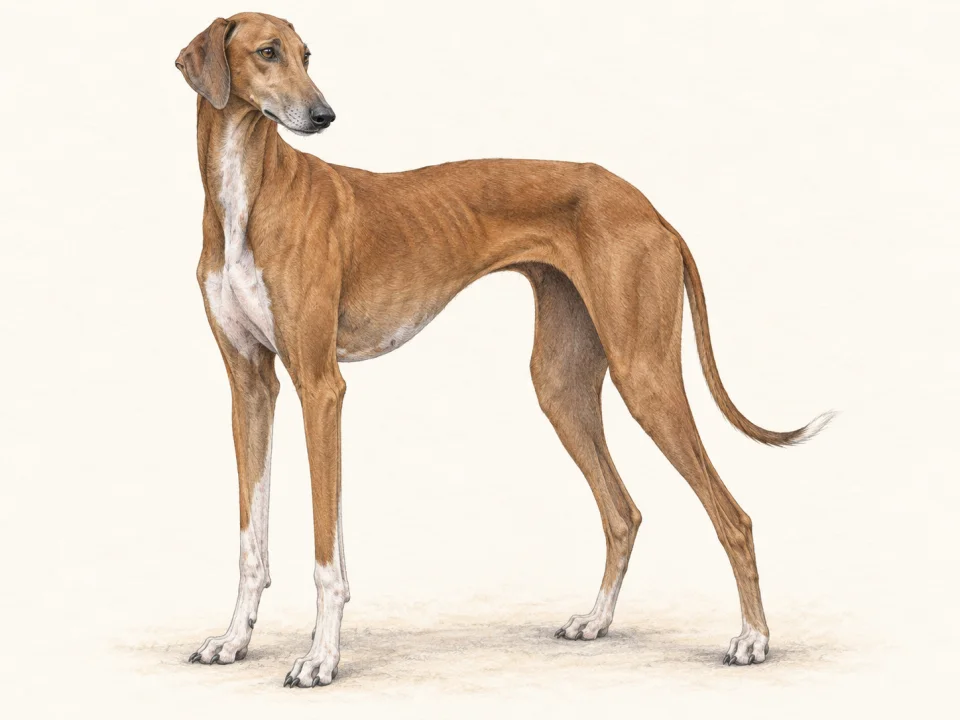
Learn the normal outline before changing the diet
An Azawakh naturally shows more underlying structure than many heavier-built breeds. AKC references males at 25–29 inches and 44–55 pounds, females at 23.5–27.5 inches and 33–44 pounds. Do not feed simply to hide every visible contour. Equally, do not dismiss new weight loss as typical: establish an individual condition baseline with a veterinarian and investigate changes.[1]
Think sighthound when planning free movement
The breed’s hunting background involves seeing and pursuing moving prey. Choose securely enclosed places for off-leash activity and maintain control elsewhere. Practise attention and returning for a reward in manageable settings, without treating a good lesson as proof that a sudden chase will be interrupted. Check a new enclosure’s gates and boundaries before letting the dog explore freely.[1]
Provide company during activity
The AKC care guidance notes that an Azawakh left alone in a yard may not exercise itself sufficiently. Join the activity rather than assuming available space is the same as an actual outing. Appropriate play or a suitable walk gives the handler a chance to observe comfort and recovery. Match demands to the individual; a breed’s athletic reputation is not an automatic training prescription.[1]
Teach with patience and clear rewards
An independently minded dog benefits from an early history of cooperative learning. Use gentle reward-based steps and stop before a lesson becomes a contest. Practise useful actions such as accepting a harness or moving with the handler in a quiet place first. Harsh punishment can undermine trust; difficulty with a task is a reason to reassess the setup, not intensify pressure.[1]
Minimal hair does not remove routine care
The short fine coat generally needs only a weekly soft-brush or grooming-mitt session, with bathing when necessary. Use the opportunity to check skin and comfortable movement rather than focusing solely on cleanliness. Nails require regular attention because excessive length can affect gait. Introduce paw handling in small rewarded steps, especially before expecting the dog to tolerate a full care session.[1]
Read health guidance beyond an empty panel
AKC lists a lifespan of 12–15 years. Its formal panel names no recommended tests, while the health discussion raises thyroid, cardiac, seizure and immune-mediated concerns for breeder conversations. Ask for current breed recommendations, identifiable records and family history. Do not turn that broad discussion into a claim that one test excludes all of those conditions or predicts an individual lifespan.[1]
Frequently asked questions
Is an Azawakh underweight if its body structure is visible?
Not necessarily; the breed is naturally lean. Establish appropriate individual condition with a veterinarian, and treat new weight loss as a change to assess rather than automatically calling it normal.
Source [1]Will an Azawakh exercise itself in a large yard?
The cited AKC guidance cautions that it may not. Plan shared activity and observe what the dog actually does instead of counting available space as exercise.
Source [1]What training approach suits an Azawakh?
Use patient reward-based teaching with manageable steps. Avoid harsh punishment and reassess the task or environment when the dog is not comfortable or engaged.
Source [1]Does the empty recommended-test panel mean there are no health questions?
No. The source discusses several concerns in its health text. Request current breed guidance, family history and actual records, and ask a veterinarian to interpret their scope.
Source [1]FAQ sources
- American Kennel Club — Azawakh breed and care guidance ↗FAQ reference 1
Sources & methodology
Breed-level measurements and comparison scores provide context. They do not predict an individual dog's health, behaviour or suitability. Open the original publisher pages below to verify the facts and compare any later updates.
- American Kennel Club — Azawakh breed and care guidance ↗Reference 1 · reviewed 2026-09-27
Make it about your dog
Build a profile around your dog's age, experiences and everyday needs.
Meet your dog →Explore local care