
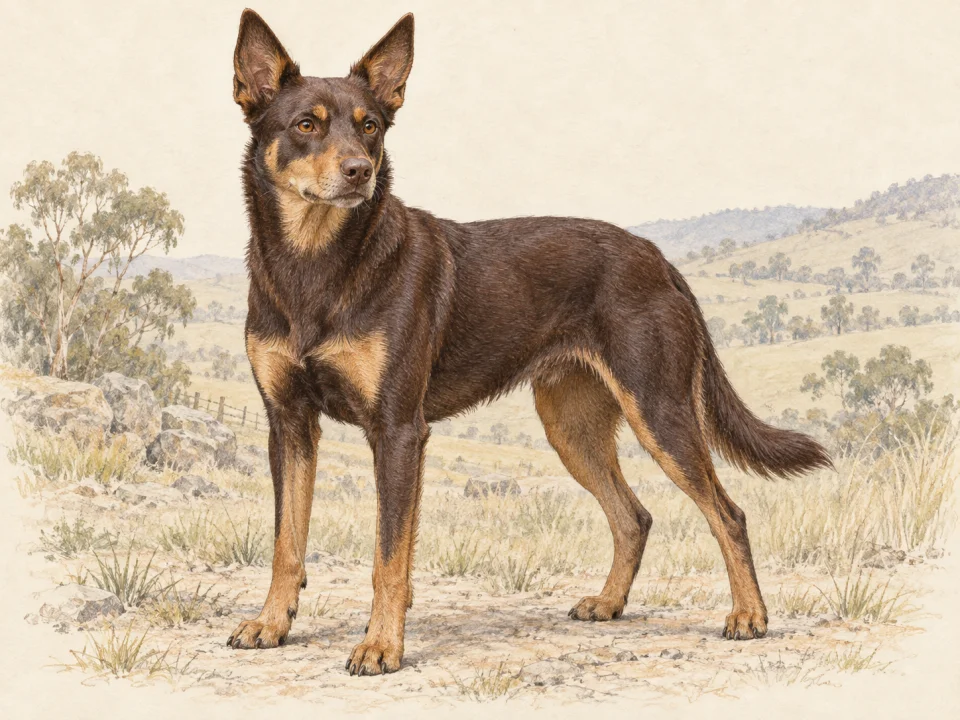
Start with the work the dog was bred to do
The Working Kelpie Council distinguishes several work styles, including wide-ranging mustering and closer yard work. Its selection advice asks owners to explain the task, terrain and livestock involved rather than choosing a dog by appearance. For a companion household, translate that conversation into equally concrete questions: what did the parents do, what has this dog practiced, and why does the breeder or rescue consider it a fit for a home without stock? Ask to see the dog in both activity and quieter circumstances. A successful working pedigree does not by itself demonstrate comfort with your neighborhood, visitors or daily absences. Choose the individual and its history, not a promise attached to the word “working.”[1]
Prevent traffic from becoming an activity
The council’s pet guidance warns that a Kelpie left without useful occupation may direct its interest toward cars or repeated fence-running. Plan secure boundaries and supervised outings before the dog arrives. If passing movement captures its attention, increase distance and redirect to a task it can manage; do not let it rehearse chasing while hoping maturity will solve it. The same guidance emphasizes a balance between stimulation and quiet. A practical household plan therefore needs both shared activity and a comfortable resting area away from constant action. A bigger yard cannot replace that arrangement, and an endless sequence of exciting games is not the same as teaching everyday cooperation.[2]
Use short lessons and keep an eye on recovery
AKC recommends short, regular training sessions adjusted to the dog’s reactions and condition. Try a simple search for a toy, a brief recall practice or learning to wait at a doorway, then allow a break. If you want to pursue a sport, seek instruction appropriate to the dog’s age and fitness instead of expecting working ancestry to provide automatic readiness. The short coat needs straightforward grooming, but check nails, ears and teeth as separate jobs. After strenuous activity, notice whether the dog returns to its usual movement and behavior. Discuss persistent changes with a veterinarian. Ask the breeder for specific health history and test reports rather than interpreting an energetic dog or a broad description of breed health as medical clearance.[3]
Frequently asked questions
Are all Working Kelpies suited to the same kind of home?
No. The Working Kelpie Council describes differences in temperament and work style. Explain your actual routine and ask why the particular dog is a suitable match.
Source [1]Will a large yard keep a Working Kelpie occupied?
Space alone does not supply companionship or purposeful activity. Secure the boundary and plan shared learning and rest, especially where cars or other passing movement attract attention.
Source [2]Should I keep extending games until my Kelpie is exhausted?
Use manageable activity and short lessons with breaks. AKC advises adjusting training to the dog’s condition; high energy is not a reason to ignore fatigue or recovery.
Source [3]FAQ sources
- Working Kelpie Council of Australia — Selecting a pup or dog ↗FAQ reference 1
- Working Kelpie Council of Australia — The Working Kelpie as a pet ↗FAQ reference 2
- American Kennel Club — Working Kelpie care ↗FAQ reference 3
Sources & methodology
Breed-level measurements and comparison scores provide context. They do not predict an individual dog's health, behaviour or suitability. Open the original publisher pages below to verify the facts and compare any later updates.
- Working Kelpie Council of Australia — Selecting a pup or dog ↗Reference 1 · reviewed 2026-09-27
- Working Kelpie Council of Australia — The Working Kelpie as a pet ↗Reference 2 · reviewed 2026-09-27
- American Kennel Club — Working Kelpie care ↗Reference 3 · reviewed 2026-09-27
Make it about your dog
Build a profile around your dog's age, experiences and everyday needs.
Meet your dog →Explore local care