
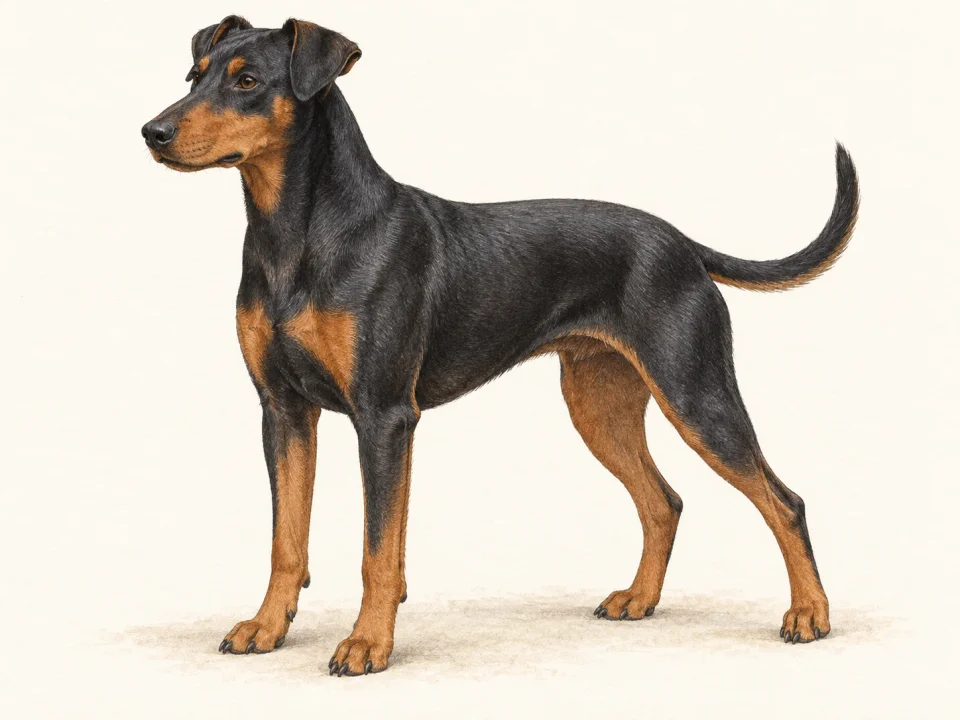
Evaluate the German Pinscher on its own terms
FCI describes an established German breed sharing ancestry with the Schnauzer, with a square build and a short smooth coat. Its height reference is 45–50 cm and weight 14–20 kg for both sexes. These details are more useful than treating the dog as a scaled-down version of another pinscher. When comparing breeds, ask about the individual’s handling needs, response to arrivals and ordinary activity rather than assuming similar markings imply identical behavior. Measure equipment for the actual dog and use veterinary assessment for healthy condition. The standard describes a watch and companion role; it does not prove that a puppy understands who may enter your home or which noises require no response.[2]
Make the small-animal plan before the introduction
AKC identifies both a rat-catching history and strong prey drive. If rabbits, rodents or other small animals already live in the home, discuss the arrangement before acquiring a German Pinscher. Plan reliable physical separation and access rules rather than using the animals to test whether the dog can resist chasing. A friendly response toward people does not answer that question. The same practical approach helps outside: identify secure exercise areas and how exits will be controlled while training develops. Offer learning opportunities that make the desired response clear and interesting, with instruction when needed. Do not interpret an active, curious dog’s mistakes as a reason to escalate force. Easy coat care is a genuine convenience, but it does not remove the commitment to supervision, suitable activity and teaching.[1]
Keep health test names attached to their results
The GPCA’s March 2015 letter distinguishes hip assessment, an eye registry examination and vWD DNA testing, and also recommends cardiac examination. Because that letter is dated, confirm current requirements with the club and veterinarian rather than treating it as an unchanging policy. In a breeder discussion, request identifiable reports with dates and results for each parent. A document for one condition cannot stand in for the others, and an unspecific claim of “fully tested” leaves too much unclear. Ask a veterinarian to interpret any finding, particularly before making assumptions about bleeding risk or a procedure. Keep the reports with the dog’s ongoing records; screening is information for decisions, not a guarantee against later illness.[3]
Frequently asked questions
Is the German Pinscher described as a toy dog in the FCI standard?
No. FCI describes a medium-sized breed and gives 45–50 cm height and 14–20 kg weight references for both sexes.
Source [1]Does friendliness toward people prove safety around pet rodents?
No. AKC describes a strong prey drive. Plan secure separation and obtain advice before considering interactions with small animals.
Source [2]Does a vWD DNA result replace a heart or eye examination?
No. The GPCA letter lists different assessments for these concerns. Verify current recommendations and have the actual reports interpreted by your veterinarian.
Source [3]FAQ sources
- FCI Standard No. 184 — German Pinscher ↗FAQ reference 1
- American Kennel Club — German Pinscher ↗FAQ reference 2
- German Pinscher Club of America — Health Testing Letter, March 2015 ↗FAQ reference 3
Sources & methodology
Breed-level measurements and comparison scores provide context. They do not predict an individual dog's health, behaviour or suitability. Open the original publisher pages below to verify the facts and compare any later updates.
- American Kennel Club — German Pinscher ↗Reference 1 · reviewed 2026-09-27
- FCI Standard No. 184 — German Pinscher ↗Reference 2 · reviewed 2026-09-27
- German Pinscher Club of America — Health Testing Letter, March 2015 ↗Reference 3 · reviewed 2026-09-27
Make it about your dog
Build a profile around your dog's age, experiences and everyday needs.
Meet your dog →Explore local care