
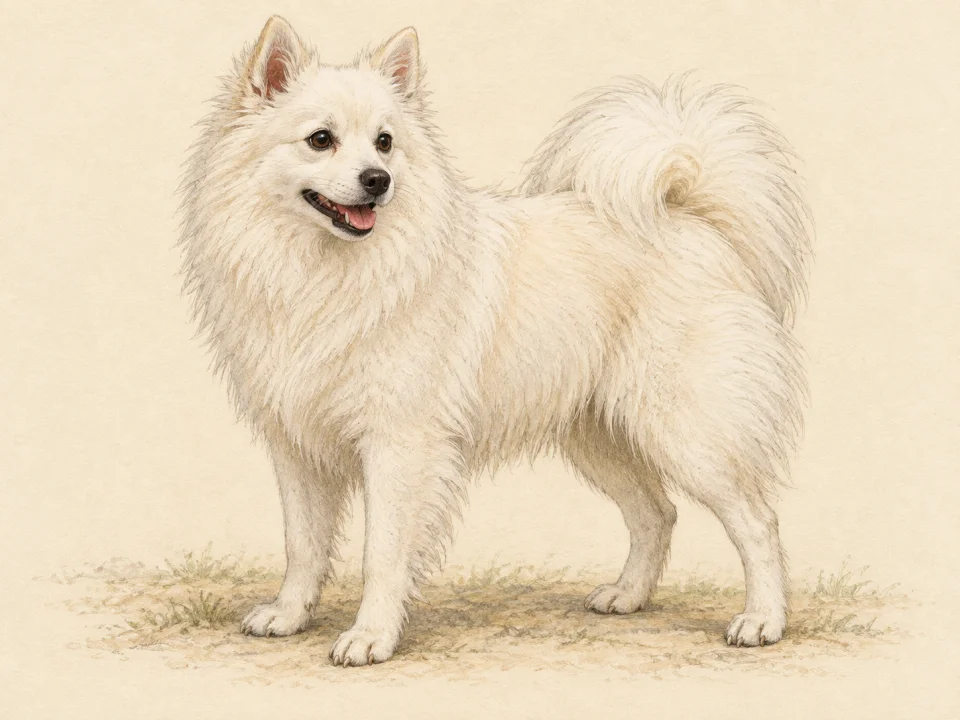
Make room for an active companion
The Volpino is small enough to carry when necessary, but that should not replace opportunities to walk, explore and learn. Build ordinary days around shared activity and a comfortable place to rest near the household. Consider who will provide companionship during long absences. A small dog still needs a daily routine that remains workable when the owner is busy.[1]
Understand the coat before choosing a grooming routine
A dense short undercoat sits beneath the longer outer coat. Brushing two or three times a week is a useful starting point in the AKC care guidance. Part the coat so you check near the skin rather than smoothing only the surface. Increase attention where tangles develop, and ask a knowledgeable groomer for help if brushing becomes uncomfortable.[1]
Teach skills with the dog on the ground
Short reward-based sessions can teach coming when called, waiting and accepting a harness. Practise on a safe surface with distractions kept manageable. If every difficult moment ends with the dog being picked up, it has fewer chances to learn what to do instead. Handling is still useful for safety, but combine it with patient teaching of practical alternatives.[1]
Separate outdoor play from outdoor isolation
This is a companion that benefits from involvement with people. A yard can provide supervised activity; it should not become the whole living arrangement. Check gates and gaps from the height of a small dog, and provide a secure boundary before considering off-leash play. Return indoors for rest and contact rather than assuming a thick coat makes isolation suitable.[1]
Use dimensions to choose equipment safely
AKC lists a height of 10.5–12 inches, with males around 10–16 pounds and females around 8–12 pounds. Fit a harness to the dog you have, checking the neck and chest rather than relying on a single weight label. Recheck fit as a youngster grows. Keep feeding decisions based on individual condition rather than the top of a reference range.[1]
Ask health questions without inventing a checklist
AKC lists a lifespan of 12–15 years, but the source’s care entry does not provide a named mandatory screening panel. Ask the breeder for family history and the current parent-club health guidance, then discuss it with your veterinarian. Do not substitute a generic list copied from another breed or assume that missing published tests means there are no health risks.[1]
Frequently asked questions
Is the Volpino Italiano only a lapdog?
No. Although small and companion-oriented, it is an active dog that needs shared activity and training as well as quiet time.
Source [1]How often should I brush a Volpino Italiano?
AKC care guidance suggests brushing two or three times weekly. Check through the double coat to the skin and adjust the routine if tangles develop.
Source [1]Can a Volpino Italiano spend all day alone outside?
Plan it as a household companion. Supervised outdoor activity is useful, but a yard does not replace contact, training and comfortable rest with the household.
Source [1]What health tests are required for a Volpino Italiano?
The cited AKC care entry does not name a specific screening panel. Request current breed-club guidance and identifiable health records, then review them with a veterinarian rather than assuming that no listed panel means no risk.
Source [1]FAQ sources
Sources & methodology
Breed-level measurements and comparison scores provide context. They do not predict an individual dog's health, behaviour or suitability. Open the original publisher pages below to verify the facts and compare any later updates.
- American Kennel Club — Volpino Italiano breed and care guidance ↗Reference 1 · reviewed 2026-09-27
Make it about your dog
Build a profile around your dog's age, experiences and everyday needs.
Meet your dog →Explore local care