
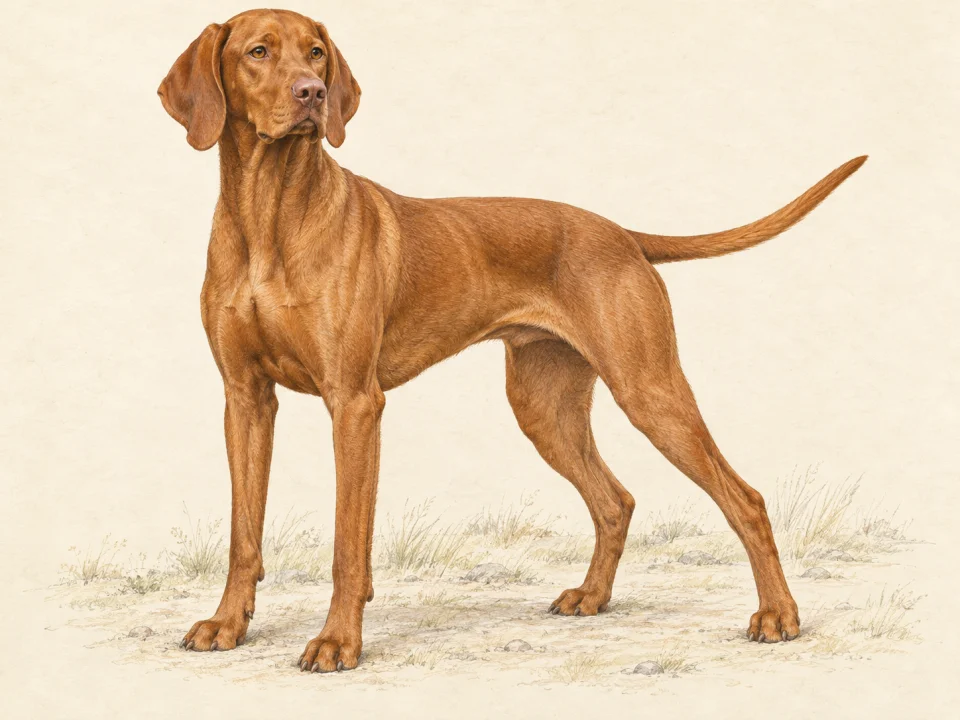
Test the weekday plan, not just the weekend ambition
The Vizsla Club of America emphasizes both activity and close human companionship. A large yard does not supply either on its own. Write down who will spend time with the dog before work, during a long absence and in the evening, then consider the same arrangement during travel or illness. Include a shared learning activity as well as physical exercise: retrieving, scent games or reward-based training can give the dog a task to do with you. Enthusiasm can also mean jumping and pulling, so adults should manage greetings and teach leash skills before expecting children to handle the dog. A short coat may save grooming time, but it does not make a Vizsla a low-involvement companion.[1]
Build an athlete gradually
AKC cautions against long-distance running with a young Vizsla before maturity. A puppy’s willingness to keep going is not a fitness assessment. Use age-appropriate play and walks, and ask your veterinarian when and how to introduce sustained running. For an adult, combine movement with learning rather than repeatedly extending exercise to tire the dog out. Use secure areas for off-leash activity and build recall without depending on it near traffic. The smooth coat sheds and benefits from brushing; ears, nails and teeth need attention too. Food quantities should follow the individual’s condition and activity, not a fixed number of cups copied from another Vizsla’s routine.[2]
Check which evaluations were actually performed
For the Vizsla, AKC’s national-club recommendations list hip, ophthalmologist and thyroid evaluations. Ask for each parent’s identifiable report and examination date rather than treating a generic DNA panel as a substitute. These entries describe different evaluations; a result for one does not answer the others. Keep the reports separate from a puppy’s routine veterinary examination and vaccination record so you know what each document establishes. A veterinarian can help interpret a finding and explain what it means for your own dog’s care.[3]
Ask about the family history that a test panel cannot settle
The Hungarian Vizsla Society identifies epilepsy and immune-mediated illnesses among concerns relevant to breeding decisions. Its guidance specifically notes that no test currently settles the risk for some complex inherited diseases, including epilepsy. This UK guidance is useful context, not a replacement for the US screening list. Ask whether close relatives or previous offspring have had diagnosed disease, what was diagnosed and how the breeder responded. “All DNA clear” cannot answer that history question. Equally, a family report is information to discuss with a veterinarian, not a diagnosis of the puppy or a prediction that it will develop the same condition.[4]
Frequently asked questions
Will a big yard meet a Vizsla’s exercise needs?
Not by itself. The breed club stresses activity with people and ongoing training. Plan who will provide those opportunities instead of relying on the dog to exercise alone.
Source [1]Can I take my Vizsla puppy on my usual long run?
Do not use enthusiasm as permission for sustained distance. AKC advises waiting until maturity for long-distance running; discuss an appropriate progression with your veterinarian.
Source [2]Which health evaluations should I ask a US breeder about?
The AKC list for Vizslas names hip, ophthalmologist and thyroid evaluations. Request actual results for the parents, with identity and date, rather than accepting “health tested” alone.
Source [3]Does a clear DNA panel rule out epilepsy in a Vizsla?
No. The Hungarian Vizsla Society explains that a test is not currently available for some complex inherited diseases such as epilepsy. Family medical history remains a separate question.
Source [4]FAQ sources
- Vizsla Club of America — Owning a Vizsla ↗FAQ reference 1
- American Kennel Club — Vizsla care ↗FAQ reference 2
- American Kennel Club — Sporting group health testing: Vizsla ↗FAQ reference 3
- Hungarian Vizsla Society — Code of conduct and health screening ↗FAQ reference 4
Sources & methodology
Breed-level measurements and comparison scores provide context. They do not predict an individual dog's health, behaviour or suitability. Open the original publisher pages below to verify the facts and compare any later updates.
- Vizsla Club of America — Owning a Vizsla ↗Reference 1 · reviewed 2026-09-27
- American Kennel Club — Vizsla care ↗Reference 2 · reviewed 2026-09-27
- American Kennel Club — Sporting group health testing: Vizsla ↗Reference 3 · reviewed 2026-09-27
- Hungarian Vizsla Society — Code of conduct and health screening ↗Reference 4 · reviewed 2026-09-27
Make it about your dog
Build a profile around your dog's age, experiences and everyday needs.
Meet your dog →Explore local care