
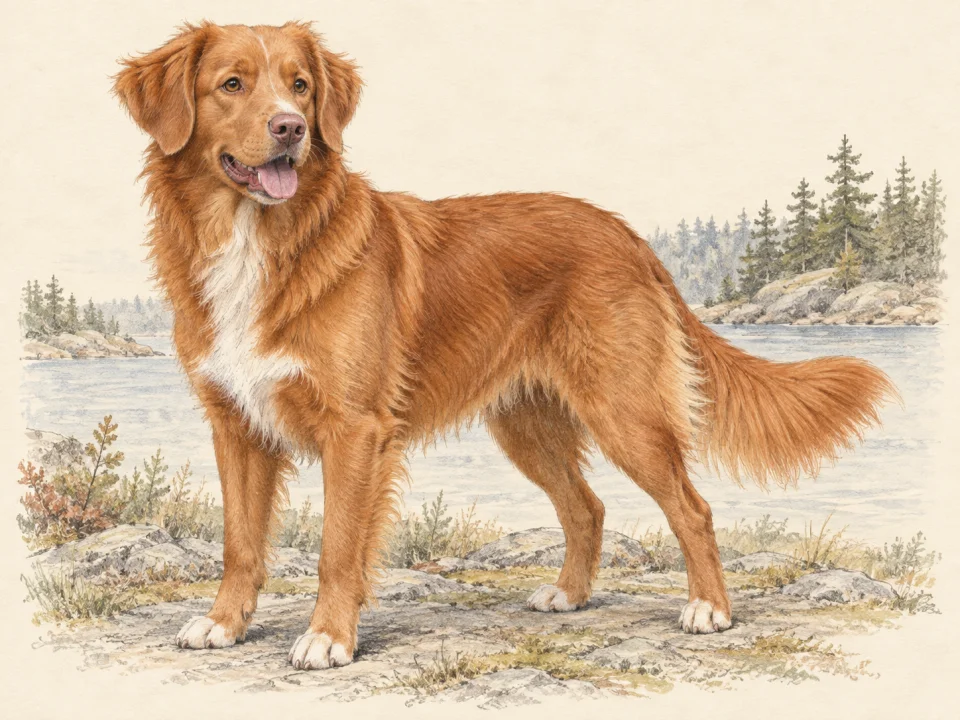
Understand what tolling means before choosing the breed
Historically, the dog’s playful retrieving along a shoreline attracted the attention of ducks offshore; retrieving birds was another part of the job. That is the origin of the name, rather than a reference to barking. The standard describes the smallest retriever as a medium-sized working dog. For a household, the useful question is whether you want to take part in that dog’s activities, not simply whether it fits in your car. Before committing, write down who will provide walks, training and suitable play on an ordinary workday, and what changes when that person is unavailable. Meet adult dogs and ask owners about their daily routine rather than choosing from a puppy photograph or assuming a Toller is a miniature version of another retriever.[2]
Build an activity routine with a clear finish
AKC describes an active dog that often enjoys short, reward-based training. A practical home routine can separate retrieving, a brief skill session and a quiet break instead of making every interaction another throw of the ball. Agree on an end-of-play cue across the household and put the toy away when the session finishes. Adjust activities to the individual dog’s age, fitness and comfort; a willingness to keep chasing is not an exercise prescription. Coat maintenance also needs a place in the routine. AKC recommends regular brushing, increased attention during seasonal shedding, and particular care around the ears where finer hair can knot. Ask a groomer to demonstrate how to work through this area comfortably. After an outdoor session, check the coat and feet before settling indoors rather than leaving tangles to accumulate until the next bath.[1]
Ask for named screening reports, not a general health assurance
The US parent club’s published screening statement lists hip, eye and cardiac examinations alongside tests including PRA, cleft palate and juvenile Addison’s disease. The document is undated, so ask the breeder which current recommendations they follow and request the actual reports. A useful record has the dog’s registered identity, the examination or test name, date, result and issuing organization; match those details to the parents being discussed. Do not treat a general statement that the parents were DNA tested as a substitute for the examination records. Keep copies for your veterinarian to interpret, including any limitations of a particular test. Screening information helps assess a breeding decision but does not promise that a puppy will remain free of illness.[3]
Frequently asked questions
Must a Toller have white markings?
No. The AKC standard describes white markings as usual but explicitly allows an otherwise high-quality dog without them. Appearance alone is not a health assessment.
Source [1]Does a Toller need endless games of fetch?
No fixed number of throws suits every dog. Provide suitable activity and training, with a clear finish and opportunities to rest. Discuss changes in exercise tolerance with your veterinarian instead of using enthusiasm for a toy as the only guide.
Source [2]Is a DNA panel enough when checking a Toller breeder’s health records?
No. The parent club also lists physical examinations, including hips, eyes and heart. Ask for the named reports and dates, then clarify with your veterinarian what each result can and cannot establish.
Source [3]FAQ sources
Sources & methodology
Breed-level measurements and comparison scores provide context. They do not predict an individual dog's health, behaviour or suitability. Open the original publisher pages below to verify the facts and compare any later updates.
- American Kennel Club — Nova Scotia Duck Tolling Retriever ↗Reference 1 · reviewed 2026-09-27
- American Kennel Club — Official Toller breed standard ↗Reference 2 · reviewed 2026-09-27
- Nova Scotia Duck Tolling Retriever Club (USA) — Health screening statement ↗Reference 3 · reviewed 2026-09-27
Make it about your dog
Build a profile around your dog's age, experiences and everyday needs.
Meet your dog →Explore local care