
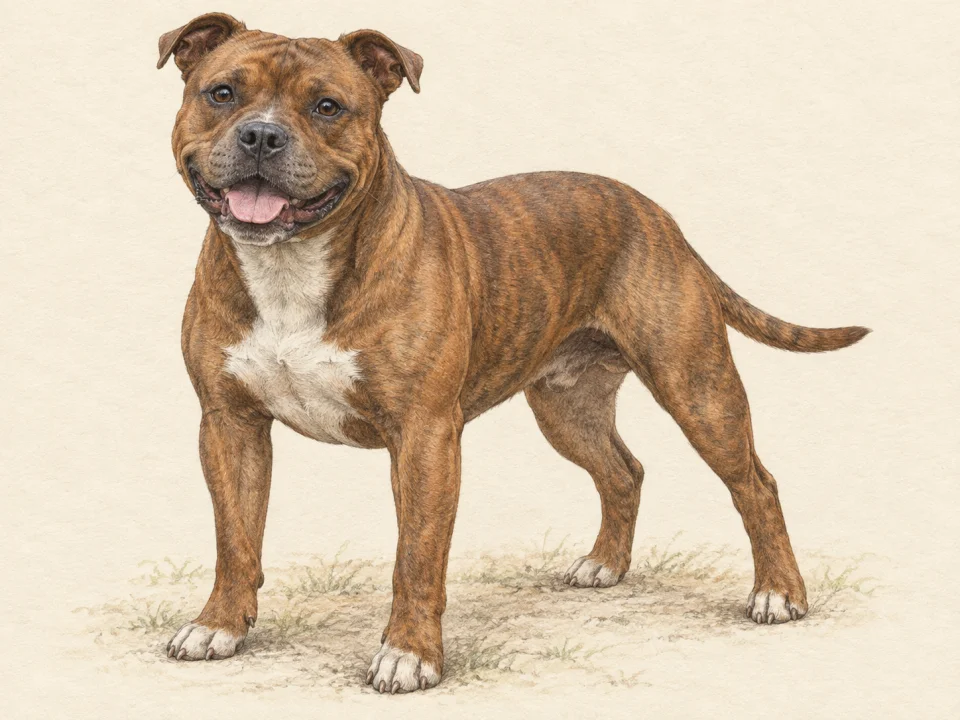
Compact does not mean physically slight
The AKC standard describes an agile dog with considerable strength for its size: 14–16 inches at the shoulder, with males weighing 28–38 pounds and females 24–34 pounds. Those are breed-standard ranges, not a weight-gain target for every pet. For a prospective owner, the practical question is whether everyone responsible for walks can handle this particular dog comfortably. Meet an adult Stafford if your only reference is a puppy photograph. Its smooth, close coat needs much less coat preparation than a long-haired breed, but an easy coat does not reduce the time needed for teaching polite greetings or providing activity.[2]
Plan family play and dog introductions separately
The parent club describes a people-oriented, active dog but also notes that some Staffords do not enjoy unfamiliar dogs. Affection toward people is not evidence of compatibility with every animal. Before adding an adult, ask about its actual experience with the pets in your household; arrange controlled introductions with suitable professional help if needed. For children, use supervised, gentle interaction and a place where the dog can rest undisturbed. If an adult cannot supervise, separate dog and child. Teach a reward-based pause in play rather than encouraging rough wrestling. A secure outdoor area and walks together can provide activity without making a busy dog park the default exercise plan.[1]
Check eyes in more than one way
The club’s health statement recommends DNA testing for L-2-HGA and hereditary juvenile cataracts, alongside an eye examination. It also discusses PHPV and PPSC, other eye conditions that should not disappear from the conversation merely because a cataract DNA result is clear. Ask the breeder to identify which examination or test addresses each condition. The statement uses the older CERF terminology; ask your veterinarian about the current specialist eye-examination scheme rather than insisting on an obsolete form. A laboratory result and an examination are different kinds of evidence, and neither is a promise of lifelong normal vision.[3]
Understand what the L-2-HGA result describes
Canine Genetic Testing identifies L-2-HGA as a neurometabolic disorder associated with the L2HGDH gene, while its hereditary cataract test addresses an HSF4 variant. These are separate tests with separate results. Keep the condition names with the reports instead of reducing them to a general “DNA clear” label. The laboratory lists neurological signs including tremors, an unsteady gait and seizures for L-2-HGA; those signs require veterinary attention and cannot establish a diagnosis at home. Do not assume that a dog with a reassuring inherited-disease result cannot develop an unrelated neurological problem.[4]
Frequently asked questions
Is a Staffordshire Bull Terrier automatically safe to leave with children?
No. A breed’s affectionate reputation is not a safety guarantee. Supervise interactions, prevent rough handling and give the dog an undisturbed retreat. Separate them when active supervision is unavailable.
Source [1]How big is an adult Staffordshire Bull Terrier?
The AKC standard specifies 14–16 inches at the shoulder, 28–38 pounds for males and 24–34 pounds for females. Individual healthy weight should be assessed by body condition, not by trying to reach the top of the range.
Source [2]Does a clear hereditary cataract DNA result replace an eye examination?
No. The parent club recommends both genetic testing and an eye examination. A test for one inherited cataract variant does not cover every eye disorder.
Source [3]Are L-2-HGA and hereditary cataract the same test?
No. The laboratory lists different genes and conditions: L2HGDH for L-2-HGA and HSF4 for this hereditary cataract test. Check the named result for each condition.
Source [4]FAQ sources
- Staffordshire Bull Terrier Club of America — Nature of the beast ↗FAQ reference 1
- American Kennel Club — Official Staffordshire Bull Terrier standard ↗FAQ reference 2
- Staffordshire Bull Terrier Club of America — Parent club health statement ↗FAQ reference 3
- Canine Genetic Testing — Staffordshire Bull Terrier tests ↗FAQ reference 4
Sources & methodology
Breed-level measurements and comparison scores provide context. They do not predict an individual dog's health, behaviour or suitability. Open the original publisher pages below to verify the facts and compare any later updates.
- Staffordshire Bull Terrier Club of America — Nature of the beast ↗Reference 1 · reviewed 2026-09-27
- American Kennel Club — Official Staffordshire Bull Terrier standard ↗Reference 2 · reviewed 2026-09-27
- Staffordshire Bull Terrier Club of America — Parent club health statement ↗Reference 3 · reviewed 2026-09-27
- Canine Genetic Testing — Staffordshire Bull Terrier tests ↗Reference 4 · reviewed 2026-09-27
Make it about your dog
Build a profile around your dog's age, experiences and everyday needs.
Meet your dog →Explore local care