
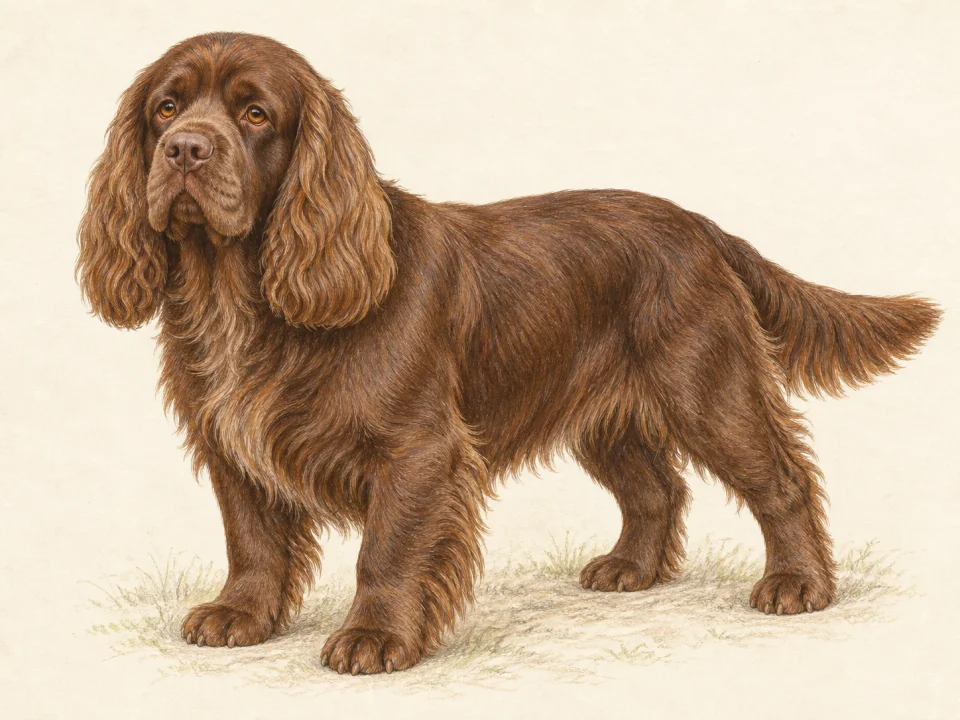
Short legs belong to a substantial working dog
The American standard gives a height of 13–15 inches and a weight of 35–45 pounds. A Sussex is therefore not a lightweight lapdog merely because it stands low. Before choosing one, consider how you would help an adult into a vehicle or manage an outing if it needed assistance. The breed developed to move through dense cover and flush game, sometimes vocalizing on scent. Its deliberate, rolling movement and solemn face should not be mistaken for a dog with no interest in activity. Allow time for sniffing on suitable walks, with secure boundaries or a lead where following a scent could take it into danger. Judge changes in your own dog against its usual movement, rather than dismissing new difficulty as the breed’s normal roll.[1]
Check behind the ears before the coat looks tangled
The UK association identifies the armpits and areas behind the ears as common matting sites. Make those locations part of your coat check, along with the leg feathering, rather than only brushing the visible back. Its guidance favors regular brushing and combing, daily where possible, and cleaning and drying dirty ear feathering. A comb helps reveal tangles a surface brush can miss. Ask a groomer to demonstrate a gentle technique on your dog; the association warns that some dematting and stripping tools can be harsh or cut coat when used incorrectly. A painful, tight mat is a reason to seek help, not to pull harder. Introduce short, comfortable grooming sessions early so handling the ears and legs is familiar.[2]
A PDP1 result and a heart examination are separate evidence
The American club discusses a DNA test for pyruvate dehydrogenase deficiency, associated with PDP1, separately from cardiac assessment. The inherited disorder can cause severe exercise intolerance; the club advises against mating two carriers. Ask for the actual results rather than a general assurance that the line is healthy. Its puppy guidance also calls for a veterinarian to listen to the heart at about eight weeks and investigate detected problems with advanced testing. A normal DNA result does not replace that clinical check. Obtain the puppy’s veterinary documentation and clarify any follow-up before collection. Unexpected exhaustion or a change in activity needs veterinary assessment; these signs are not enough for an owner to diagnose PDP1 deficiency.[3]
Frequently asked questions
Is the Sussex Spaniel light enough to carry easily?
Not necessarily. The American standard lists 35–45 pounds despite a height of only 13–15 inches. Plan vehicle access and emergency assistance around the adult dog’s weight, not its height alone.
Source [1]Where does a Sussex Spaniel’s coat commonly mat?
The breed association highlights the armpits and behind the ears. Include these areas and the feathering in regular gentle brushing and combing, and get help with tight or painful mats.
Source [2]Does a clear PDP1 test mean a Sussex puppy has a normal heart?
No. The DNA test addresses a particular inherited disorder. The breed club describes cardiac examination separately, with further investigation when the veterinarian detects a problem.
Source [3]FAQ sources
- Sussex Spaniel Club of America — Official breed standard, effective January 2024 ↗FAQ reference 1
- Sussex Spaniel Association — Grooming ↗FAQ reference 2
- Sussex Spaniel Club of America — Breed health ↗FAQ reference 3
Sources & methodology
Breed-level measurements and comparison scores provide context. They do not predict an individual dog's health, behaviour or suitability. Open the original publisher pages below to verify the facts and compare any later updates.
- Sussex Spaniel Club of America — Official breed standard, effective January 2024 ↗Reference 1 · reviewed 2026-09-27
- Sussex Spaniel Association — Grooming ↗Reference 2 · reviewed 2026-09-27
- Sussex Spaniel Club of America — Breed health ↗Reference 3 · reviewed 2026-09-27
Make it about your dog
Build a profile around your dog's age, experiences and everyday needs.
Meet your dog →Explore local care