
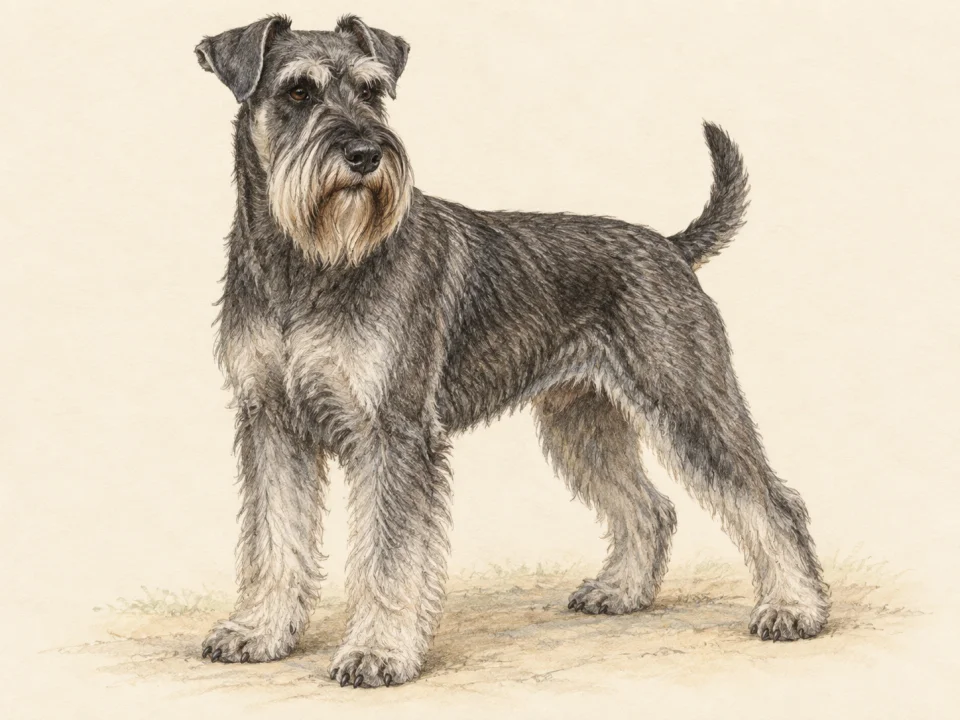
Choose a coat-care method before booking the haircut
The breed club distinguishes hand-stripping, which maintains the characteristic wire coat, from clipping, an option for household pets that can soften the texture over time. Tell the groomer whether you want to maintain a stripped coat or a clipped pet trim; do not assume every Schnauzer appointment includes stripping. Either choice leaves work between appointments: comb the beard and leg hair often enough to prevent tangles becoming mats. Ask the groomer to demonstrate on your dog and help set a workable schedule. A tidy outline on grooming day does not mean the furnishings can be ignored until the next visit. Minimal shedding is not the same as minimal maintenance.[1]
Teach a new skill instead of repeating a finished lesson
AKC describes an energetic dog that learns quickly and may lose interest in repeated drills. Make a household task the lesson: returning from the yard, waiting while a door opens, or settling beside you after an outing. Reward a clear success, then stop or change the setting gradually instead of demanding the same response indefinitely. This is a practical way to use intelligence without assuming the dog will work out your house rules unaided. Walks, shared play and suitable dog sports offer different outlets; a yard alone does not supply the interaction this breed seeks. Choose activities around the individual dog’s fitness and recovery rather than pursuing a universal daily mileage target.[2]
Read the dates as well as the names of the health tests
The club’s February 2024 policy covers hips, specialist eye examinations and the Standard Schnauzer DCM DNA marker. Its eye-examination requirements differ by age: for breeding dogs under seven, the examination must be within the preceding twelve months; for older dogs, it specifies an examination performed at seven or later. The hip policy also distinguishes preliminary evaluations from those for adults over two. Ask the breeder to show how each parent’s dated result fits the policy, rather than accepting a list of tests without ages. For the inherited DCM marker, the club specifies that a carrier be paired with a tested negative dog, not another carrier. Review the actual pairing results with a veterinarian; this genetic assessment is not a guarantee against every possible heart condition.[3]
Frequently asked questions
Must a pet Standard Schnauzer be hand-stripped?
Not necessarily. The breed club describes clipping as an option for pets, with a change toward softer coat texture. Hand-stripping maintains the wire coat. Discuss the method with an experienced groomer; both require ongoing care of the beard and legs.
Source [1]Will a large yard keep a Standard Schnauzer occupied?
It provides space, but does not replace activity with its people. Combine suitable walks and play with short, purposeful training rather than leaving the dog to invent its own entertainment.
Source [2]Does the DCM DNA test replace hip and eye screening?
No. The club’s health policy lists all three separately. Check the hip evaluation, the age and date of the eye examination, and each parent’s DCM result.
Source [3]Sources & methodology
Breed-level measurements and comparison scores provide context. They do not predict an individual dog's health, behaviour or suitability. Open the original publisher pages below to verify the facts and compare any later updates.
- Standard Schnauzer Club of America — Frequently asked questions ↗Reference 1 · reviewed 2026-09-27
- American Kennel Club — Standard Schnauzer care and breed information ↗Reference 2 · reviewed 2026-09-27
- Standard Schnauzer Club of America — Health testing best practices, approved February 2024 ↗Reference 3 · reviewed 2026-09-27
Make it about your dog
Build a profile around your dog's age, experiences and everyday needs.
Meet your dog →Explore local care